


When I was in grad school, I was obsessed with David Ogilvy.
At the same time, I was watching Mad Men, the show starring Jon Hamm about the advertising world.
People often said Ogilvy was a major inspiration behind the show. That idea fascinated me. Advertising wasn’t just selling. It was art.
So I read everything Ogilvy wrote.
When I graduated, I tried to turn that interest into a career. I applied for jobs at ad agencies. Every single application was rejected. At the time, it felt like a dead end. Looking back, it taught me something that stuck.
Ogilvy believed deeply in writing as a career skill. He put it bluntly:
“The better you write, the higher you go in Ogilvy & Mather [his agency]. People who think well, write well. Good writing is not a natural gift. You have to learn to write well.”
I kept that idea in the back of my mind.
It wasn’t until four years later, long after my failed start in advertising, that I began writing consistently.
I wasn’t writing ads or to make money. No, I started writing to think clearly. To make sense of what I was doing.
Since then, I’ve seen the power of writing up close. Because of writing, I built a career. Because of writing, I became financially independent.
Most people think writing creates wealth through obvious paths. Copywriting. Books. Content. That’s not what this article is about.
What actually matters are the small, overlooked effects of writing. The things no one talks about, yet quietly shape your decisions, behavior, and long-term outcomes.
Here are 24 of them.
Better formulated goals — Writing forces you to be specific. Specific goals lead to usable plans.
Faster decision-making — If you can write a decision down clearly, you can act on it faster.
Less emotional spending — Writing slows impulse. Impulse is expensive.
Fewer bad yeses — Bad opportunities look bad on paper. That’s hard to ignore.
Stronger self-trust — Clear thinking reduces the need for constant external validation.
Better listening skills — Good writers listen to understand, not to reply.
Cleaner priorities — Writing exposes what actually matters versus what feels urgent.
Lower stress levels — A written mind carries less mental debt.
Fewer repeated mistakes — You can’t fix patterns you never name.
Better negotiation outcomes — Clear thinkers communicate boundaries calmly.
Stronger memory of lessons learned — Written lessons compound. Forgotten lessons repeat.
More accurate self-assessment — Writing reveals what you truly know and what you don’t.
Longer-term thinking — Writing slows time and favors compounding over chasing.
Better problem framing — Most problems are costly because they’re framed poorly.
Less mental clutter — Clutter creates avoidance. Avoidance delays progress.
Better follow-through — Written commitments feel heavier than mental ones.
Higher quality conversations — People trust those who express themselves clearly.
More strategic patience — Writing turns waiting into a conscious decision.
Clearer trade-offs — Every decision costs something. Writing makes the cost visible.
Better risk assessment — Writing separates fear from fact.
More leverage from the same effort — Written ideas can spread. Mental effort doesn’t.
Fewer reactive moves — Reaction is expensive. Response is profitable.
Clearer personal rules — Written rules reduce daily decision fatigue.
A stronger internal compass — People with direction waste less time chasing noise.
Write more, even if you don’t see immediate results
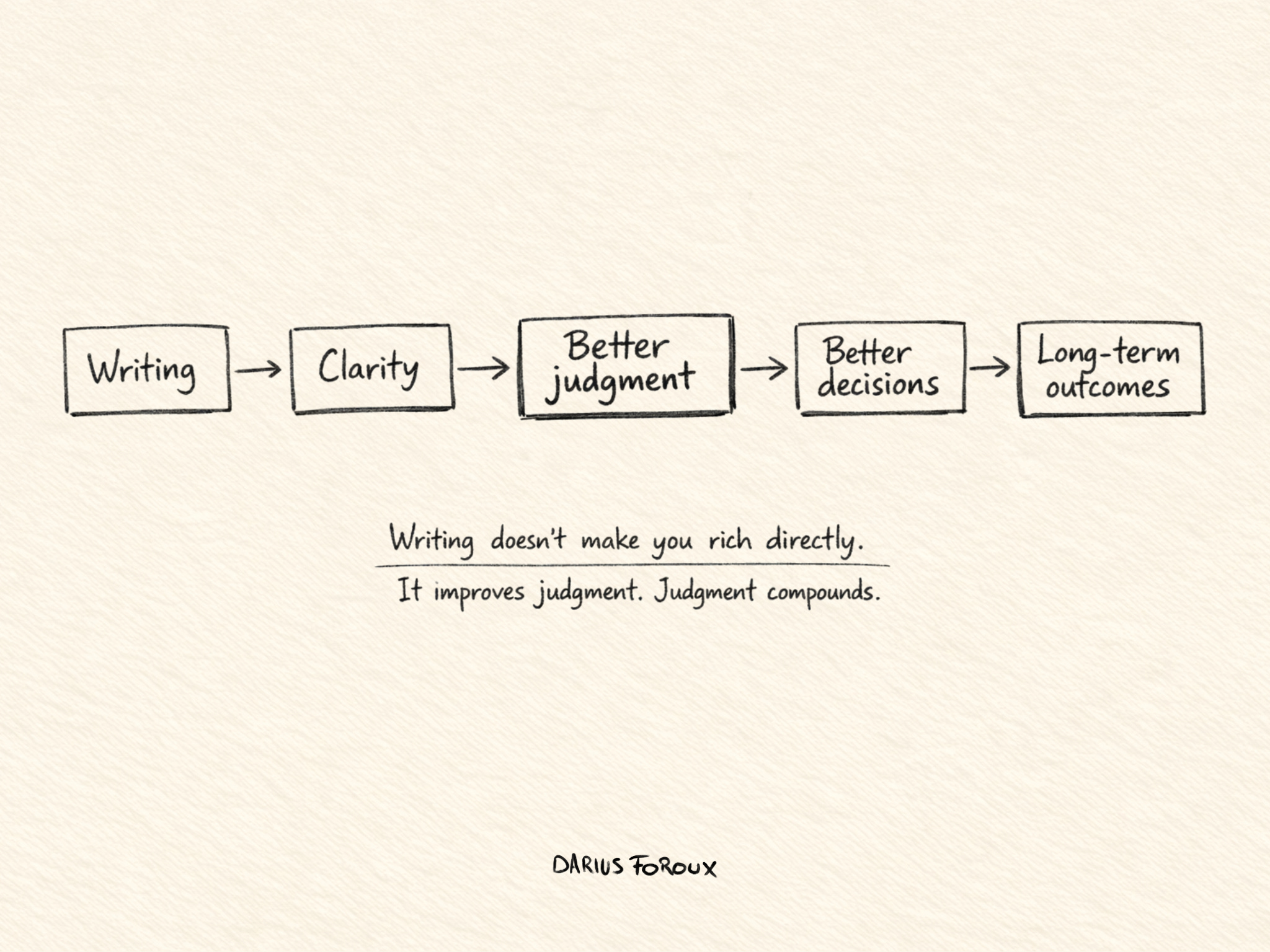
Writing doesn’t directly make you wealthy. And that’s okay because it takes time to build wealth. We know that.
However, this is something most people never consider: Writing removes the behaviors that keep you where you are.
The other day I was talking to an acquaintance who said:
“I thought that I would be living my best life by now, but instead, I’m working at a restaurant.”
Look, there’s no shame in trying. In fact, it’s the most honorable thing you can do.
Just make sure that your efforts are not going to waste. Start writing and get more clarity.
Writing sharpens your judgment.
It helps you think longer, act more deliberatively, and waste less time.
And if you keep doing that, it’s only a matter of time before you achieve your goals.
Reading and writing, the foundation of everything! Keep writing Darius, I enjoy your work!
Need to start digging deep and keep the horse running. Well written.