


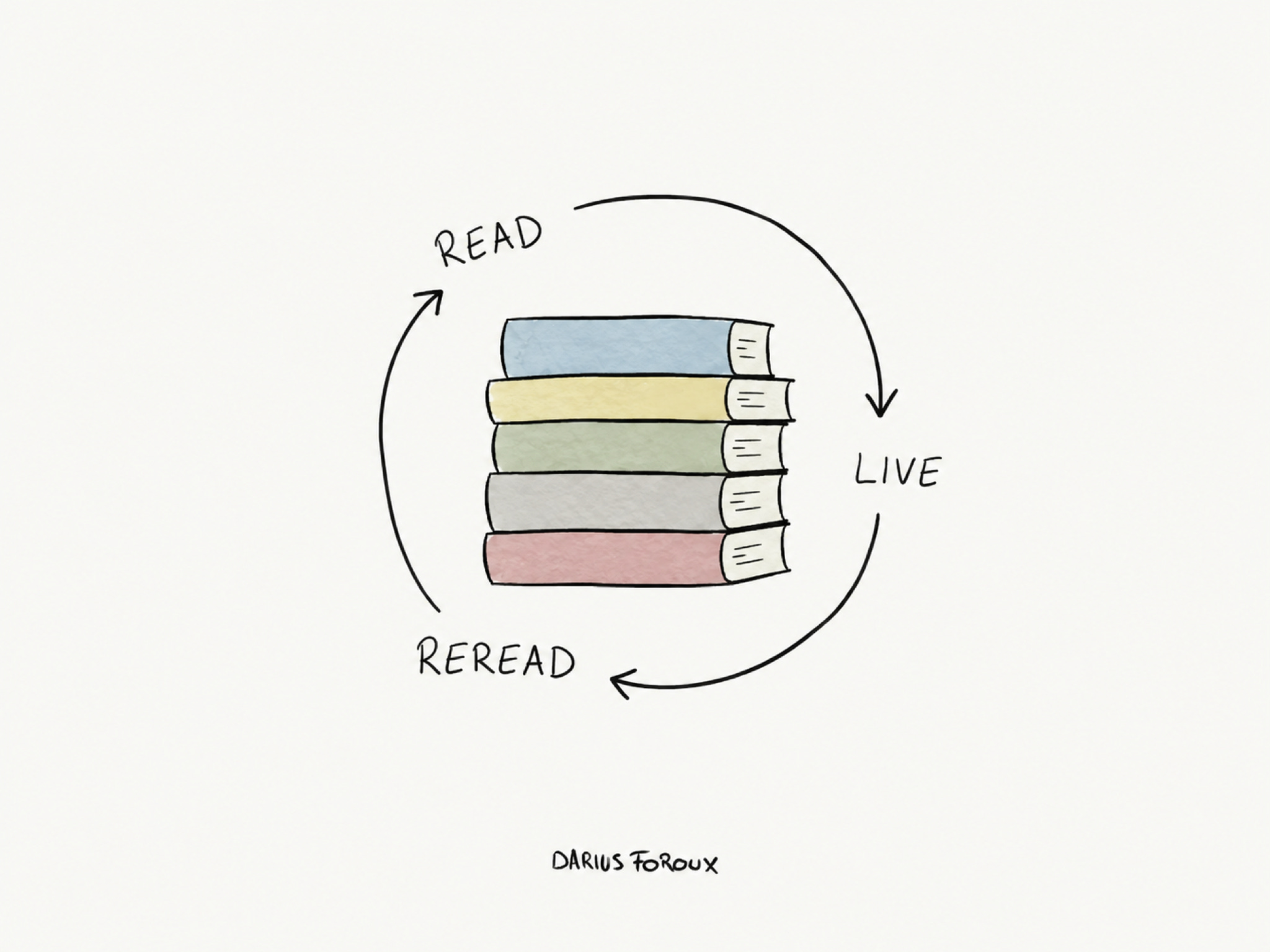
When I look back on the biggest breakthroughs I’ve personally made, I can track back every single one of them to a book that I’ve read.
People learn in different ways. I learn primarily through reading and then doing the things I realized whilst reading.
You see? It all starts with reading.
Over the years, I’ve often shared my favorite books. I realized that I hadn’t published a list in YEARS.
“Why is that?” I thought to myself.
Well, after reading a lot of non-fiction books, you don’t really come across that many new or different ideas.
That’s why it’s so important to re-read your favorite books. The books that change your perspective and inspire you. It’s worth coming back to them as often as you desire.
Here are 5 of those books for me.
1. Stillness Speaks by Eckhart Tolle
When you spend a lot of time in your head, you keep replaying conversations or worrying about things that haven’t happened yet. And you can keep doing that all day.
I’ve dealt with that for much of my life. And Stillness Speaks is one of the books that helped me look at my thoughts differently. Here’s a passage from the book:
“Here is a new spiritual practice for you: don’t take your thoughts too seriously.”
You don’t have to argue with every thought or figure out what it means. Sometimes you can just notice it and get back to what you were doing.
Tolle writes in short passages, so you can read a little and think about how it applies to your life. You can even practice while you’re reading. When your mind wanders, notice it and return to the page.
2. A Manual for Living by Epictetus
This is the book I return to the most. If you want an introduction to Stoicism, I’d start here.
Focus on what you can control: Your choices, how you treat people, and the effort you put into your work. You can prepare for a job interview and still not get the job. You can be considerate and still upset someone.
That’s frustrating. But getting angry about the outcome won’t change it. Here’s a line from the book:
“It is our attitudes and reactions that give us trouble.”
I think you keep doing your part without demanding that life gives you the exact outcome you want. And when something goes wrong, look at what you can do about it.
I still need reminding of this. Knowing the idea doesn’t mean you suddenly stop getting frustrated. That’s why I keep coming back to the book.
3. Writing to Learn by William Zinsser
Zinsser is one of my biggest writing influences. And you don’t need to publish anything to benefit from this book. As he writes:
“Writing is thinking on paper.”
I always begin a new project by writing down my strategy. It helps me see what I want to do before I start doing it.
You can do the same when you’re thinking about changing careers, starting a business, or dealing with a problem at work. Write down what you want to do and why. Try to explain it in plain language.
You’ll probably get to a point where you don’t know exactly what you mean. You might realize you haven’t thought through part of your plan. Keep writing until you can explain it. That’s how you use writing to understand something better.
4. Essays and Aphorisms by Arthur Schopenhauer
Schopenhauer sometimes seems like a miserable guy. But at the same time, he’s also worth reading!
What I find useful in his work is the attention he gives to your inner life. We put so much effort into what we own and what people think of us. But you still have to live with yourself when nobody’s around. In Essays and Aphorisms, he writes:
“People need external activity because they have no internal activity.”
Think about how quickly we look for something to entertain us when we’re bored. We grab our phones, buy something, or look for somewhere to go.
I like his idea of inward wealth. When you have interests of your own, you can enjoy learning and thinking without needing someone else to entertain you. You can keep developing your mind and your character throughout your life.
You don’t need to agree with all of Schopenhauer’s views. But I think he’s worth reading if you spend a lot of time chasing things and still don’t enjoy your own company.
5. Awareness by Anthony de Mello
De Mello is so good at pointing out the expectations that make us miserable. In Awareness, he says:
“We don’t want to be unconditionally happy.”
We say we want to be happy. But it depends on a lot of conditions, right!?
We want someone’s approval, we want our partner to behave a certain way, or we want things to go exactly as we planned. And while we’re waiting, we make ourselves miserable.
In other words: The world needs to do exactly as I please, otherwise I’m not happy.
My favorite idea from the book is his distinction between loneliness and enjoying your own company. Being alone can feel completely different depending on how you relate to yourself. If you can’t enjoy your own company, having someone around won’t automatically solve that.
Of course, relationships matter, and you shouldn’t accept poor treatment. But you can’t expect another person to take responsibility for your happiness. You have to look at your own expectations too.
That’s what I like about this book. It makes me look at my own behavior.
What will you do differently after reading?
There are so many new books published every year. And you really don’t need to read every single book that looks enticing.
Just pick a book that fits something you’re dealing with now.
Read a few pages, highlight an idea, and try it in your own life.
And when you forget, go back to the book. I still do too. After all, we’re humans. And if there’s something we’re good at it’s forgetting what we’ve learned.
But the good thing about us is that we also re-learn things fast.
Love this
While I am sure that these are all meritorious, I am disappointed that all five are men?