


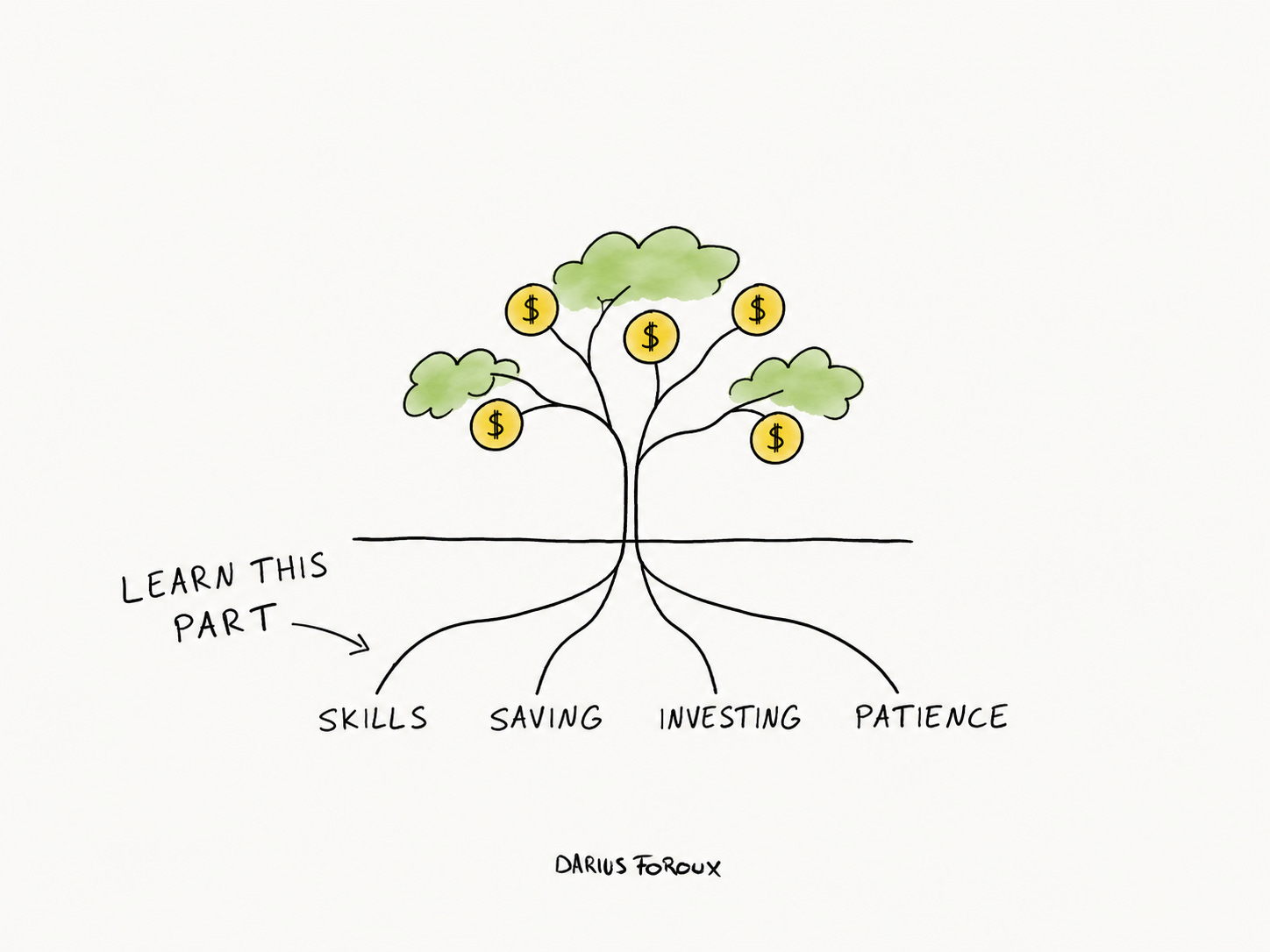
Getting rich is a skill.
How else do you explain someone who starts one successful business, sells it, and then starts another that also makes money?
Sometimes even in a different industry.
Sure, you can get lucky once.
For example, selling a company at the height of a business cycle is definitely luck. But the luck part is always about the extent of the success.
But what if someone builds a successful business multiple times?
We have to be honest. Success is mostly a matter of skill.
What does it take to get rich?
Generally speaking, there are a few things we have to do:
Earn money with your skills and ideas.
Keep most of that money instead of spending everything.
Invest in things that can grow or produce income.
Avoid taking risks that could wipe you out.
You probably know someone who earns a lot but always complains about money.
Well, if you spend everything, it doesn’t matter how much comes in. And you can be a good saver but never do anything with the money either.
At one point, I put $5,000 into an S&P 500 index fund and then didn’t add anything for several years. I knew investing was a good idea. But I wasn’t doing it consistently.
I had to get my habits right. And I learned a lot of that by looking at other people.
The #1 thing that matters: Do what rich people did BEFORE they got rich
Before I took my writing career and my career as an investor seriously, I was open to ideas from all kinds of people. Teachers, family, whoever had something to say. And often, I ignored them and just followed my own ideas. Which weren’t necessarily any better.
I didn’t start getting the results I wanted until I became ruthless about who I listened to. This is my rule:
If you’re not at the top of your field, I will not listen to you.
I have to admit, that’s a judgmental mindset. And I’m not saying it’s for everyone, because you will piss people off. Especially people around you who think they know what’s best for you.
But if I want to learn about money, why would I listen to someone who hasn’t done anything with it? I want to learn from people with results.
Here’s a line from Al Ries and Laura Ries’s book, The 22 Immutable Laws of Branding, that explains what I mean:
“If you want to be rich, you have to do what rich people did before they were rich”
That’s the part we often miss. We see someone with a big house, a nice car, and all this free time, and we want that life.
Okay, but what did they do for the 20 years before that?
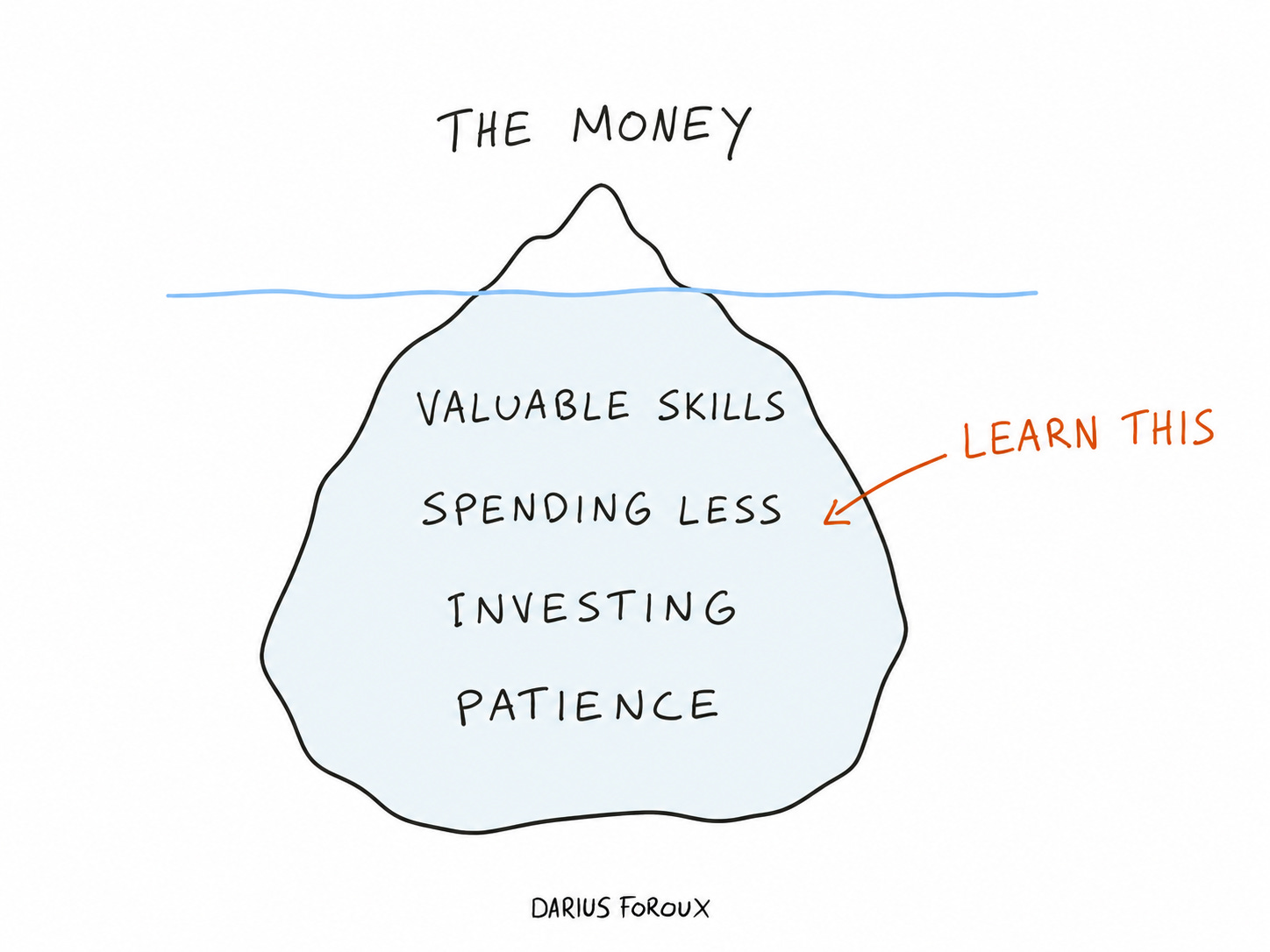
Let me be clear: I don’t believe in blindly imitating someone’s entire life.
Just because someone is successful doesn’t mean you have to copy everything they do.
You have to separate their habits from their taste and personality.
Let me give you a few examples of what I mean.
1. Get better at your work
Charlie Munger had this idea of giving himself the best hour of the day to improve his mind. The rest of the world could buy the other hours. I learned about that in the book University of Berkshire Hathaway.
When I applied that idea, I focused on writing, persuasion, and decision-making. I read books and made notes. Those were skills I could actually use in my work.
And then you have to make time for it. Successful writers spend hours alone, thinking, reading, writing, and editing. You want to become a top writer but can’t make room for that? I’m sorry, but it’s not going to happen.
So I imitate the work ethic. But do I want to write the same way as the writers I admire? No. I use my own taste and ideas.
2. Keep more of what you earn
When I started saving, I could only put away 10% of my income. I didn’t earn that much. So there was a limit to how much I could cut.
Between 2017 and 2021, I started earning substantially more, but I kept my living costs the same. I didn’t upgrade my house or car. So every year, I could save more.
But then you get a raise and immediately start thinking about all the things you can buy. We all do this. You have to be a bit careful there, because your higher income won’t help you build wealth if you spend the whole increase.
I’m all for enjoying your money. I just don’t want to spend everything and then wonder why I’m not getting ahead.
3. Put the money to work
One of the wealthy people I learned from used to be my landlord.
He spent nearly 20 years building a training company. At first, he gave seminars to businesses himself. Later, he hired trainers. Eventually, he sold the company and invested the proceeds in real estate.
When I knew him, he had time for his family and his boat, and he’d outsourced most of the work on his properties. You could look at him and think, “That guy has it easy.”
But he told me he’d missed a lot of his children’s childhood while building the company. So no, I don’t want to copy everything he did. That’s a high price to pay.
What I learned from him was how he used the money. He built a business, sold it, and invested in things that kept bringing in income.
You don’t need to sell a company to start doing that. You can earn a salary and invest some of it in a diversified fund. You can build something of your own alongside your job. But you have to start somewhere.
4. Learn to deal with losing money
You can read all the investing books you want, but at some point you’ll lose money. And then you find out how you actually feel about risk.
After the 2008–2009 crash, I stopped investing. I let my emotions get the best of me and missed the bull market that followed.
In 2020, when the market crashed because of COVID, I felt the urge to sell everything again. But by then, I’d spent years studying Stoicism and applying it to investing. I stayed invested. I even bought some stocks.
Did I suddenly know where the market was going? Of course not. I just dealt with the uncertainty better than I did the first time.
And you also have to be sensible about what you’re doing. If you put money you need for your family into one speculative stock, you can’t expect Stoicism to help you sleep at night. You’re taking a risk you might not be able to afford.
That’s why I want to learn from people who’ve kept their wealth for years, through good and bad times. How did they do that? What mistakes did they make? What do they stay away from?
These are the things I’m interested in. Someone’s stock tip, expensive watch, or morning routine doesn’t tell me much. I want to understand what they did with their time and money, and what I can use in my own life.
This was extremely helpful. Thank you!
“And you also have to be sensible about what you’re doing. If you put money you need for your family into one speculative stock, you can’t expect Stoicism to help you sleep at night. You’re taking a risk you might not be able to afford.”
Lmao. 😂 😂
This is nothing but the truth. That's an expensive and uncalculated risk that you might not be able to come back from easily.