


Recently, one of the younger employees at our family business asked me for career advice.
He had just graduated in business administration and asked, “What did you do after university?”
I told him I didn’t really know what I was doing at the time. But looking back, I’m glad I made the decisions I made. In my case, I made them out of necessity.
This was in 2010 and 2011, when the economy was still dealing with the aftermath of the financial crisis. Nearly all of my peers wanted a traineeship or a job at a large company. And I mean all of them.
But traineeships were scarce, and many companies had stopped hiring. Only a handful of people I knew got the positions they wanted. The rest took whatever was available, often in government or administrative work.
I took a different gamble and started a business with my dad.
I had studied business administration and imagined working in finance or at a large multinational. Instead, I barely got paid and spent much of my time doing tedious work in a cold warehouse, surrounded by industrial machines, dirt, and people who were much older than me.
It wasn’t the career I had pictured.
But we couldn’t afford to hire people. So I learned bookkeeping, built a website, did sales, managed customer relationships, handled procurement and shipping, and learned about tax rules.
I also took on real responsibility. When I made a mistake, nobody quietly fixed it for me. We dealt with the consequences ourselves.
After three years, I had experience across almost every part of a business. I used it to get a good job at Gartner, the IT research firm, in 2014.
During my recent conversation with our employee, we looked up a few of my former classmates on LinkedIn. More than a decade later, some were still doing pretty much the same work.
What is the experience paradox?
You can’t get a good job because you don’t have experience. But you can’t get experience because nobody will give you the job.
So when you’re starting or switching your career, your main goal is not maximizing your salary. You want to maximize your experience:
Skills you can use in more than one job or industry
Responsibility that forces you to grow
Relationships with people you can learn from
Proof that you can create results
This often means accepting lower pay, longer hours, or worse work-life balance for a few years. You shouldn’t live that way forever. But sacrificing some comfort early can change the rest of your career.
Many people do the opposite. They take the comfortable job and coast while things are going well. Then their work becomes unbearable, the industry changes, or their role becomes redundant.
Only then do they start learning new skills, contacting old connections, or building something on the side. By that point, the new thing needs to work immediately. And useful skills, reputations, relationships, and income streams rarely appear on demand.
That’s what I mean by building when you don’t have to.
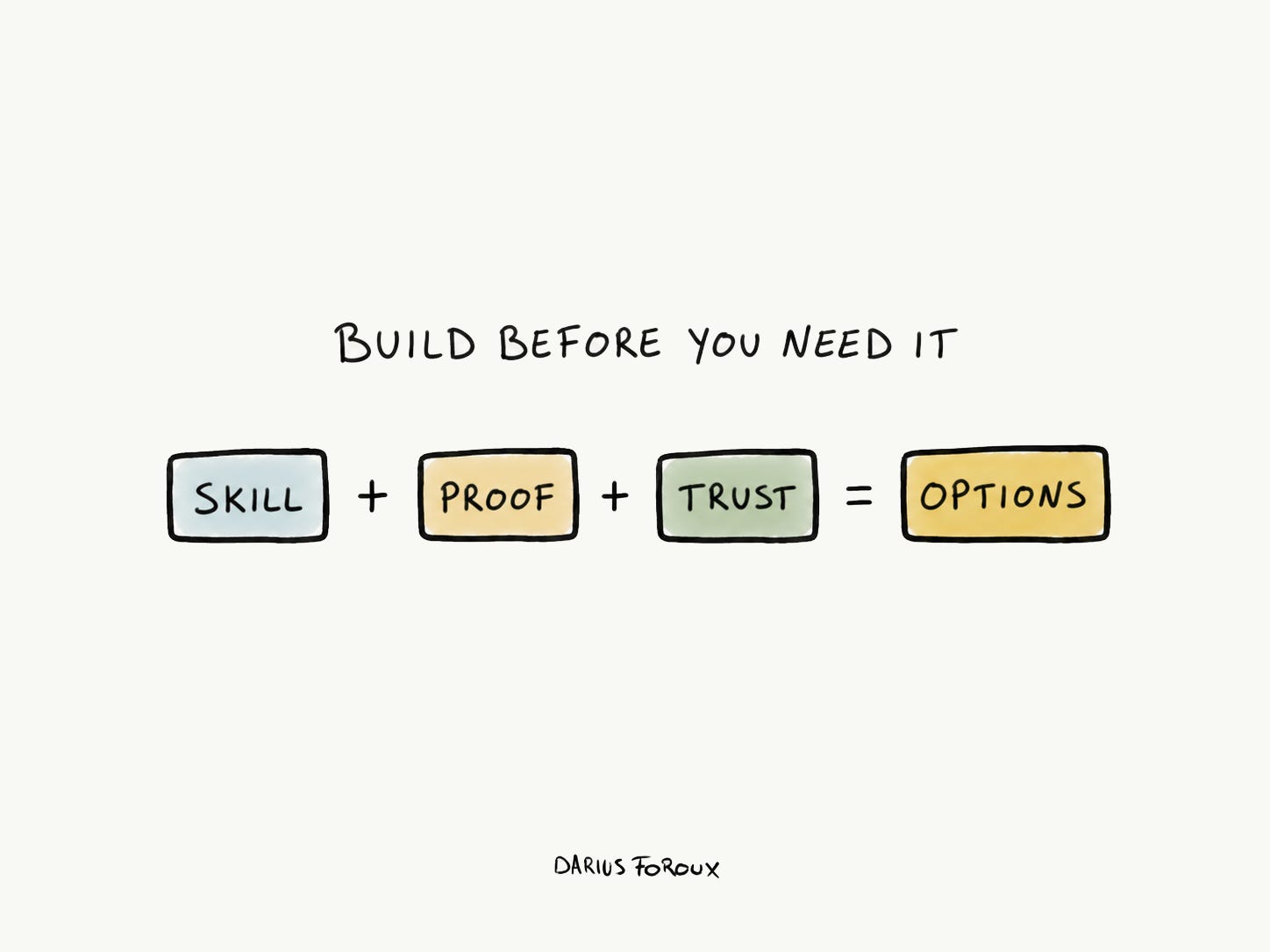
You build skills while your job is stable. You create proof while you have an income. You maintain relationships before you need help. And you test new directions before you’re desperate for one of them to work.
The best career decisions often look inefficient in the short term. But they can give you something much more valuable later: Options.
In the rest of this guide, I’ll show you how to build those options without turning every evening into another full-time job.
If you haven’t upgraded yet, become a paid member to unlock the full guide and the complete Wise & Wealthy Academy archive.