


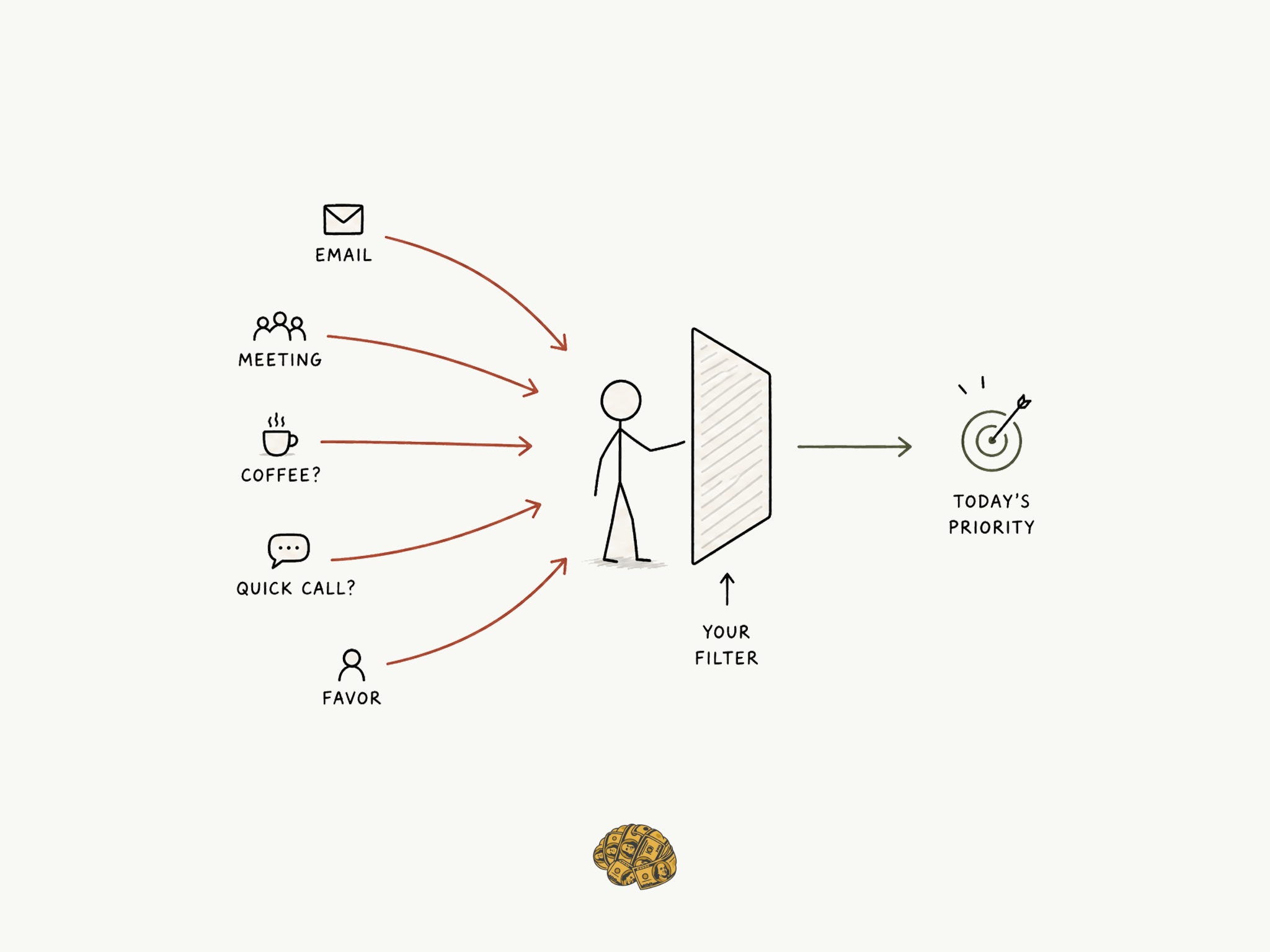
Think about the last time you said yes to something you didn’t want to do.
How did you feel afterwards?
My guess is not so great.
That happened to me all the time before.
A meeting that had nothing to do with your work. A favor that ate your entire afternoon. A commitment you agreed to because saying no felt awkward in the moment.
I would say yes to these types of things, and then immediately got angry with myself.
“Why can’t I just say NO!”
Most people say yes constantly. At work. In their personal lives. To requests that have nothing to do with what they actually want to get done.
And then they spend the rest of the day slightly resentful, slightly distracted, wondering why they can’t make progress on anything that actually matters.
Every yes is a no to something else. Your time is finite.
When you give it to one thing, you take it from another. Most people never think about it this way because saying yes feels easy and saying no feels uncomfortable.
So they keep saying yes. And keep filling their days with other people’s priorities.
Warren Buffett has a line on this:
“The difference between successful people and really successful people is that really successful people say no to almost everything.”
I talk more about this in the video below.
Why Most “Say No” Advice Gets It Wrong
Here’s where I disagree with most of what’s written on this topic.
The typical advice goes like this: Guard your time ruthlessly, you don’t owe anyone an explanation, just say no to everything.
That might be true. But if you take it literally, you risk becoming someone nobody wants to work with.
We’re social beings. The people asking things of you are usually your colleagues, clients, and friends.
The people you see every day. Shutting them down without explanation doesn’t protect your time. It damages the relationships that make your work possible.
There’s a better way.
You really don’t have to be ruthless about saying no. Simply be honest.
Saying no is about knowing what you’re working on, committing to it, and communicating that clearly when something else comes up.
For example, it would be strange for me to stop replying to reader comments. That’s part of my work. Some things deserve a yes even when they’re inconvenient.
I also don’t subscribe to the whole idea of, “Calculate your hourly rate and say no to everything that doesn’t make money.”
Let’s say one author claims their hourly rate is 1000 bucks because that’s how much they make with their books and articles. Okay, great. But that doesn’t mean you should only be writing.
If you just keep on writing and don’t do anything else, you run out of material at some point.
Here’s what people who optimize everything around money miss. The things that look like distractions are often where your best work comes from.
The conversation that has nothing to do with your current project gives you the idea for the next one.
The book that isn’t “useful” shows up in your writing six months later. The walk where you weren’t being productive is where you solved the problem you’d been stuck on for a week.
If you say no to everything that doesn’t directly advance your career, you slowly starve the work you’re trying to protect. Input matters as much as output. You can’t just produce. You have to refill the well.
So the goal isn’t to say no to everything that you don’t like or that advances your career.
Life is not that transactional. However, that doesn’t mean you should go around saying yes to everything because you fear that you will let people down.
Find a balance. If you really can’t do something, just say no.
But how do you know when you can or can’t?
Enter:
The Priority-First Framework
Here’s a framework you can use in your career. I share more on personal situations later.