


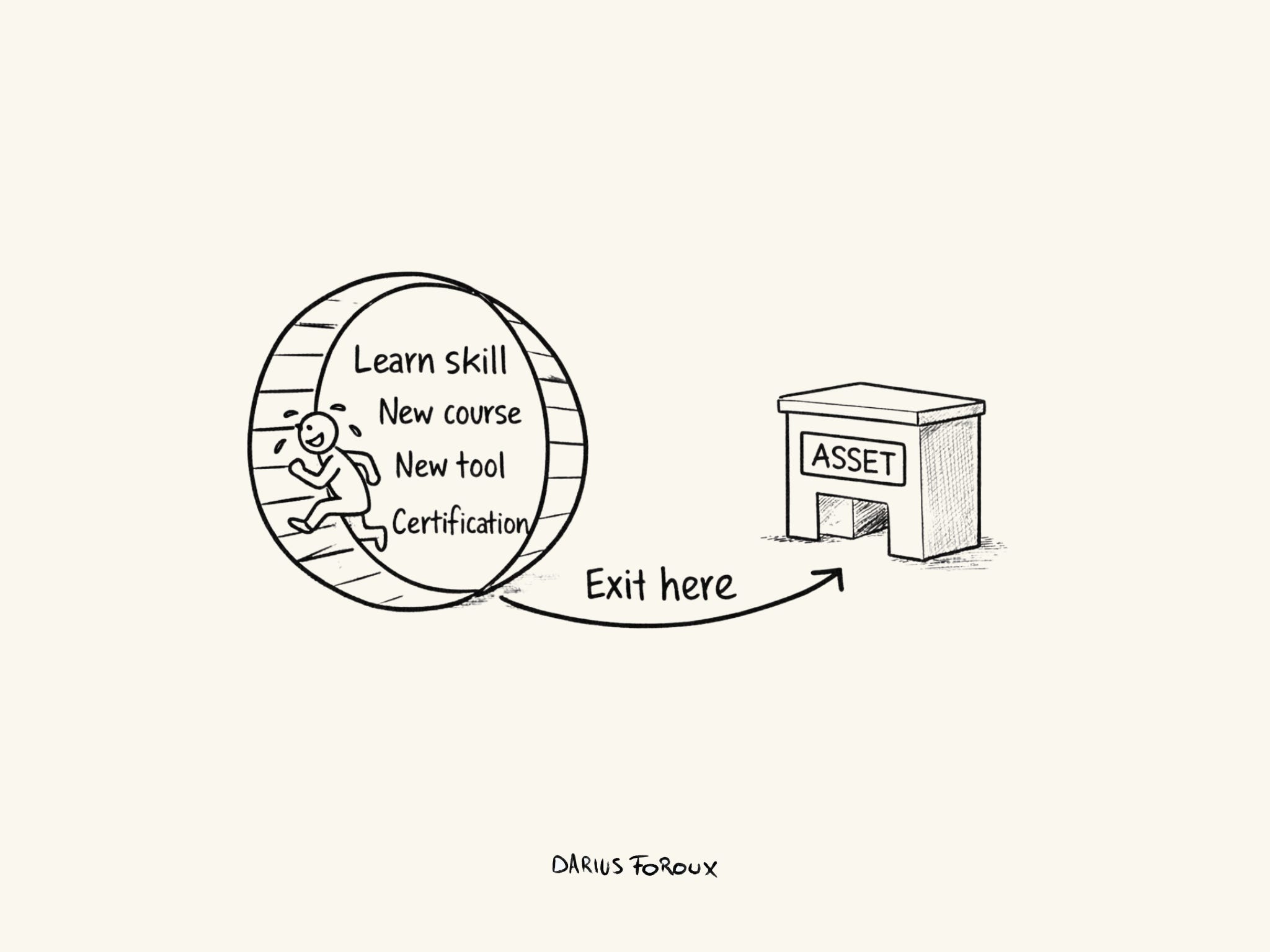
Everyone is telling you to learn a new skill.
Learn psychology. Build your personal brand. Master ChatGPT. Get certified in something.
The list never ends.
And look, I get it. When the world feels unstable, learning feels productive. It feels like you’re doing something.
But here’s the hard truth: most people who are “learning” right now are spinning their wheels. They’re not making any real progress.
The people who are already getting left behind
I’m seeing it in real life. Graduates who can’t find jobs. People with one or two years of experience who are sending out hundreds of applications with nothing back.
Companies are quietly raising the bar on who they hire. Entry-level roles are disappearing. Starter jobs that used to exist just don’t anymore.
And the question nobody wants to ask out loud: who’s next?
This shift in the economy isn’t stopping. AI doesn’t hit a ceiling. It doesn’t plateau.
The tools keep improving, and companies keep realizing they can get more done with fewer people. The group that feels the squeeze today is bigger tomorrow.
Technology doesn’t close the gap. It widens it.
This is the part most people skip over. They hear “AI creates new opportunities” and assume those opportunities will be evenly spread.
They won’t be.
Just look at history. Every major technological shift in the last 200 years has followed the same pattern. The printing press. The steam engine. Electricity. The internet. Each wave created enormous wealth. And each wave concentrated that wealth at the top.
The internet is the clearest example. In theory, it opened the world to everyone.
In practice, it created a small group of wealthy people while millions of workers in retail, media, and logistics got squeezed out. The winners built platforms and acquired assets. Everyone else optimized their resume.
Technological unemployment is not a new concept. Economists have studied it for over a century.
What’s new is the speed. And the fact that this time, it’s targeting white-collar work, the jobs everyone assumed were safe until a few years ago.
The gap between people who use this moment to build something real and people who just consume it is about to get very real.
If we don’t watch it, we risk getting stuck in the permanent rat race.
I don’t believe that the economy will crash. People are just too addicted to spending.
However, inequality will just keep rising. AI will create a lot of new wealth, but it won’t be distributed equally.
It’s up to us to profit from it before we get stuck in a permanent rat race, where we’re always struggling to live well.
Why skills alone won’t save you
Here’s the problem with the “learn a skill” advice. Skills without results are just information sitting in your head. And right now, information is the cheapest thing in the world.
Think about what the standard advice actually produces:
You spend 3 months learning a skill
You have a certificate or a completed course
You have nothing to show for it in the real world
You move on to the next skill on the list
That’s the rat race in a new outfit. Always busy. Always learning. But never building anything that compounds.
I used to do this too. I’d pick up a skill, feel good about it, then move on. There was no moment where I could point at something and say: I made that, and it works.
That changed when I stopped asking “what should I learn?” and started asking “what can I build or acquire that generates real results?”
The only thing that matters now: Results
Here’s the thing about AI that nobody is being straight with you about. It really doesn’t have a steep learning curve.
You can set up most AI tools in half an hour. Even more advanced tools like Claude take a few hours to get comfortable with. After that, it’s just usage.
That’s it.
Usage is the skill.
The person who wins isn’t the one who “knows AI” the best. You can find thousands of those geniuses on Twitter. That place is full of people who scream about how they are building revolutionary AI applications, but they can never show anything.
No, the winner is someone who uses AI most relentlessly to create something real. Something with a result attached to it.
And results in the real economy always come down to four things:
Saving time — yours or someone else’s.
Saving money — cutting costs, reducing waste, removing friction.
Making more money — growing revenue, finding new customers, creating new products.
Reducing risk — protecting what already exists.
That’s it. Every valuable business, product, service, or partnership in history solves at least one of those. If what you’re building doesn’t touch any of them, it won’t last.
Upgrade your membership. By becoming a paid member, you get access to the Wise & Wealthy Academy. Every Saturday, I share a new members-only post with practical tips on building wealth, thinking better, and staying ahead.
What “building something real” actually looks like
This is where I want to be direct, because too many people assume this is only about starting a newsletter or building an audience. That’s one path. It’s not the only one.
Here are some real examples of what building looks like:
Forming business partnerships. I’ve been involved in running my family's laundry business since 2010. We started by buying, refurbishing, and selling industrial equipment.
Over the years, we evolved into a distributor for major brands. We built real relationships with end customers and with manufacturers.
Now, those relationships are turning into co-developed products and services. That’s leverage no algorithm can copy. That’s what happens when you stop thinking about transactions and start thinking about long-term value creation with the right people.
How can you bundle your experience, ideas, and network with someone else? Think about that, and you might just create a new asset that can generate a lot of wealth.
As the business platitude goes, it’s better to own 50% of a growing business than 100% of a dying one.
Acquiring physical assets. Real estate. A small business. A share in a local operation. These things generate cash, build equity, and don’t disappear when a platform changes its algorithm.
The truth is that we’re brainwashed into believing that owning assets is risky. You should never take out a loan! Debt is bad!
Well, that’s what will keep you exchanging your time for money. The truth is that risk-taking is part of wealth building.
Acquiring assets always feels risky in the moment. But in 5 or 10 years, you will thank yourself for acquiring something that has appreciated in value.
Building distribution. Think of an audience, a network, a client base. Distribution is one of the most valuable things you can own.
Manufacturers want to work with our business because we own the relationship with the end customer. That’s true in almost every industry. The person who controls access to the buyer has leverage.
The point isn’t to do all of the above.
The point is to train yourself to always think in acquiring assets, and not in exchanging time for money (i.e., a salary).
The 90-day test
Here’s a simple filter.
Ask yourself: if I put 90 days of real effort into this, can I point to something at the end that proves it worked?
Revenue. A client. A finished product. A signed partnership. A property with a tenant. An audience that responds.
If the answer is no, it’s not worth your time right now.
The good news is that compounding works in your favor once you start.
The first result leads to the second.
The second partnership opens the third door.
The asset you acquire this year is worth more next year.
That’s how real wealth is built, not through certificates, but through things that accumulate value over time.
Most people are still watching and waiting.
For what?
Most people read about AI and how the economy is shifting, get anxious, and then go back to business as usual.
They’re not building anything, which means the space is still open.
But it won’t stay that way.
It’s still early
In a way, this period reminds me of when I started writing online in 2015. I wasn’t part of the early wave, which started a few years prior.
But I was early enough.
That’s also what’s going on with AI and the economy right now. We’re no longer in the early stages. But let’s face it, we’re just starting.
The key is to take action.
So stop asking what skill to learn next.
Start asking: what can I create or acquire that someone else would pay for, come back to, or build on?
That’s the only question worth your attention right now.
Loved this.
Lived this — 27 years building assets for me, 17 years teaching it.
Be creative by building assets: systems that work for you.
Getting skilled is a byproduct of creating, not the other way around.
This is by far one of the most practical pieces of advice I've ever read.. Most articles induce extreme fear or extreme hype. This article does neither. You share the things that actually build wealth.. Build relationships, assets and distribution to get ahead. Love it, thanks for sharing Darius!