


When it comes to work, I’m not always that productive.
I have times when time seems to stop and I’m fully fully focused, completing one thing after the other.
During these times, it’s also easy for me to write. The words just magically flow out of my fingers on the keyboard and show up on the screen. Everything is effortless.
But I also experience times when everything is flipped.
I’m slow, all over the place, and the worst thing… writing feels like a struggle. I have to squeeze out the words. And I don’t experience much joy because of the resistance.
These phases of work are normal. We all experience them.
The question is: How do you deal with long stretches when your work is taking a toll on you?
Because if you don’t watch it you burn out.
Burned-out people push hard for months or years and then hit a wall so hard they can’t get back up.
I’ve done this too.
Let me share with you how to avoid burning out.
The week my body made the decision for me
A few years into writing seriously, I was putting in long days. Write for hours, then switch to course work, then back to writing.
The output was good, and I had a lot of momentum. So I kept pushing.
Then one morning I woke up with a headache that didn’t leave for four days. I was tired in a way that sleep didn’t fix. My brain felt like a wet towel.
I sat down to write and produced almost nothing. I’d look at a sentence and not know how to finish it. I tried to outline and the ideas wouldn’t come.
I was still “working,” in the sense that I was at my desk. But the real work was gone.
I took the rest of that week off. It took another week before I felt like myself again.
Two weeks of lost output because I didn’t take a day off when I needed one. That’s the math nobody tells you about.
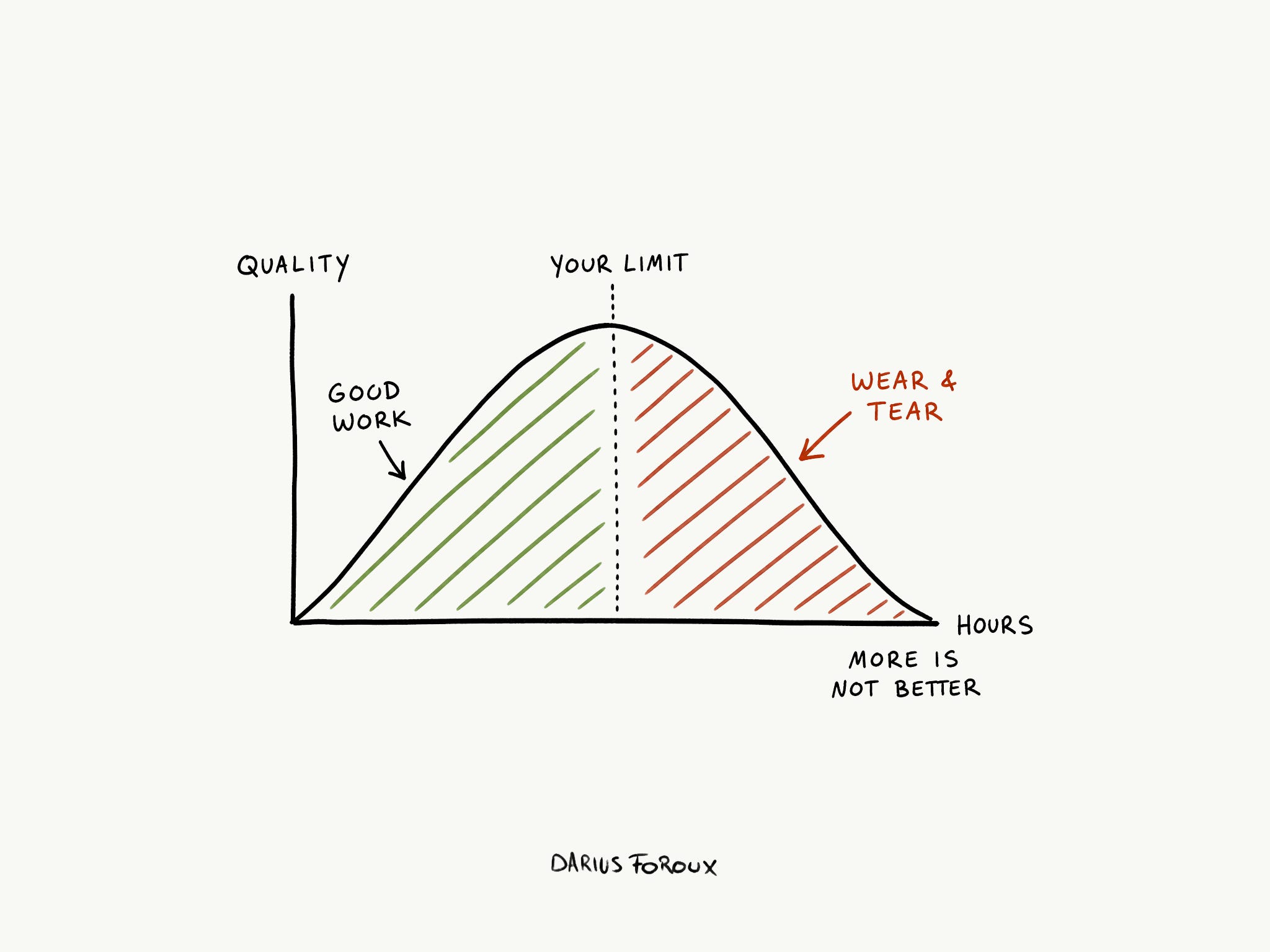
The point beyond which quality drops
Paul Graham has this popular essay called How to Work Hard. Most people quote the parts about effort and ambition. This has stayed with me:
“You can’t solve this problem by simply working every waking hour, because in many kinds of work there’s a point beyond which the quality of the result will start to decline.”
He says his personal limit for deep writing or programming is five hours a day.
Beyond that, quality drops. And if you think grinding past your limit is admirable, he says to get that idea out of your head.
You’re just showing off to yourself.
That’s so true. I’d spent years thinking more hours meant more output. It doesn’t. It means worse output, followed by a crash.
Work is sprinting, not a marathon
Here’s the mental model most people carry: Work is a marathon. You pace yourself. You stay consistent. You keep going.
That model is wrong in one specific way.
Deep, focused work is not a marathon. It’s a series of sprints. And sprints require recovery. A sprinter who runs flat out for 200 meters doesn’t immediately run another 200. They recover first. Their muscles rebuild. Then they sprint again.
Knowledge work is the same.
Your brain is not a machine that produces the same output every hour. It’s a biological system with limits. Push it past those limits and it produces worse work.
Push it past that and it stops producing at all.
Seneca understood this about the mind long before anyone ran a study on it. He said this 2000 years ago:
“Our minds must relax: they will rise better and keener after a rest. Just as you must not force fertile farmland, as uninterrupted productivity will soon exhaust it, so constant effort will sap our mental vigour, while a short period of rest and relaxation will restore our powers.”
The rest is not wasted time. The rest is what makes the next session possible.
10 lessons on longevity
You might read this and think, “maybe I should work less.” But that’s not really what I’m saying.
The idea is that, if you want to avoid burn-out, work in a way that doesn’t require you to quit in two years.
Here are some practical things to keep in mind.
Know your daily limit. Track what happens to the quality of your work after three hours of deep focus. After four. After five. You’ll find a point where it drops. That’s your limit. Work up to it. Stop before you cross it every single day.
Protect sleep like a deadline. Sleep is not optional recovery. It’s the primary recovery. One bad night is manageable. A pattern of five-hour nights for weeks is how you end up with headaches that don’t leave and output that doesn’t come.
Move your body every day. When your brain is spent, physical movement restores something that sitting at a desk cannot. Walking, lifting, swimming — anything. This is not advice about health. It’s advice about output. Movement is recovery for knowledge workers.
Take one full day off per week. Not a day where you half-work. A day where the laptop stays closed. One day off per week is how you show up fully for six. Skip it for a month and you’ll feel the deficit.
Stay hydrated and eat real food. Dehydration kills focus faster than almost anything else. Before you diagnose yourself as uninspired or blocked, drink two glasses of water and eat something real. A surprising amount of mental fog is just a body that hasn’t been maintained.
Balance deep work with lighter work. Not every hour needs to be your hardest. Schedule your most demanding work for when you’re sharpest — usually the first few hours. Save lighter tasks for when the energy dips. Meaningful productivity is not about maximum effort every hour. It’s about the right effort at the right time.
Take strategic breaks inside the workday. A ten-minute walk. Eyes closed for a few minutes. A break from the screen. These are not distractions. They’re part of the work cycle. The brain needs micro-recovery even within a single session.
Watch for the early warning signs. The first sign you’re crossing your limit is usually subtle. Slower thinking. Less patience. The feeling that everything is slightly harder than it should be. When you notice that, stop. Don’t push through it. The push-through instinct is what turns a recoverable dip into a multi-week crash.
Take vacations before you need them. Most people take a break only after they’ve already burned out. That’s like drinking water only after you’re dehydrated. Schedule proper breaks proactively, before the crash.
Balance long-term and short-term goals. The projects with a deadline next week and the projects that matter in five years need different energy and different attention. If all your capacity goes to urgent work, the important work never happens. Schedule both deliberately. Don’t let one consume the other.
The goal is decades, not weeks
The people who do good work for a long time are not the ones who grind until they break and then restart. They’re the ones who figured out how to work hard without that cycle.
They treat their capacity as something to maintain, not consume.
That mindset shift changes everything.
You stop treating it as guilt and start treating it as fuel. You stop admiring people who sleep four hours and start noticing they disappear every few years. You stop measuring yourself in hours and start measuring yourself in output over decades.
Don’t waste years recovering from months you didn’t have to break yourself in.
Work hard. Protect the capacity. And above all, keep going!
I just want to say one thing, yeah as a solution—Check the word 'FLOW' something called by psychologists as our mental state at that time. You will get to know about this. BTW good post. Thanks for sharing it.
Hey there Darius,
Great post, as always. A couple of things really stayed with me here:
1. The whole thing about burnout and the different reasons, but no one talks about working without stopping just to show off to yourself as one of them. I mean we feel when we overwork, everyone will notice and team members might even get more inspired/motivated, but that’s really just our hero complex.. no one really cares that we are burning the candle at both ends, and some colleagues or even your boss might actually mistake it as you have nothing better to do/take it for granted.
2. Your whole point about knowing what to do when. I think this is quite important. Each of us has different energy levels at different times of the day. Rather than force our energy levels to match the task at hand, it might just be better to plan to do the task that suits our energy level at the time. Luckily, given that most of us are now in the knowledge work era, that is easier to do than before. For example, plan meetings for times when you're not maybe at your sharpest. Leave all the deep work for times when you are sharp, etc.
As always, lovely reading your post.
Cheers,
Gunjan