


Who else hates marketing?
What about posting on social media like a self-absorbed and inconsiderate jerk?
Self-promotion is a necessary part of work, but it feels unnatural to many of us.
A lot of people grew up with an old-school work ethic: Put your head down, do good work, stay modest, and don’t draw attention to yourself.
You learn to fly under the radar and hope your results speak for you.
But if you’re an artist, writer, freelancer, or entrepreneur, people first need to know that your work exists.
And that’s where the discomfort starts. You want to share your work without becoming someone who turns every conversation into a sales pitch.
I’ve been writing online since 2015, and I’m still not interested in becoming an internet personality. But I’ve learned how to promote my work in a way that fits me.
Here are five things that helped me.
1. Accept marketing as part of the work
The first step is accepting that marketing belongs to the work.
To be honest, I don’t love the commercial side of my career. I don’t enjoy the pressure of constantly putting out books, courses, and articles that also need to perform financially.
But I know myself. Without a financial incentive, I probably wouldn’t do the work with the same urgency and discipline. An idea becomes more serious when customers, expenses, and revenue are involved.
That’s simply how our society works. Money creates an incentive to make something useful, finish it, and keep improving it. You don’t have to worship money, but it makes no sense to pretend the incentive isn’t there.
The starving artist idea has always bothered me. Some people act as if earning money ruins the purity of creative work. But if your work can’t support you, something else has to. And that usually means you have less time and energy for your art.
So I see marketing as part of the creative process. I make something that can help people. Then I explain what it is, who it’s for, and how they can get it.
There’s nothing dirty about that.
2. Choose a medium that fits your personality
You don’t have to promote yourself in the way everybody else does.
I’m a talker, but I like to go deep. I have a hard time connecting with people who always stay on the surface and only want to talk about gossip, trends, or the latest news.
Writing fits my brain. I can take an idea, think about it, and explain it properly. That’s why I use articles, Medium, Substack, and email. TikTok and Instagram don’t give me that same feeling, so I don’t direct my energy there.
Fortunately, there are more ways to share your work than ever:
If you think through writing, use articles, newsletters, or essays.
If you like speaking but prefer being alone, record a podcast or talk to a camera.
If your work is visual, show the process, details, and finished result.
If you prefer one-on-one contact, use conversations, referrals, or personal emails.
Pick the medium that makes it easiest to express what you actually think. You might still feel vulnerable, but at least you won’t also feel like you’re playing a character.
And give one medium enough time. Constantly moving from email to Instagram to YouTube to whatever comes next is exhausting. You never stay long enough to become good.
3. Give people the information they need
This is the most useful lesson I’ve learned from studying copywriting.
I’ve read people like David Ogilvy, Gary Halbert, and Claude Hopkins, who wrote Scientific Advertising. Their work taught me to look at marketing as informing the reader.
You can’t convince someone to want something they don’t want. You can make your offer clearer and more attractive, but you can’t force genuine interest.
So answer the questions a reasonable person would have:
What did you make?
Who is it for?
What will it help them do, feel, or understand?
Why did you make it?
What does it cost?
Where can they get it?
Good marketing makes those answers easy to find. It gives people enough information to make their own decision.
This mindset removes a lot of pressure. You don’t need to manipulate anyone or act excited all the time. You simply say, “I made this. Here’s why it might be useful to you. Take a look if you’re interested.”
Some people will buy. Most won’t. That’s normal.
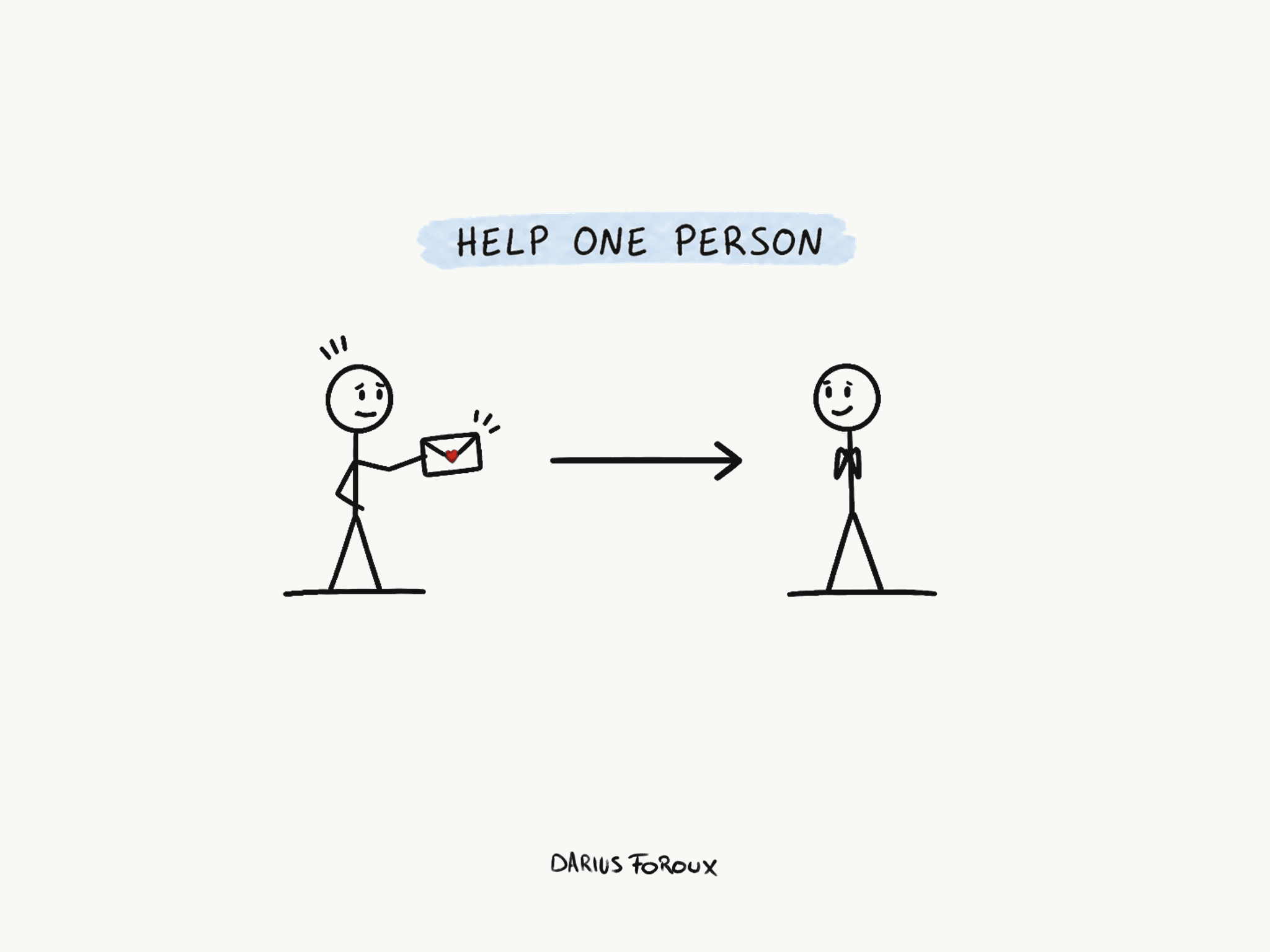
4. Write for one person
The word “audience” can make marketing feel more intimidating than it is. You imagine a large crowd judging every sentence.
I don’t find that useful. When I write an article or email, I think about one person with one problem.
In this case, that person is the painter who feels uncomfortable emailing customers. She doesn’t need to reveal her entire inner life to sound authentic. She can write something as simple as:
I just finished a new series of five paintings. I started working on them after noticing how different the same landscape looks in the early morning. You can see the full series here. If one of the paintings speaks to you, they’re now available.
That’s personal, clear, and useful. And it doesn’t turn the email into a diary entry.
Authenticity comes from telling the truth about your work and your intentions. You can keep private things private. You can also be direct about the fact that something is for sale.
Before you publish or send anything, ask yourself: “Would this help one person understand my work better?”
If the answer is yes, send it.
5. Don’t take silence personally
This is probably the hardest part. You share something that matters to you, check your inbox, and nobody replies.
Your mind immediately turns that silence into a judgment: Nobody cares. The work wasn’t good. I made a fool of myself.
But you don’t know why someone stayed silent. They might have read the email while waiting in line, liked the work without needing to comment, decided the offer wasn’t for them, or planned to come back later and forgot.
The only useful approach is to treat marketing as a game you’re learning to play. Every email or post gives you information.
If few people open, work on the subject line.
If they open but don’t click, make the offer clearer.
If they click but don’t buy, look at the product, price, timing, or sales page.
If one person replies, pay close attention to what resonated.
Don’t judge yourself after one email. Look for patterns over several attempts.
And adopt a little more of a “who cares?” mindset. People have opinions about everything. If you hold on to every reaction, or every lack of reaction, you hand strangers control over your work.
You sent an email. You didn’t commit a crime.
Learn from the result and send the next one.
Get comfortable with being uncomfortable
Some people say you’ll get used to putting yourself out there. To be honest, I don’t think you ever fully do.
You can get better at marketing, sure.
You’ll learn to write better emails, explain your work more clearly, and deal with silence without taking it personally.
But talking about yourself will probably always feel a little uncomfortable.
This is cliché, but we just need to get comfortable with that feeling. Don’t use it as a reason to hide.
You never know whose life your work might change. But you’ll never find out if you don’t make yourself available and give people a chance to see what you can do.

My new course, AI Pro, is out now.
Thank you Darius for this article, it tackles a struggle for many Including myself, keep posting good stuff!
Darius, thank you for thinking of ME when you wrote this. Lol! So much useful information I needed to hear to take some necessary steps this week. Keep at it and thanks again!