


This is a Wise & Wealthy Academy post. Every week, I publish a new training that focuses on a single idea from one of four areas: clear thinking, personal execution, career antifragility, and investing psychology.
When I quit my corporate job to become a writer, it felt like I was starting from scratch.
I had spent years in client-facing roles at an IT research firm, building relationships, learning how large organizations think, and developing skills I didn’t fully appreciate at the time.
And then I walked away from all of it to write on the internet. To most people around me, that looked like throwing everything away.
But here’s what I realized later: I wasn’t starting over. I was building on everything I had learned. I just couldn’t see it clearly at the time.
The skills I developed in my family’s industrial laundry business got me the Gartner job. The training methodology I experienced at Gartner, which has one of the best corporate training academies in the world, became the foundation for how I structure my own courses today.
Every step was built on the last, even when I wasn’t consciously aware of it.
That’s how careers actually work. Not like a ladder you climb and abandon. More like a compounding investment where every experience adds to the base.
I talk more about that in this video:
A Career is Not Like a Relationship
Most people look at their career like a romantic relationship.
You’ve put years into it. You’ve given it your energy, your time, your identity. So when you think about leaving, it feels like a breakup. Like you’re walking away from everything and starting completely fresh.
But that’s not how it works. A relationship ends when you leave.
Your skills, your judgment, your network, your reputation; none of those have an end.
They come with you.
Every client conversation, every project, every difficult colleague, every training program you sat through. All of it is still in you. You don’t leave it behind. You carry it forward.
This thinking also creates the sunk cost trap. You’ve invested so much time in this company, this industry, this career path, that leaving feels like admitting it was wasted.
So you stay.
Not because you want to, but because walking away from what you’ve already put in feels unbearable.
The time is already spent. It’s gone regardless of whether you stay or go. The only question worth asking is: what’s the best move from here?
Your Career Compounds
Here’s the better frame.
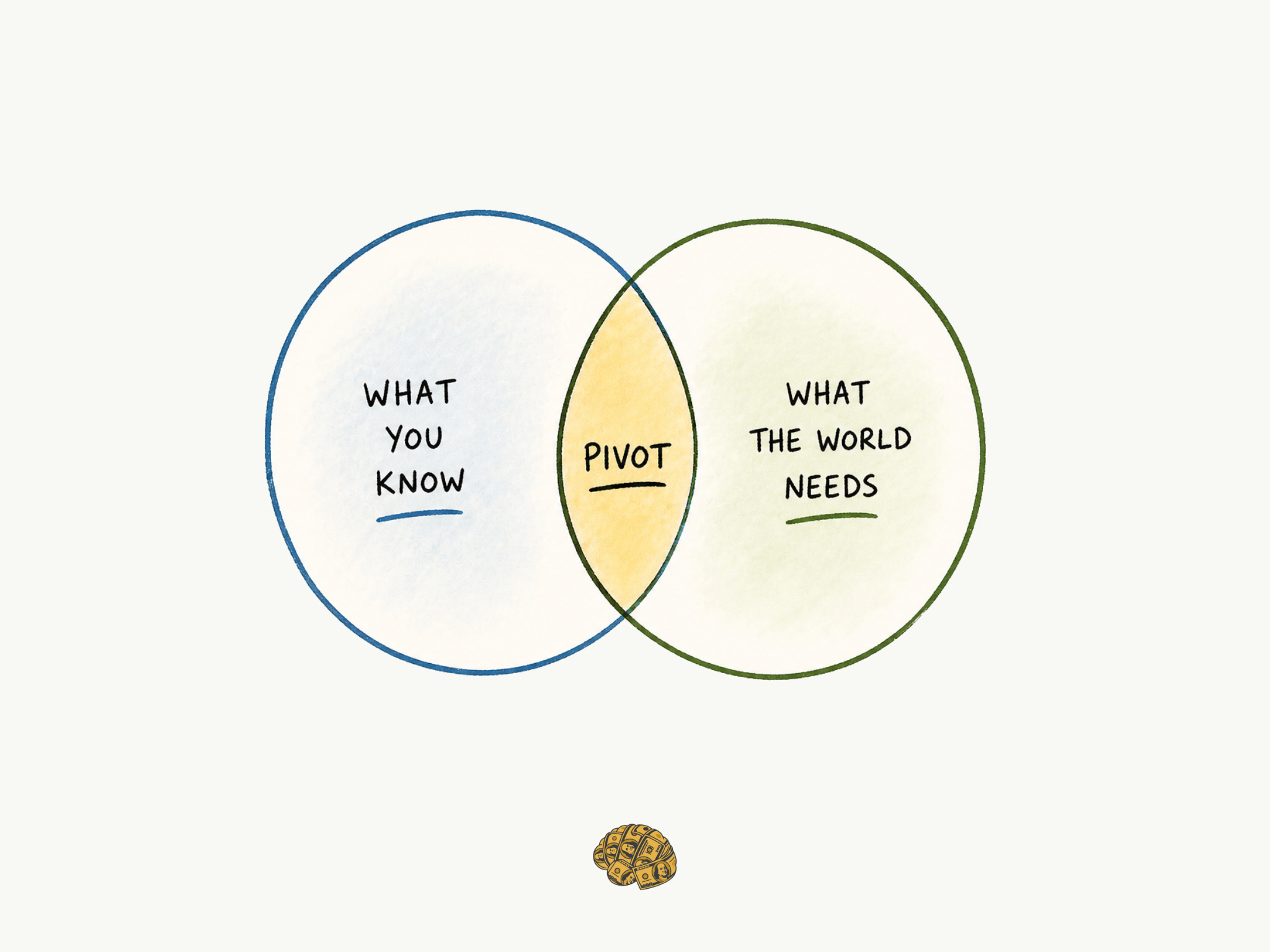
Every skill you develop, every industry you work in, every relationship you build adds to your base. When you pivot, you’re not abandoning that base. You’re redirecting it.
The person who spent ten years in corporate finance and moves into consulting doesn’t start from zero. They bring a decade of financial judgment, stakeholder management, and organizational knowledge that someone starting fresh simply doesn’t have.
The sales professional who starts building an audience online is doing exactly what they’ve always done, just to a different kind of customer.
More than 58% of professionals globally have switched industries at least once in the past three years. Most of them didn’t start over. They translated.
The key word is translate. Not abandon, not restart. Take what you have and find the new context where it’s valuable.
And true starting over is almost impossible anyway. If I decided tomorrow to become a professional musician, that would be starting over. The gap is too wide. But most career pivots don’t look like that.
They look like a marketer moving into brand consulting, an engineer moving into product management, a teacher moving into corporate training. These are redirections, not restarts. What changes is the context, not the foundation.
How to Actually Pivot
Find the overlap first.
Before you do anything else, identify where your existing skills meet what the new direction needs. You don’t need a perfect match. You need enough overlap to get in the door.
When Gartner came up for me, I wasn’t a textbook fit. But I had client-facing experience and had closed high-value contracts in my family business. I led with that in the interview process. And they appreciated it enough to offer me the job after four rounds of interviews.
Look at the skills you’ve built across your entire career, not just your most recent role.
Communication, judgment, leadership, relationship-building, project delivery. These transfer everywhere.
Most people underestimate how much they already have because they’re looking at job titles instead of actual skills.
Stage it if the gap is wide.
If the distance between where you are and where you want to go feels too large, find the intermediate step. What role gets you 60% of the way there? Start there.
Pivot again in 18 months from a stronger position. Staged pivots have a much higher success rate than single large leaps.
Think of it like investing. You don’t go from cash to an aggressive portfolio overnight. You build toward it. Career pivots work the same way.
Build proof before you leave.
In 2026, hiring managers care less about your previous title and more about what you can do right now. Start building evidence in the new direction before you make the full move.
Write about it, take small projects, get a short credential, connect with people already in that field.
By the time you make the full transition, you’ll have proof instead of just intentions.
Be opportunistic.
You don’t always get to choose your exact destination in advance. Sometimes the right pivot is the one that appears in front of you, not the one you planned.
Stay directional, not rigid. Know what skills you want to use and what kind of work you want to do. But stay open to the specific opportunities that appear.
Some of the best career moves come from having the self-awareness to see how your existing skills make you a strong fit for something you didn’t anticipate.
The Pivot Story
One thing almost nobody prepares for is how to talk about the pivot.
