


This is a Wise & Wealthy Academy post. Every week, I publish a new training that focuses on a single idea from one of four areas: clear thinking, personal execution, career antifragility, and investing psychology.
I want to start with something that should feel strange but doesn’t anymore.
The S&P 500 started 2026 near all-time highs, after returning 18% in 2025, 25% in 2024, and 26% in 2023.
Gold was up over 60% in 2025 alone, and is currently still near record territory.
This, while there’s an active war in the Middle East, rising unemployment, geopolitical instability at levels not seen since the Cold War, and an AI revolution reshaping entire industries in real time.
Most people look at that and feel confused. How can markets be this strong when everything feels this unstable?
The answer is simple, even if the implications are uncomfortable.
The market doesn’t care about your feelings about the news. It prices in what it knows.
And what it knows right now is that the Magnificent Seven, the largest tech companies in the world, are planning to spend over $680 billion on AI infrastructure this year alone.
That’s committed capital. Amazon, Alphabet, Meta, Microsoft. All of them are spending at a pace that’s unprecedented.
The AI revolution is not pausing for geopolitical tension.
And if you’re sitting on the sidelines waiting for things to calm down before you invest, you’re making the most expensive decision of your financial life.
More on this in the video below:
The Problem With Waiting
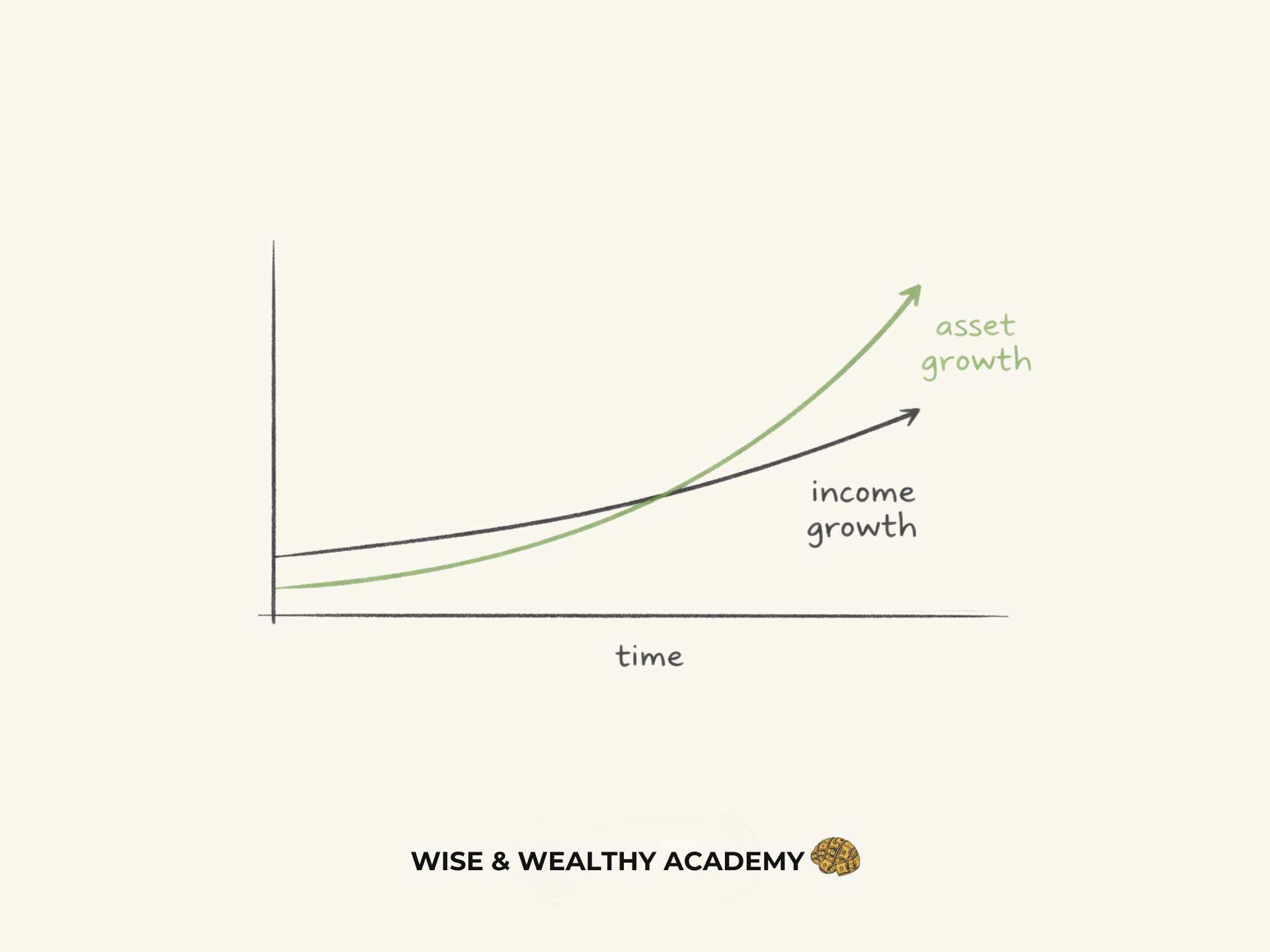
Here’s what I’ve observed over the past six years of building my portfolio: asset growth has consistently outpaced my income growth.
In my earlier years, my career income was the primary driver of my financial progress.
That made sense. I didn’t have a large enough portfolio for compounding to matter much.
But as I earned, saved, and invested consistently, something shifted. My assets started growing faster than my income. The portfolio became the primary engine.
That only happens if you stay in the market.
The people who missed the last five years of growth didn’t miss it because they made bad investment decisions.
They missed it because they were waiting. Waiting for stability. Waiting for certainty. Waiting for the right moment that never arrived.
Right now, with all the uncertainty in the market, most people are doing the same thing again.
Perceived risk is at its highest.
And that is precisely why, historically, forward returns tend to be strong. When most people are afraid to invest, the ones who do are taking on less competition for assets.
Prices reflect fear, not fundamentals. And when fear subsides, those prices correct upward.
The riskiest time to invest, emotionally, is often the most rewarding time to invest, financially.
Is There an AI Bubble?
Honest answer: Probably, in parts.
The spending numbers are staggering. Current AI revenues sit around $20 billion annually.
For that spending to make sense at current valuations, revenues would need to grow to roughly $2 trillion by 2030. A hundred-fold increase. That’s a lot of assumptions baked into a lot of stock prices.
So yes, there is likely a bubble in AI spend. The question is whether that bubble is in the companies building AI infrastructure, or in the companies using AI to generate real revenue.
This is where the internet analogy is useful. In the late 1990s, the bubble was in consumer internet companies. Pets.com. Toys.com. Fun projects with no business model. When the bubble burst, those companies went to zero.
But the companies that survived — Amazon, Google, Apple — went on to become the most valuable businesses in history.
Not by being consumer darlings, but by becoming the infrastructure and productivity layer of the modern economy. B2B. Enterprise software. Hardware. The boring, profitable stuff.
AI is following the same pattern. The consumer-facing AI companies are burning cash and struggling to monetize.
The shift is already happening toward B2B applications, enterprise productivity tools, and infrastructure. The companies that figure out how to make businesses more productive with AI will be the Amazon and Google of this era.
The problem is nobody knows which ones those will be.
Why You Shouldn’t Try to Pick the Winners
This is the part most investors get wrong.
Right now, everyone online has an investment thesis:
Quantum computing
Storage and data infrastructure
Nuclear energy
Space
Optics and semiconductors
Everyone is claiming to build a portfolio around a theme, buying five to ten stocks in a sector they think will win.
Most of them will be wrong.
Not because the thesis is wrong, but because picking the specific winners within a sector is extraordinarily difficult even for professionals with full-time research teams.
My approach is different. I don’t try to pick the winners of the AI era. I bet on the existing companies that will grow because of it.
Those companies are already in the S&P 500 and the Nasdaq 100.
They’re the infrastructure of the global economy. Some of them will lead the AI transition. The ones that don’t will be replaced in the index by the ones that do.
The index self-cleans. You don’t have to.
My Current Strategy
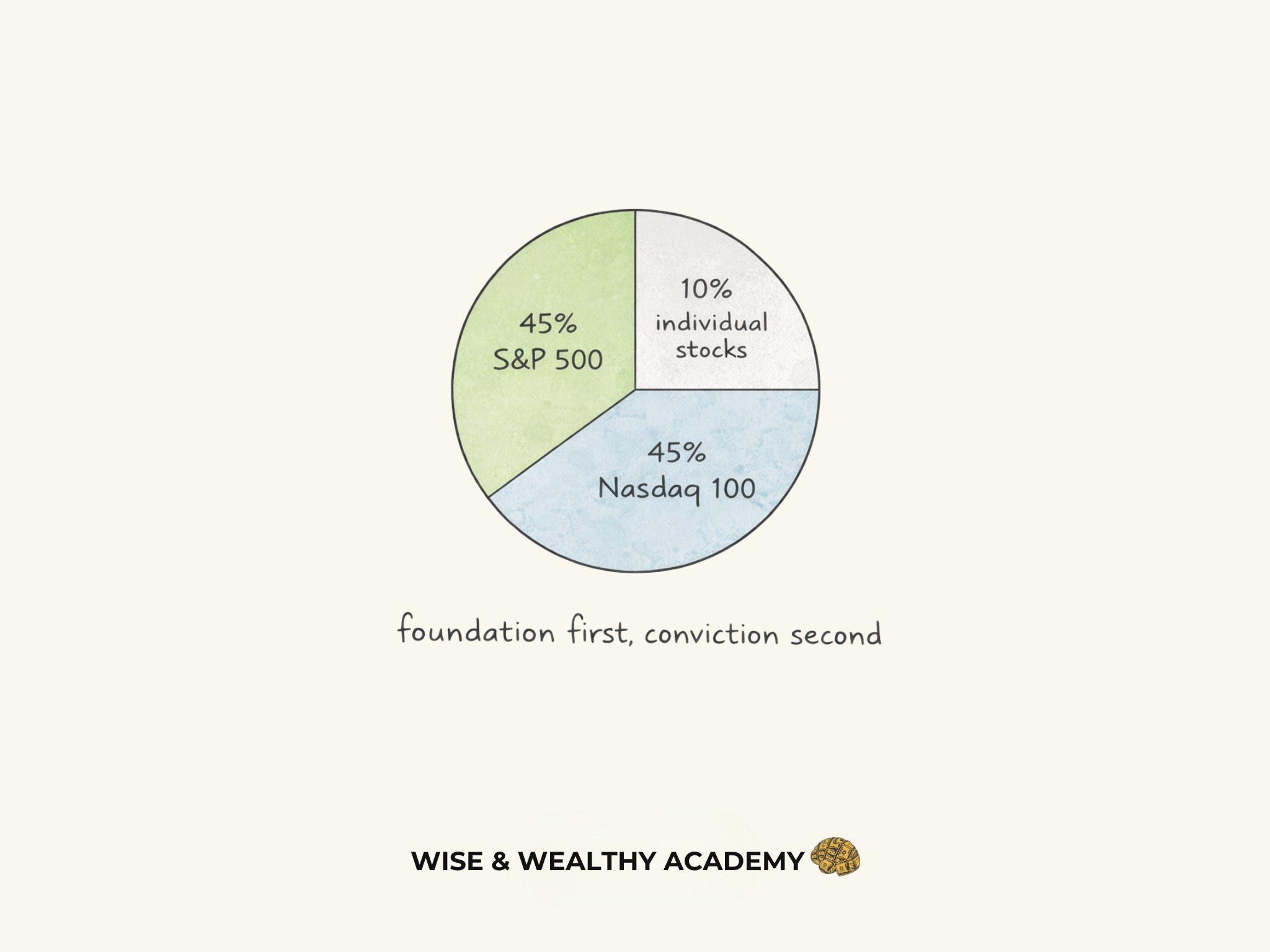
I want to be transparent about how I think about this; not as financial advice, but as an example of how to build a system that fits your personality and your life.
For years, I ran a 90/10 approach:
90% in the S&P 500
10% in individual stocks I had conviction in