


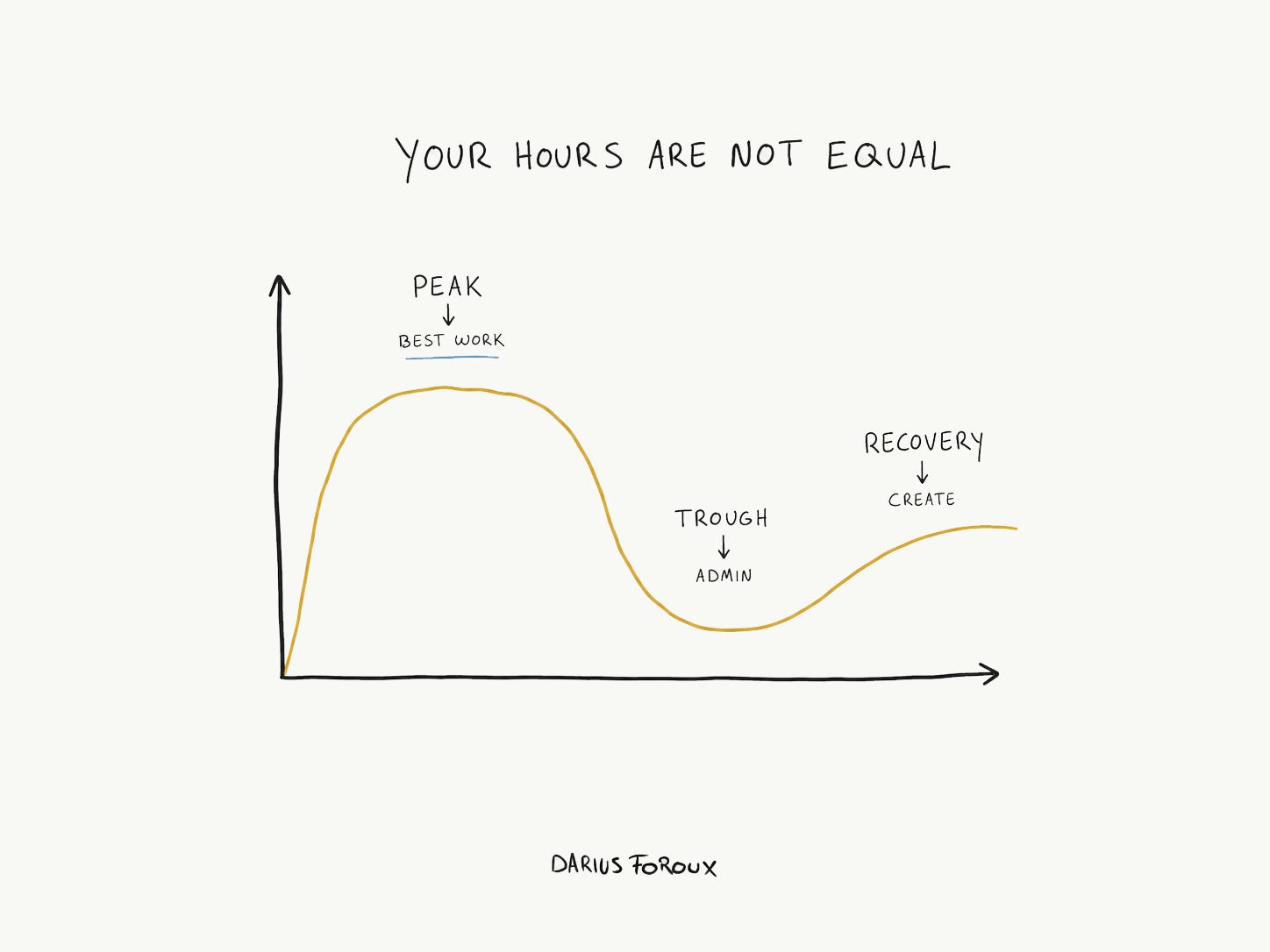
You don’t have eight equally useful hours in a workday. Nobody does.
But most people plan as if they do. They make a list, look for an empty space on the calendar, and put the work there. If the morning fills up with email and meetings, the important task moves to the afternoon. If the afternoon gets busy, it moves to the evening.
Then they sit down at the worst possible time and wonder why the work feels so hard.
I think this is one of the biggest mistakes we make in personal productivity. We pay too much attention to time and not enough attention to the quality of our energy during that time.
Right now, I do my best work in the morning. That fits my current life and responsibilities. I use the later part of the day for routine work and then I recover.
But I haven’t always worked this way. I’ve also had periods when my best work happened in the late afternoon, evening, or even at night. During those periods, I started the day with admin, exercise, or lower-intensity work and saved the difficult work for later.
So I don’t believe everyone should wake up at 5 AM and do their most important work before breakfast. That advice sounds good on social media, but it ignores how people actually live.
You have classes, working hours, meetings, children, exercise, relationships, and a body that doesn’t produce the same level of energy all day. Sometimes you can adapt your responsibilities to your rhythm. Sometimes you need to adapt your rhythm to your responsibilities.
Either way, you need to understand the three windows that shape your day:
Your peak
Your trough
Your recovery
If you don’t get the match right, you’ll always feel like you’re forcing yourself. You’ll feel behind even when you have enough time because you keep using the wrong type of energy for the work in front of you.
And there’s another problem: Many people give the best hour of their day to everybody else.
They use it for email, Slack, meetings, or work that could easily wait. Then they give their own book, business, studies, health, or future the exhausted leftovers.
If that’s you, I want you to change it.
In the rest of this guide, I’ll show you how to identify your peak, trough, and recovery windows, match different types of work to each one, fit the cycle around a job or class schedule, and protect at least one of your best hours for your own future.
If you haven’t upgraded yet, become a paid member to unlock the full guide and the complete Wise & Wealthy Academy archive.