


Do you want to accomplish any one of the goals below?
Start a business.
Get in better shape.
Make money with stocks.
Build an audience online.
Write a book.
Become financially independent.
Most people who want to accomplish something like this start by asking themselves: How do I do this?
Let’s say you want to build an audience.
You go to AI or Google and write: “How to build an audience.”
Then you go looking for the steps. The framework. The success story you can model.
After all, this is what the internet and every self-help book focus on.
Tony Robbins built an empire on the idea that “success leaves clues.” Just find someone who did it, copy what they did, and you’ll get the same result.
“Here are the 5 steps to building a successful YouTube channel.”
“Here’s how I grew my newsletter to 10,000 subscribers on Substack.”
“Here’s the morning routine of a billionaire.”
The problem is that this works for simple, well-defined goals.
Training for a marathon? Sure. Follow the plan. The steps are clear and the outcome is predictable.
But anything creative, anything career-related, anything involving money or building something original?
Mimicking others doesn’t get you there. Because those outcomes depend on context, timing, personality, and judgment that can’t be copied from someone else’s playbook.
There’s a better question to ask first.
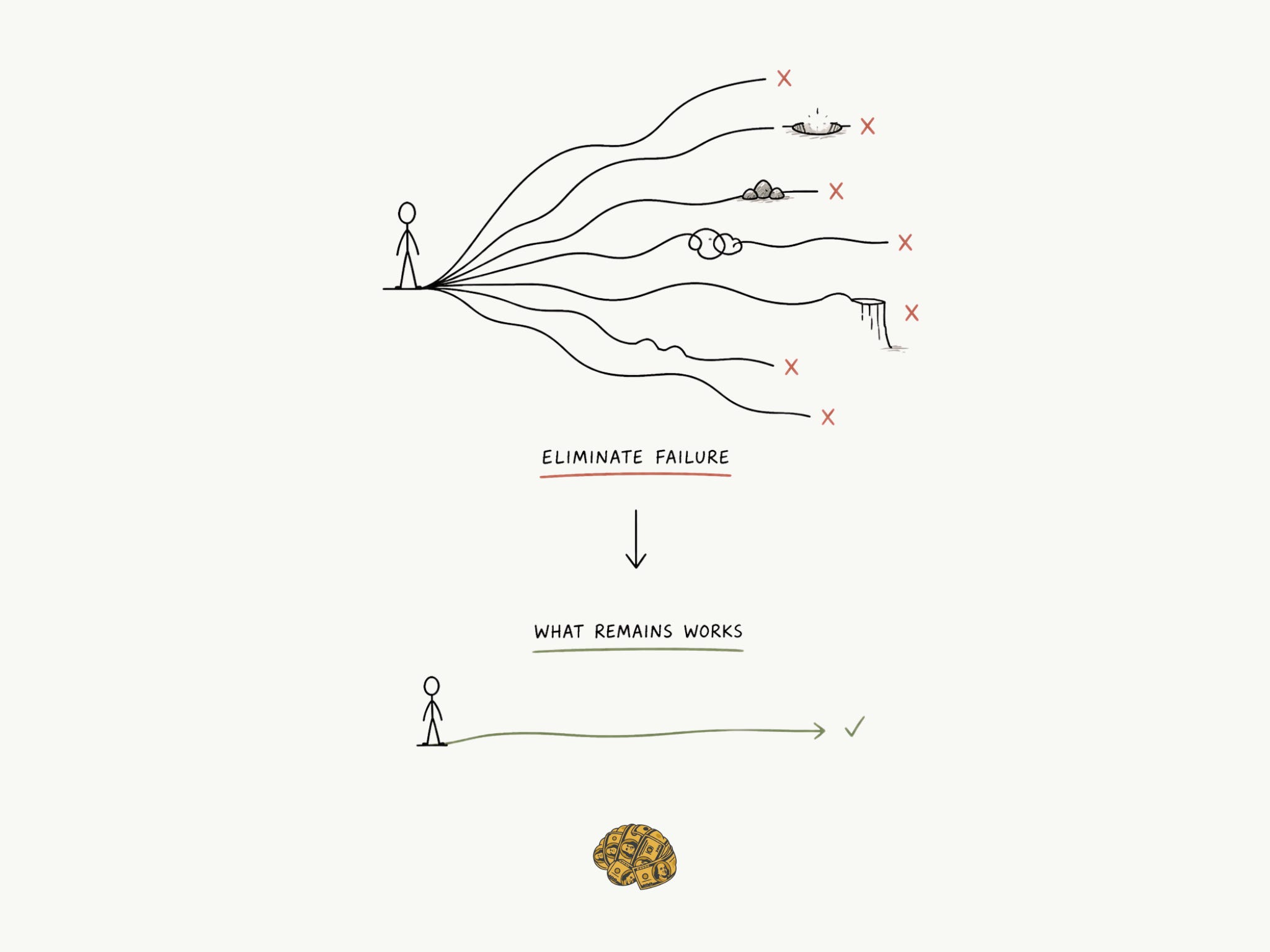
Not “how do I succeed?” but “what would guarantee failure?”
Find those things. Then make sure you never do them.
That’s inversion. And it’s one of the most underused thinking tools available.
Where It Comes From
The idea comes from a 19th-century German mathematician, Carl Jacobi. He discovered that some of the hardest problems in mathematics became easy when you approached them backward.
His rule: “Invert, always invert.”
Charlie Munger, Warren Buffett’s business partner at Berkshire Hathaway, picked this up and applied it to everything. Business, investing, life.
This is what Munger said about his own success:
“It is remarkable how much long-term advantage people like us have gotten by trying to be consistently not stupid, instead of trying to be very intelligent.”
Not trying to be brilliant, but instead just trying not to be stupid.
That’s inversion in practice. You don’t need to know exactly how to win. You need to know clearly how to lose, and then avoid those paths.
Why It Works Better Than Forward Thinking
Forward thinking is optimistic by nature. You imagine the outcome you want and build a plan to get there. That’s fine.
But optimism creates blind spots. You underestimate obstacles. You overestimate your ability to execute. You see what you want to see.
Inversion forces pessimism as a tool. Not as a lifestyle, but as a check. It asks:
What could go wrong? What’s most likely to blow this up? What am I not seeing because I want this to work?
Munger again:
“All I want to know is where I’m going to die, so I’ll never go there.”
That line sounds a bit morbid. But it’s one of the most practical thinking frameworks you’ll ever use.
Know the failure modes. Avoid them. Let the good outcome happen as a result.