


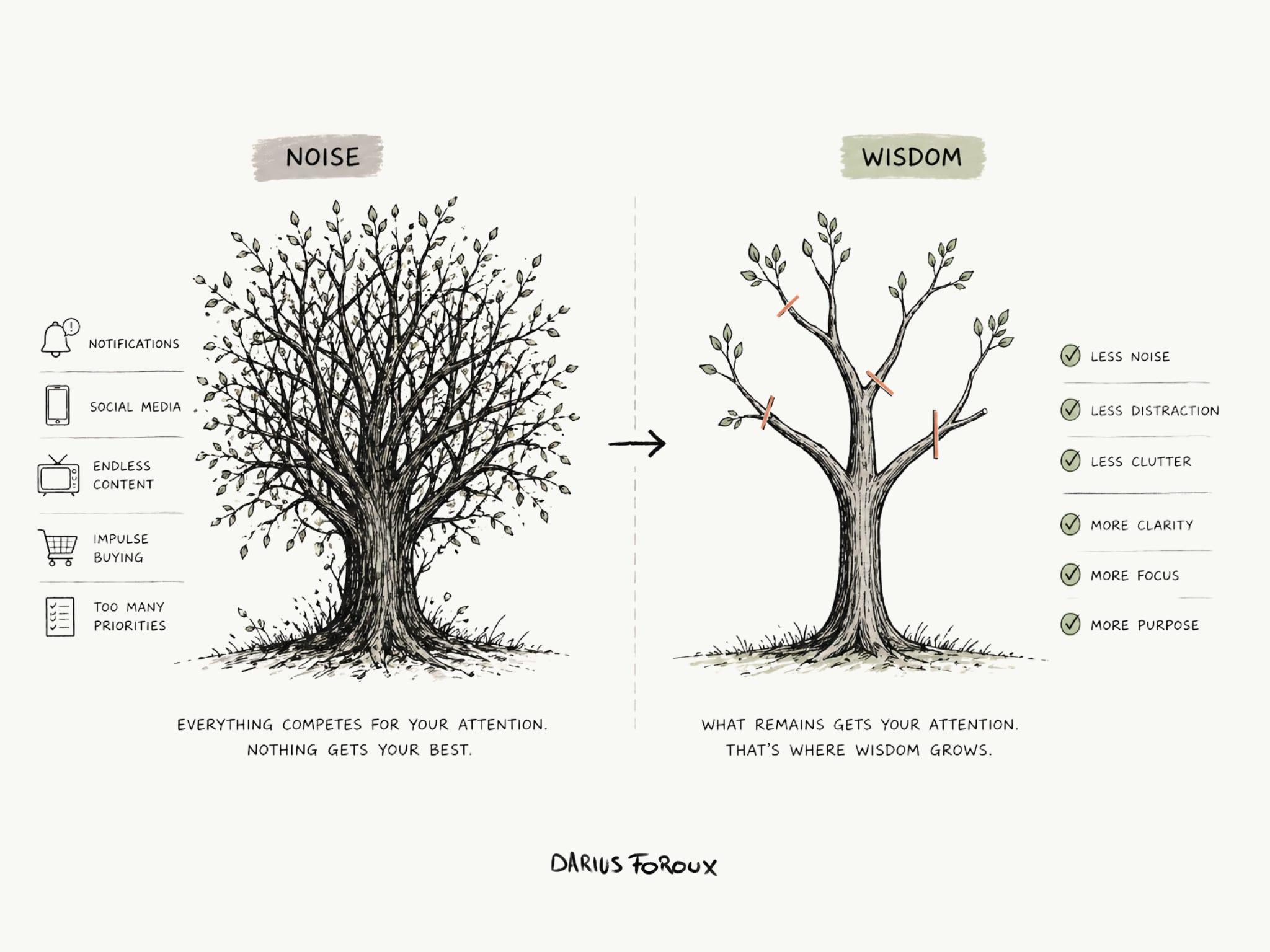
I recently shared an article on the basics of building wealth. A list of fundamentals to come back to when you’re starting out or when you feel stuck.
This is the companion piece. Because as Aristotle said:
“Knowing yourself is the beginning of all wisdom.”
And you can’t truly know yourself if you’re always chasing external things. Wealth without wisdom is just a string of digits in a bank account.
This list is about the other side of the equation.
Wisdom is harder to define than wealth. But you know it when you see it in someone.
They’re calm when others panic. They ask better questions. They don’t chase things that don’t matter. They know who they are.
That’s what this list is about. Not philosophy for its own sake. The practical habits and shifts that actually make you wiser over time.
1. Read old books, not just new ones
New books tell you what’s trending. Old books tell you what’s true. The ideas that have survived for hundreds of years are those tested by reality over and over again. Seneca, Schopenhauer, Aristotle, Epictetus, Montaigne. These people lived in harder times than you and figured things out. Start there.
2. Walk more than you think you need to
Not for better fitness, but for better thinking. Your best ideas don’t come at your desk. They come when you’re moving and not trying. I do some of my clearest thinking on a long walk with no phone, no podcast, nothing. Just moving and letting the mind work.
3. Write your thoughts down every day
Just a blank page and a pen to start the day. Write what’s on your mind. You’ll be surprised by what comes out when you force yourself to put thoughts into words. Writing is thinking. The clarity you’re looking for is often one page away.
4. Learn to sit in silence
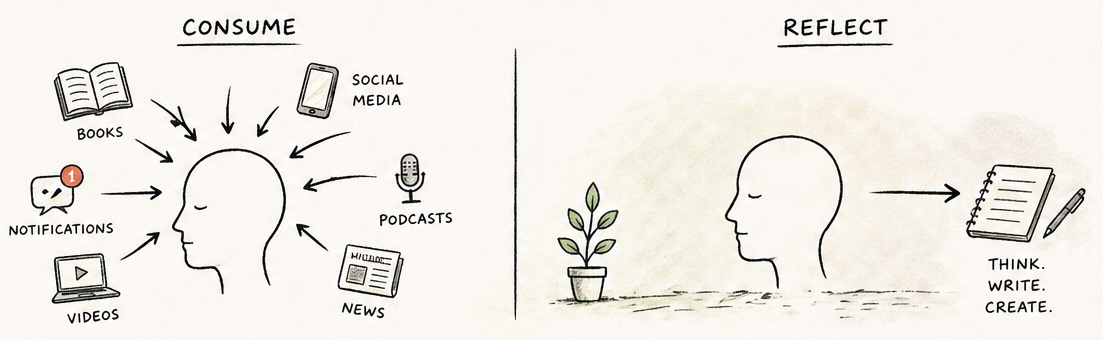
Most people never actually hear themselves think. They fill every gap with noise. Music while working. Podcasts while walking. TV while eating. The mind never gets a chance to settle.
The people who know themselves best have learned to sit with nothing. Try it. It’s uncomfortable at first. That discomfort is exactly the point.
5. Turn off notifications permanently
This is not a productivity tip. The goal is not to boost your focus (while that’s a welcome side effect). The goal is to protect your sanity.
Every notification is someone else’s agenda breaking into yours. Wisdom requires uninterrupted thought. You can’t build it in two-minute fragments between pings.
I’ve turned off notifications for all apps and group chats. Just calls and messages, so I don’t miss anything important.
6. Fix the story you tell about yourself
Your labels are not facts.
“I’m undisciplined, unlucky, not smart enough, too old, too late.”
None of that is fixed. It’s a frame, a story you tell yourself. And frames can be changed. I wrote a full article on this recently. The short version: most of your problems are linguistic, not real. Change the words and the problem often changes with it.
7. Don’t take things for granted
It’s easy to complain about your situation.
I’m too young, and no one takes me seriously.
Work is too busy.
Taking care of a baby is exhausting.
Someday you’d give anything for three minutes of exactly that. Wisdom is seeing the value before it’s gone, not after.
8. Express yourself or fall apart
When you hold back who you are, something suffers. Therapy works because people finally say what they’re actually thinking.
You don’t need a therapist to do that, though. Maybe you just need a journal, an honest conversation, or just the courage to say what you mean. Blocked expression is one of the most underrated causes of feeling stuck and unhappy.
Let it out and then move on.
9. Protect your curiosity like your life depends on it
School, boring jobs, and uninspiring people are all very good at killing it. Wisdom starts with staying curious. Ask questions. Go down rabbit holes. Follow your interest even when it seems useless.
The most interesting people I’ve met never stopped being curious. Most adults stopped somewhere in their twenties and never noticed.
10. Go off the radar regularly
24 to 48 hours without social media, news, or any type of other content consumption (except books and movies). Just immerse yourself in an activity.
Hard to explain what happens when you do this. Your mind starts working again. Ideas come back. You remember what you actually think, separate from what the internet has been telling you to think.
Over the last few years, my wife and I have gone on several long road trips by car. Entire days spent driving. It’s like you live in an alternative universe. You remember every moment of the day. What you talked about, what you ate, what you saw.
When you get back to your routine, you feel refreshed.
11. Embrace spontaneity
Your best memories didn’t come from plans. They came from impulse. The random trip, the unexpected conversation, the night that turned into something you still talk about years later. Wisdom knows when to let go of control.
Not everything needs to be optimized!
12. Minimize everything
The wisest people I know own less, do less, and think about fewer things. Not because they’re lazy.
Because they figured out what actually matters and cut the rest. Complexity is usually a sign that something hasn’t been thought through properly.
Simplicity is a sign of mastery.
13. Replace consumption with real conversation
Next time you go for a walk or get in the car, call someone you care about instead of putting a podcast on. You’ll learn more and feel better.
Connection is not a luxury. It’s part of how wisdom gets built. Other people’s experiences, honestly shared, are one of the fastest ways to learn what you haven’t lived yet.
14. Spend time with older people
The fastest shortcut to wisdom is sitting with someone who’s already made the mistakes you’re about to make.
Most young people ignore older people. That’s one of the most expensive mistakes you can make. Find someone 20 or 30 years ahead of you and ask them what they wish they’d known.
15. Learn to sit with uncertainty
The need to have everything figured out is what keeps most people stuck. They wait for clarity before acting, for certainty before committing, for the right moment before starting.
Wisdom doesn’t come from having all the answers. It comes from getting comfortable not knowing and moving forward anyway.
There’s a reason Socrates, one of the greatest minds in history, said:
“The only true wisdom is in knowing you know nothing.”
He wasn’t being modest. He was making the most important point about wisdom there is.
The moment you think you’ve figured it out, you stop learning. The wisest people I know are also the most curious, the most open, and the most willing to say “I don’t know.”
That’s humility as strength.
These habits won’t make you wise overnight. Nothing does.
But wisdom isn’t a destination. It’s a direction. And every day you practice even one of these, you’re heading the right way.
This is such awesome advice. I'm going to bookmark this particular post so I can come back to it when I need a good reminder. In my own life journey, recently, I've been trying to practice empathetic listening, i.e. to listen without thinking about what I want to say next, what advice I so badly want to give (esp. when it is not asked), judging the person who is speaking, but instead observing, to try and identify the feelings and unmet needs of the other person. I have found it so not easy. So far, the end result of one conversation I had when I am able to wholeheartedly just be present without my own agenda has been good. Yay! Anyway, baby steps. Hope it's ok to share this here - Geri (a retired person who is still learning!)
The only true wisdom is knowing you know nothing.......thank you for this 🙏🏽