


Aristotle once wrote:
“Well begun is half done.”
He was talking about getting the fundamentals right before anything else. The same applies to money.
Here’s something most people don’t think about.
You only have to get rich once.
After that, your job is to protect it and grow it.
That makes wealth building one of the most worthwhile games you can play. Because the rewards of playing it right will last a lifetime.
But building wealth is still a game. And like any game, you have to commit to playing it before you can win it.
Here are the basics.
Come back to this list whenever you feel stuck.
1. Adopt a contrarian mindset
Before any tactics, any investing, any strategies, this comes first.
Building wealth requires a fundamentally different mindset from the people around you.
Most people optimize for the now.
Nice things, nice experiences, looking the part. The person who builds wealth optimizes for later. They make small sacrifices today that compound into big advantages over time.
So if you want to build wealth, you need to adopt a contrarian mindset.
It’s contrarian because the default behavior of most people around you will prevent you from getting wealthy.
When your friends are upgrading their cars, you’re investing.
When everyone is talking about the latest thing to buy, you’re thinking about what to sell. When the market crashes and everyone panics, you’re looking for opportunities.
This isn’t about being cheap or antisocial. It’s about consciously deciding to play a different game. A longer game. A better game.
You have to make building wealth a priority. Not a vague intention. An actual commitment you make to yourself and return to every single day.
2. Keep your burn rate low — always
Everyone knows “spend less than you earn.” Almost nobody does it consistently.
The reason is social. We don’t want to be left behind. We want something to talk about on Monday. The concert, the trip, the new car. That’s how most people live, and it’s hard to opt out of that culture when it surrounds you.
But the people who build wealth simply can’t play that game. At least not in the early stages.
You can do it later, once the foundation is in place. But in the beginning, protecting the gap between what you earn and what you spend is everything.
My burn rate today is higher than it was ten years ago. But my income is proportionally higher.
The gap feels the same. That’s the goal.
As your income grows, resist the urge to grow your spending with it. Always feel like you could upgrade your lifestyle and consciously choose not to.
That gap between income and expenses is where wealth is built. Protect it like your future depends on it. Because it does.
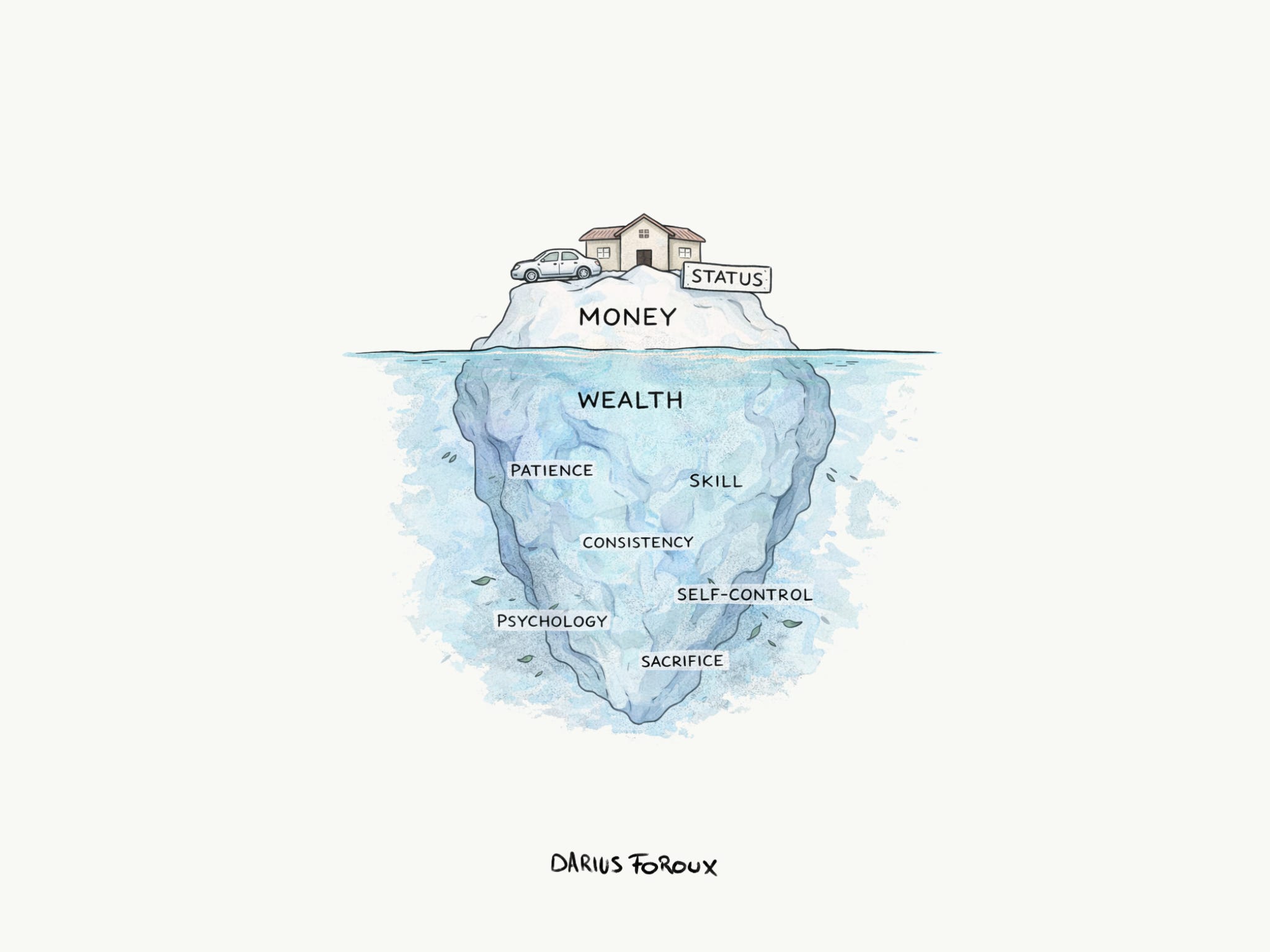
3. Wealth and money are not the same thing
Money is a number. Wealth is freedom and options.
It’s easy to fall into the trap of just optimizing for a higher paycheck. A better salary, a bigger bonus, a fancier title.
None of that is bad. But it’s not the goal. The goal is to build something that gives you real security and real choices.
Always keep the end goal in mind.
You’re not here to earn more. You’re here to build wealth.
4. Invest consistently, not perfectly
Nobody perfectly times the market. Not you, not the experts on TV, not the guy in your group chat who seems very confident.
The people who build real wealth through investing do it by being consistent, not clever.
They invest regularly, reinvest their returns, and leave it alone.
They don’t get distracted by the hot opportunity someone throws in their path.
They don’t chase 1,000% returns.
They stay boring and they stay invested.
Time is the engine. Consistency is the fuel. Everything else is noise.
5. Your biggest wealth enemy is your own mind
Fear, impatience, comparison, and overconfidence. These destroy more wealth than bad investments do.
Almost every financial mistake I’ve made came from emotion, not ignorance.
Buying when I was excited. Selling when I was scared.
Moving away from a strategy because I read something alarming. Every time, the enemy was me.
Fix the psychology first. Everything else is easier after that.
Also, avoid financial media. Especially financial accounts on Twitter and YouTube. Everyone thinks they know everything and is making predictions.
They are very convincing. But rarely right.
Stay focused on the path.
6. You can’t get rich by saving alone
Saving builds the foundation. It’s not the strategy, though.
Money sitting in a savings account loses value to inflation every year. You save so you have something to invest.
The goal is to put money to work so it earns while you sleep.
Save aggressively. But never confuse saving with wealth building. They’re related but different.
7. Don’t fall into the signaling trap
Appearances matter in certain contexts. If you’re a consultant or a lawyer, you need to look the part. That’s just reality. I’m not talking about that.
I also wouldn’t trust a doctor who dresses like a personal trainer.
What I’m talking about is the deeper trap. The one I fell into when I was working at a corporate firm in London.
I spent a lot of money on suits. I thought constantly about buying a Rolex. I didn’t have the money for it, but if I had, I probably would’ve bought it without thinking twice.
That’s the trap.
Spending money to signal that you have money. Expensive bags, luxury brands, things you accumulate to show others you’re doing well. It feels good in the moment.
It’s a wealth killer in the long run.
Here’s the honest question to ask yourself: Do I actually need this, or do I just want it?
The answer is almost always the latter. And wanting something is not a reason to buy it.
Invest the money instead.
8. Build one reliable income stream before chasing multiple
Everyone talks about multiple income streams. Almost nobody talks about mastering one first.
Without a solid foundation, diversification is just a distraction dressed up as a strategy.
I’ve seen people split their focus between five different income ideas and excel at none of them.
Get one thing working well. Then build from there.
9. Delayed gratification is the whole game
Every wealthy person you admire traded short-term pleasure for long-term gain, repeatedly, over years.
Not once. Not occasionally. Consistently, for a long time.
There is no shortcut around this. The sooner you accept it, the sooner you stop looking for one.
I wrote more about the art of delayed gratification if you want to go deeper on this one.
10. Make money from what you’re genuinely good at
This is the one that took me the longest to figure out.
When I was working at our family business in industrial laundry equipment, and then later at a large IT research firm, I could see a path forward. But it felt slow and not really aligned with my strengths.
A corporate career where you aim for a promotion, build your resume, move to another company, and come back. Trying to become a VP someday.
There’s nothing wrong with that path. A lot of people have built real wealth through corporate careers, especially in tech over the last decade.
But it wasn’t for me. I felt like I would never reach my real potential that way.
This is also about fulfilling your potential.
Finding what you’re actually here to do. And then asking the honest question: Is there a profitable path in that direction?
I can’t give you a clean answer to that. Everyone’s situation is different. But the principle is the same.
Get very good at what you do.
The better you get, the more value you create.
The more value you create, the more you will earn.
Don’t look at your current salary. Look at your potential. Ask yourself whether the path you’re on gives you a real chance to reach it.
If you can put yourself in a position where you provide serious value, where you would genuinely be missed if you left, it’s only a matter of time before you build real wealth.
Play the long game. Focus on what you’re good at. Everything else follows from there.
None of this is flashy. No hacks. No shortcuts.
But if you come back to this list every time you feel stuck, you’ll find the answer to most financial problems somewhere in it.
The basics don’t stop being true just because you’ve heard them before.
Your ladder from saving to investing to owning productive assets hits because it removes drama. I use a tiny rule, every raise gets split 50, 30, 20 into index funds, skill stack, and guilt free fun, so lifestyle creep never grabs the wheel. Curious where you place buy back attention costs like childcare or a cleaner, expense or wealth multiplier?
This is where I agree most strongly: The signaling trap may be one of the most dangerous wealth killers because it feels like progress while quietly destroying the foundation. A lot of people (especially younger people) do not want wealth first. They want to be read as wealthy first. The car, the watch, the rentend Miami penthouse, the trips, the restaurants, the upgraded lifestyle. All of it can create the illusion of movement while the actual financial base remains fragile. That is where mindset matters so much! The market is not always the enemy. Income is not always the limitation. Very often, the damage comes from impatience, comparison, ego, and the inability to delay gratification long enough for money to become useful. Wealth requires a certain willingness to look less impressive than you could look today, so you can become much stronger than people realize tomorrow. That used to be not that complicated. Today, however, it is just very hard for people who need constant confirmation from the outside world, especially through social media.