


This is a Wise & Wealthy Academy post. Every week, I publish a new training that focuses on a single idea from one of four areas: clear thinking, personal execution, career antifragility, and investing psychology.
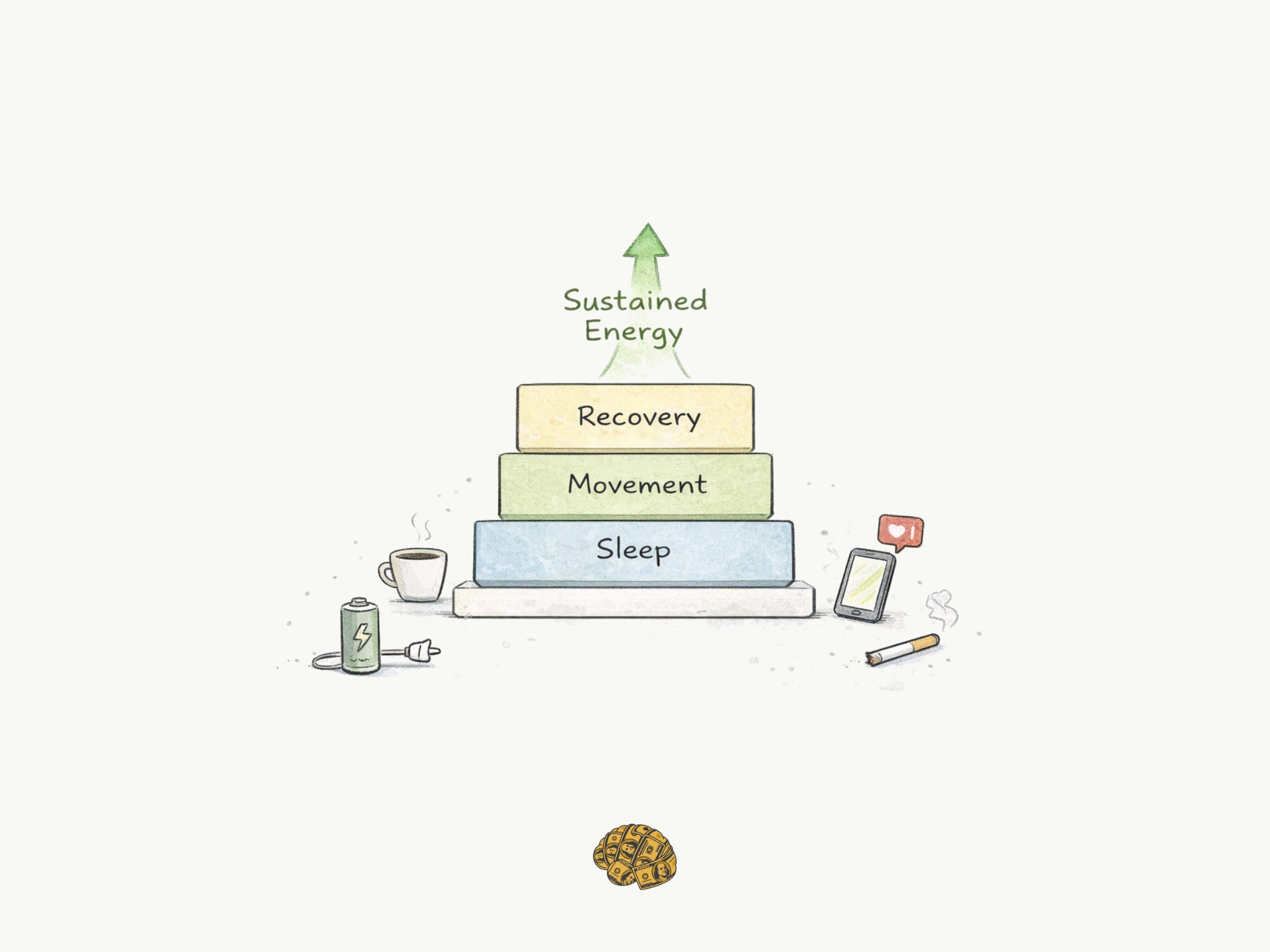
“Manage your energy, not your time.” We’ve heard it thousands of times.
Sleep is the foundation. Stop running on coffee. Take breaks. Protect your mornings.
We all know energy matters. And yet, we’re collectively exhausted.
Over 80% of the global workforce reports lacking the time or energy to do their job effectively, according to Microsoft’s Work Trend Index.
More than half of full-time employees say they feel burned out. In the UK, 91% of adults reported high or extreme levels of stress last year. The numbers are not improving.
Just ask people around you how they’re doing.
Not “how’s work?” but “how are you?”
A large number of them will say some version of “tired.” Not as a complaint. Just as a fact. Like it’s the normal state of being.
Sadly, it is. And that’s the problem.
This isn’t another post telling you sleep is important. Everyone knows that.
This is about why the solutions aren’t working and what you can do to build back your energy.
The Energy Trap
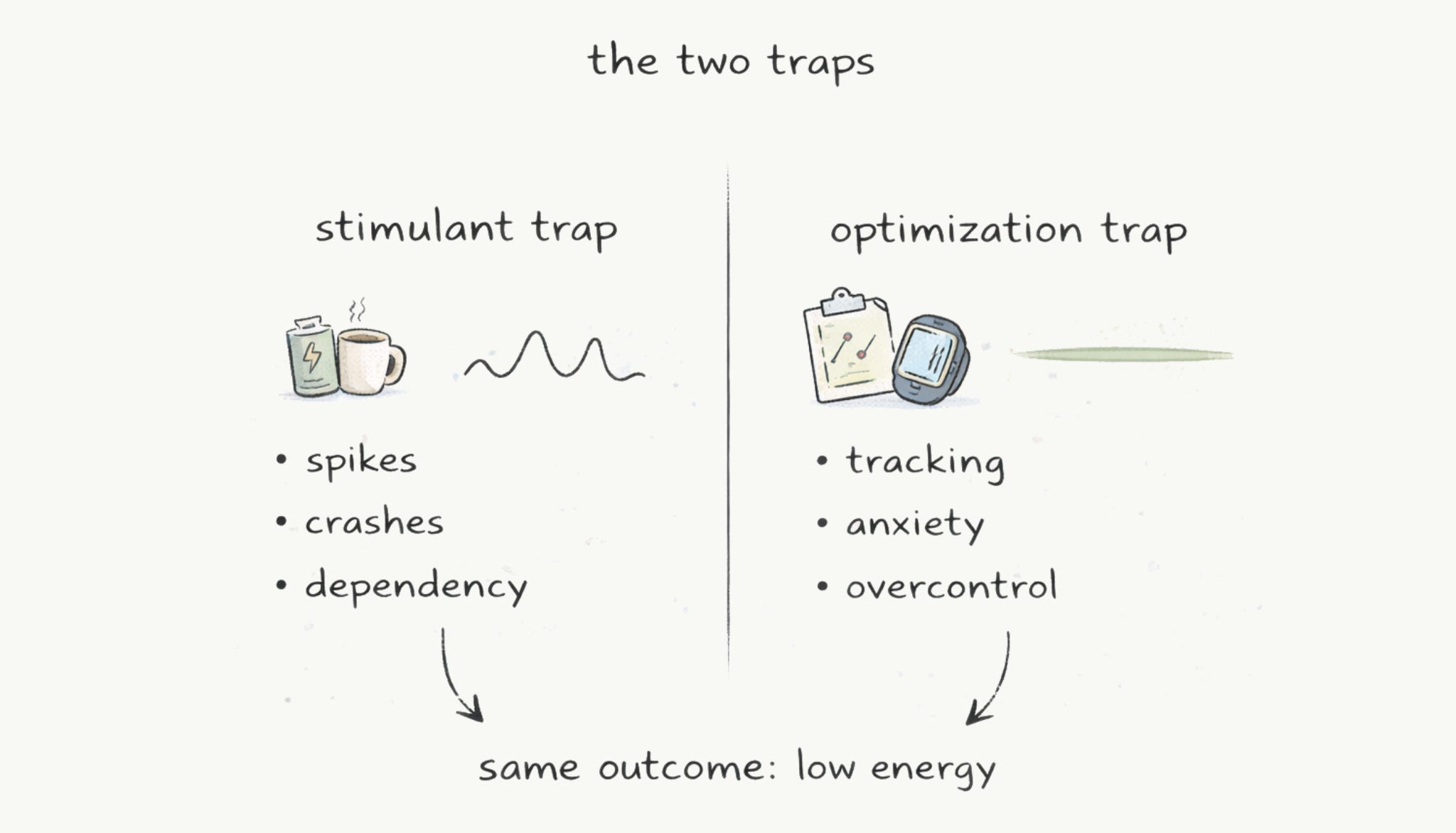
Most people manage their energy the wrong way. They wait until it’s low, then reach for a boost:
Coffee to start the day
Another coffee to get through the afternoon
Nicotine to take the edge off
A dopamine hit from social media when motivation dips
An energy drink before a big task
A motivational video to feel inspired again
It works. For a few hours. Then the crash comes, and they reach for another boost.
This is not energy management. It’s stimulant dependency dressed up as productivity.
The problem isn’t the coffee or the nicotine by themselves. It’s the underlying pattern.
Every artificial spike is followed by a trough. Every trough requires another spike.
Over time you need more stimulus to get the same effect, and your real baseline keeps dropping.
You’re not energized. You’re running in debt.
The Other Extreme
On the opposite end, there’s a growing obsession with optimization:
Cold plunges and ice baths
HRV monitoring every morning
Red light therapy before bed
Sleep scores tracked on a wearable
Supplement stacks timed to the hour
Biometric dashboards to measure everything
There’s nothing wrong with being intentional about health. But optimization culture creates its own trap.
Researchers coined the term orthosomnia for what happens when people obsess over sleep tracking.
They noticed a growing number of patients seeking treatment for self-diagnosed sleep problems, based entirely on what their fitness tracker said. People would lie in bed longer trying to improve their sleep score.
They’d feel anxious before bed, worrying about whether tonight would be a good night on the app.
The obsession with sleep was causing worse sleep than if they’d never tracked at all.
Both extremes share the same mistake. They treat energy as something to be manufactured or engineered rather than protected and naturally replenished.
I’ve stopped tracking my sleep for two years now. And I’m sleeping just fine, if not, even better than when I was tracking it daily.
The Adrenaline Problem Nobody Talks About
A friend of mine left a senior corporate role a few years ago. He’d finally made the jump to work for himself.
A few months ago, I asked how it felt. He said something I haven’t forgotten.
“I’m free, but I still feel like I’m running on a treadmill. Every month feels like the end of the quarter. Every Sunday feels like the night before a big presentation.”
He’d left the job. The job hadn’t left him.
His body was still running on corporate adrenaline. The quarterly pushes, the year-end sprints, the constant performance measurement.
That conditioning doesn’t disappear when you hand in your badge. It lives in your nervous system.
This is more common than people admit. After years of corporate conditioning, your body learns to associate productivity with pressure. You feel guilty when you’re not stressed. Rest feels like falling behind. Calm feels suspicious.
The result: even when the external pressure is gone, you manufacture internal pressure to replace it. And you burn energy on urgency that no longer exists.
Decoupling from this takes time. The first step is recognizing it as conditioning, not reality.
My dad, who’s been a business owner since 2010, still says that he falls back into the trap of when he was working for a boss. Sometimes he just rushes things and gets impatient. Like someone is telling him to be faster.
“It’s because of decades of work stress,” he said.
What Actually Works
The longest-lived, highest-energy populations in the world don’t biohack.
The Blue Zones, Sardinia in Italy, Okinawa in Japan, Ikaria in Greece, are regions where people routinely live to 100 in good health.
Researchers have studied them extensively. Their shared habits are almost insultingly simple:
They walk as part of daily life, not as exercise
They eat mostly plants, simply prepared
They sleep when it’s dark and wake when it’s light
They have strong community and a sense of purpose
They don’t track anything
Only about 20% of how long you live is determined by genetics, according to the Danish Twin Study.
The other 80% is lifestyle. And the lifestyle that produces the most sustained energy isn’t complicated.