


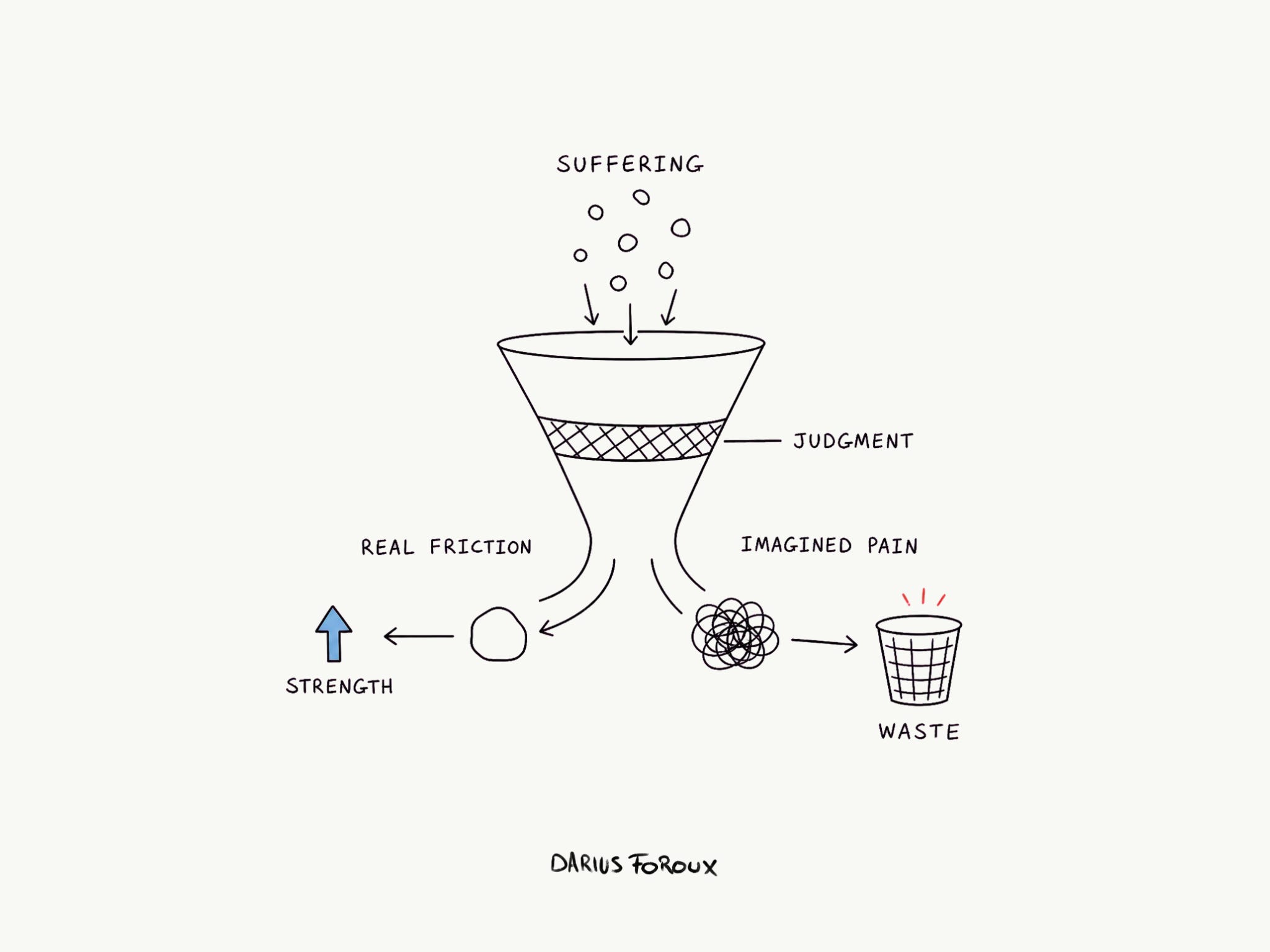
Most of our suffering is useless.
Eckhart Tolle wrote a line in Stillness Speaks that I often think of:
“Suffering is necessary until you realize it is unnecessary.”
He is of course referring to the mental suffering that so many of us go through every day. The constant mental chatter that takes away our attention from the present to the voice that’s never satisfied.
You see, we all want to live a happy and interesting life. We want to feel that we’re in control of our destiny.
We want to enjoy the time we have on this planet.
Isn’t that a weird goal?
It wasn’t that long ago that our species was just focused on survival. We didn’t have time to suffer in imagination.
But that’s the topic of another article.
The truth is that we can have a pretty good life. The thing is, you have to go through a lot of suffering to make that happen.
The two kinds of suffering
There are two kinds of suffering, and they feel identical from the inside.
The first kind is useful. It comes from real friction with the world:
A bad grade
A rejection
A job you can’t stand
A business that isn’t working
These things hurt because there are actual stakes involved. You can’t think them away. You have to go through them. And going through them is exactly what strengthens you.
I have a six-month-old son. And sometimes I look at him and think, “You have a lot of challenges ahead of you!”
In a good way, I mean. Isn’t that the beauty of life? You go through all of these obstacles and you have so much to learn. And every year, you feel like you’re a little bit smarter than before.
That’s the proper way to live.
But most people stop living like that. And that’s caused by another kind of suffering.
The second kind of suffering is 100% useless. This is what Eckhart Tolle was talking about. It’s the low-key suffering that runs in the background of your life:
Doubt
Anxiety without a clear reason
Worrying about mundane things
A lack of self-confidence
I also know that second kind very well. For my entire life, I carried a constant unease with me.
Worrying about my career. Worrying about finding a partner when I was single. I had all these expectations and demands of life, and the gap between where I was and where I thought I should be produced a steady hum of anxiety that never went anywhere.
And even after I built a writing career, it didn’t disappear.
When I’d open registration for a course, I’d judge the whole launch by the first day.
If only a few people signed up, I’d immediately think: “I need to change something. This is going to be a failure.”
By the time the launch closed, it was always fine, and people signed up. All that early judgment produced nothing except a bad mood.
Because I know this type of suffering well and found a way to stop it, I’ve made it my mission in life to help others to do the same.
This is one of my main priorities with my son as he grows up. I want to teach him early on that doubt, failure, and challenges are a normal part of life.
It’s a waste of energy to “suffer more often in imagination than in reality,” as the great Stoic Seneca said.
We need to develop a sense of judgment that helps us to determine what’s useful suffering and what’s not.
Your past doesn’t get to decide
So what if you want to start living life in a different way? You want to stop the excessive worrying. You want to be someone who doesn’t overthink. Someone who takes action and doesn’t let anything stop them.
Well, you can.
What’s stopping you?
“My past,” is what a lot of folks say.
The psychologist Alfred Adler built his entire philosophy around the idea that you are NOT your past.
Through his work, he noticed that a lof of people let a failure get a hold on their soul and replay it for years in their minds. They build their identity around their past.
Where Freud said your past determines who you are, Adler said the opposite: You are driven by your goals, not your history.
Adler wrote:
“No experience is in itself a cause of success or failure. We do not suffer from the shock of our experiences, but instead we make out of them whatever suits our purposes.”
The experience itself doesn’t decide anything. You decide what it means.
Two people can go through the same failure. One uses it as proof they’re not good enough. The other uses it as fuel.
No matter what you’ve been through, you have the power to change.
You have the power to be different and to move forward.
Thank you for the critical reminder. The self-doubt during job search in this environment is paralysing. Also, I recently read "The Courage to be disliked" based on Adlerian Psychology. I recommend it to everyone along with this article...
I have not commented before, but better late than never! Your insights and suggestions for approaching life and the every day challenges are second to none. Thank you for what you do.