


Most people treat a wandering mind like a defect. They see it as a leak in their productivity bucket.
“Time to get back to work.”
“Stop daydreaming.”
We’ve been conditioned to believe that if we aren’t staring at a screen or checking off a to-do list, we are failing.
But Daniel Goleman, the psychologist who popularized Emotional Intelligence, argues the opposite in his book Focus:
“The mind’s wandering is a source of creative ideas... The problem is not that our minds wander; it’s that they wander away from what matters.”
That line matters because it exposes a modern lie: You can’t be “on” all the time.
But when you try to stay “on” 24/7, you don’t actually get more done.
You just become mentally exhausted, less creative, and ironically, unable to focus when it actually counts.
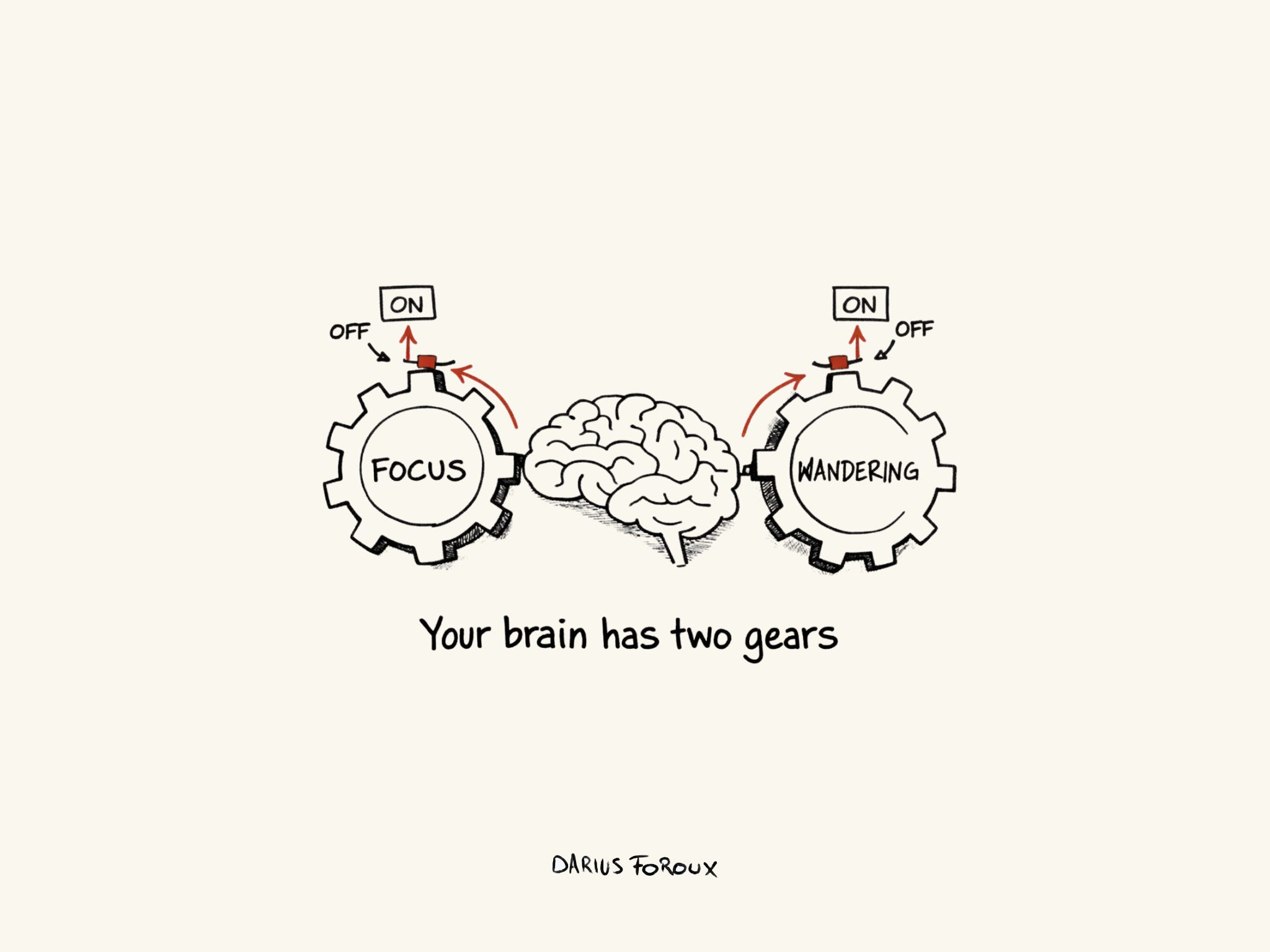
Your brain has two gears
Neuroscience shows us that the brain operates in two primary modes.
The Task-Positive Network (TPN): This is your “focus” gear. It’s active when you’re solving a math problem or writing a report.
The Default Mode Network (DMN): This is your “wandering” gear. It kicks in when you rest, daydream, or reflect on the future.
The DMN is where the magic happens. It’s responsible for “autobiographical planning”—making sense of your life and connecting disparate ideas.
“Time off” is not wasted time. It is integration.
It is the process where your brain stitches together the information you’ve been feeding it. If you never allow that stitching to happen, you get a common modern result: You stay busy all day, but nothing ever “clicks.”
There is a famous Harvard study titled “A Wandering Mind is an Unhappy Mind.” It found that when people’s minds wander, they often report feeling less happy.
Most people use this as an excuse to kill daydreaming. But that’s like saying exercise is bad because your muscles get sore.
The problem isn’t the wandering itself; it’s uncontrolled wandering.
An anxious mind wandering in circles of “what ifs” feels terrible.
But a rested mind wandering freely produces insights. It’s the same behavior, but with different fuel.
One is fueled by stress; the other is fueled by curiosity.
Marcus Aurelius wrote about this nearly 2,000 years ago:
“Nowhere can man find a quieter or more untroubled retreat than in his own soul.”
But Seneca added an important warning. He said, “Leisure without study is death—it is a tomb for the living man.”
The secret is intentional wandering.
Don’t just let your mind drift into the gutter of anxiety. Give it the space to explore the ideas that matter.
The post-pandemic overcorrection
Why are so many of us restless all the time? Why do we feel jittery as soon as we’re wandering for a bit?
I believe that Covid played a huge role in the way our brains have developed over the past few years.
2020 and 2021 were very long. We have a distorted view of the past 6 years.
Yes, it’s six years!
Most countries spent 2 years locked up. and then slowly coming back from 2022, and then by 2023, it was almost normal. But because we were FORCED to do nothing and wander, we don’t want to anymore
I think the majority of the population is stuck in this perpetual state of being “switched on” because we still feel the pain of being switched off.
When the restrictions went away, we wanted to do as many things as we could
And our brains have changed because of that.
We can’t slow down because it reminds us of the dread of 2020 and 2021.
It’s almost like PTSD
I still hear people talk about Covid like it was yesterday. As if they are still scrambling to get the most out of their time before they enter the next lockdown.
By now, people are constantly trying to kill boredom.
But when we kill boredom, we kill the wandering mind.
And when we kill the wandering mind, we kill our ability to innovate.
How to reclaim a more natural rhythm so you can become more productive again
You can’t be focused 24/7 for the same reason you can’t hold a plank for 24/7. Attention is a finite resource.
In psychology, Attention Restoration Theory (ART) suggests that our “directed attention” (the TPN) gets fatigued.
To fix it, we need “soft fascination,” which is environments like nature that hold our attention gently without effort.
If you want better focus, you need more unfocused time. Not “cheap distraction” (social media), but real “off” time.
The goal isn’t to become a monk. The goal is to train the “switch.” You want to be 100% “on” when it’s time to work, and 100% “off” when it’s time to recharge.
Here is how you train that skill:
Reclaim one “dead zone” per day: Pick one activity—walking to your car, waiting for coffee, or the classic example of washing dishes. Do it with zero input. No phone. No music. Just let your mind drift.
The “Blank Walk”: Three times a week, walk for 20 minutes with no audio. It will feel uncomfortable for the first five minutes. That’s the “itch” of digital addiction leaving the body.
Set an “Input Cutoff”: Pick a time (e.g., 8:00 PM) when you stop consuming new information. No news, no podcasts, no “learning.” Your brain needs time to digest what you learned during the day.
Keep a “Wandering Log”: Keep a small notebook or a single note on your phone. When a great idea surfaces during your “off” time, write it down immediately and then go back to wandering.
Today, the ultimate status symbol is being “busy.” We think being reachable and informed 24/7 makes us valuable.
In reality, it just makes us fried.
Wandering is not the enemy of focus. It is the foundation of it. If you want to produce better work, you don’t need more hustle. You need more space.
Your brain does not run on intensity. It runs on rhythm.
“Time you enjoyed wasting is not time wasted”. John Lennon
Great Read. Thank you.