


This is a Wise & Wealthy Academy post. Every week, I publish a new training that focuses on a single idea from one of four areas: Clear thinking, personal execution, career antifragility, and investing psychology.
In business school, everyone tells you the same thing. Specialize.
Pick a field, go deep, become the expert. I believed it completely. My plan was finance. Then I graduated into the aftermath of the financial crisis, and there were no finance jobs. Anywhere.
So in 2010, I started a business with my dad in the industrial laundry industry. And I brought my business school thinking with me. I told him: I’m the marketing guy. That was my strength in school. Don’t bother me with bookkeeping, taxes, or the technical stuff.
That attitude didn’t survive contact with reality.
When you run a small business, there’s no department to hand things to. I had to understand the machines we sold. Read the numbers. Deal with suppliers. Chase invoices.
Slowly, I changed my mind. To actually operate and grow a business, you need to know a bit about everything.
Years later, that range paid off in a way I never expected. When I joined Gartner, a large IT research firm, my broad background meant I could talk to anyone. Sales support, consultants, the VP. That did more for my career than my marketing “specialty” ever did.
For fifty years, the advice was to specialize. AI is about to flip it fast.
I talk more about this in the video below.
The Specialization Era Is Ending
The old career story made sense for the late twentieth century. Industries were stable. Companies rewarded depth. Your competition was other humans, and other humans were slower, fewer, and easier to out-specialize.
That world is gone.
AI is the ultimate specialist. Deep, narrow expertise is exactly what large language models do well. They absorb every paper in your field overnight. They draft contracts, write code, and produce work that ten years ago required a graduate degree.
McKinsey’s 2025 workforce data shows the shift clearly. Demand for AI fluency has grown sevenfold in two years. The skills most exposed to automation are the most specialized: quality control, detail-oriented analysis, narrow programming, structured technical work.
The skills least exposed: leadership, judgment, negotiation, communication. Anything that requires reading a messy situation and making a call.
Notice what those have in common. They aren’t deep in one domain. They’re wide. They draw on people, context, and experience from many.
The Misquoted Phrase
You’ve heard this your whole life: “Jack of all trades, master of none.”
Now, there’s some truth in it. If you hop from skill to skill every other week, you never get good at anything. Dabbling isn’t range.
But the phrase is also one of the most misquoted lines in career advice. The full original saying is: “A jack of all trades is a master of none, but oftentimes better than a master of one.”
Read that twice. The original meaning was the opposite of how we use it today. Being broad was the strength. Modern career advice cut off the second half and inverted the wisdom.
Range Is the Job
Here’s what the specialize-crowd forgets. Most people don’t work in hyper-specialized corporate roles.
Most jobs reward you for having multiple skill sets. And if you want to run a business or lead anything, range isn’t optional. It is the job.
A CEO has to understand finance, strategy, sales, marketing, and people. Not at expert level. At decision level. Because they’re the one who has to decide.
That’s what I learned the hard way in the laundry business. The person who knows a bit about everything sees the whole board. The specialist sees one square.
What the Research Says
David Epstein studied this question across hundreds of professions in his book Range. His finding: in simple, predictable domains, specialists win. In complex, unpredictable domains, generalists outperform.
Most knowledge work is complex and unpredictable. Most of life is too.
The pattern shows up at the highest levels. Researchers Robert and Michele Root-Bernstein studied Nobel Prize winners and found they were 22 times more likely than average scientists to perform, act, or sing in their spare time. Twelve times more likely to write fiction. Seven times more likely to paint.
The people doing the deepest work in narrow fields refused to live narrow lives. Range wasn’t a distraction from depth. It fed it.
Seneca made the same point two thousand years ago in a letter about how a thinker should learn:
“We should follow the example of the bees, who flit about and cull the flowers that are suitable for producing honey, and then arrange and assort in their cells all that they have brought in.”
The bee that visits a hundred flowers makes the honey. So what does this mean for you, today?
It means the detours in your life, the side interests, the unrelated jobs, are not noise on your resume. They’re ingredients.
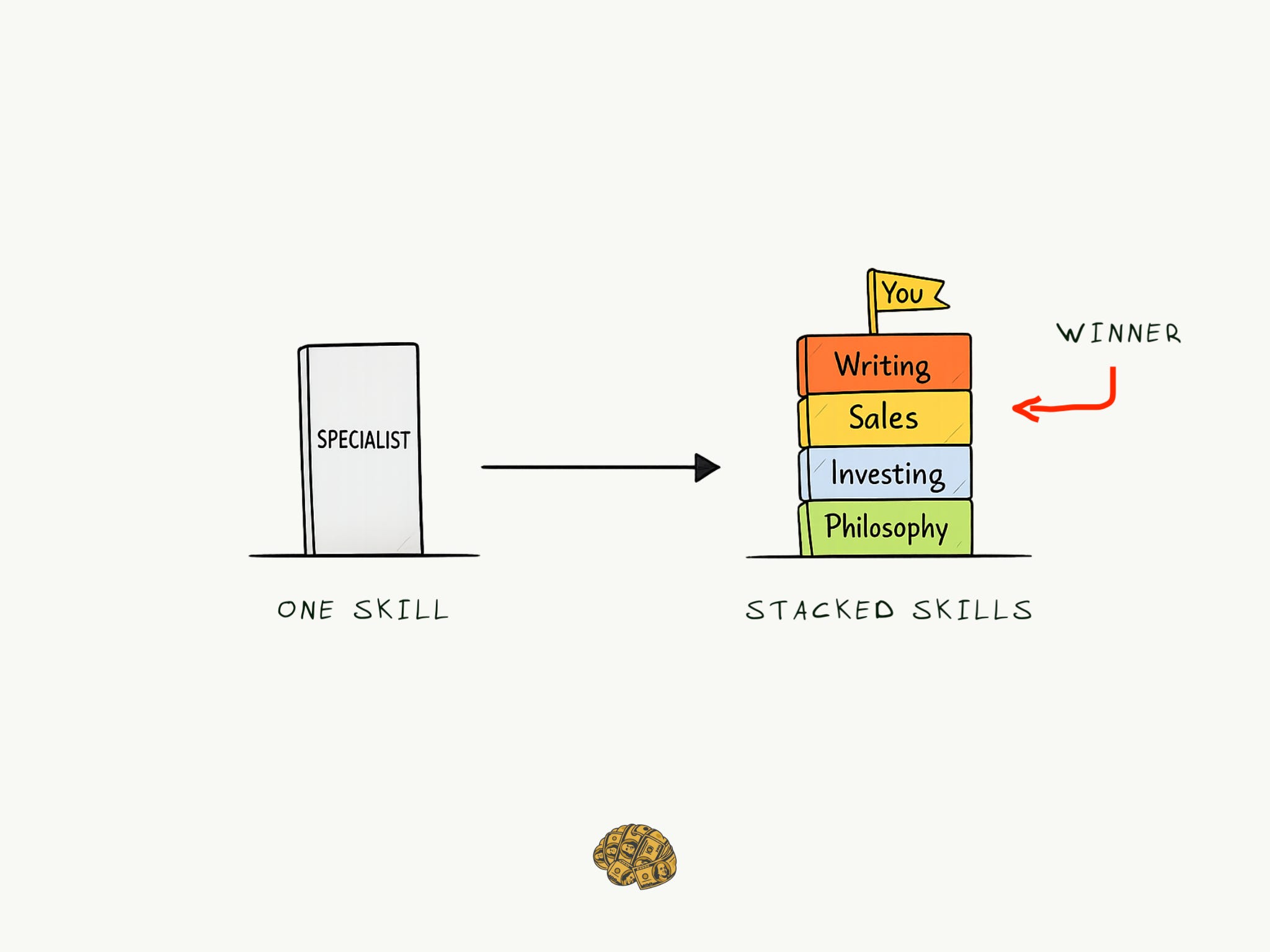
Enter: The Skill Stack.
