


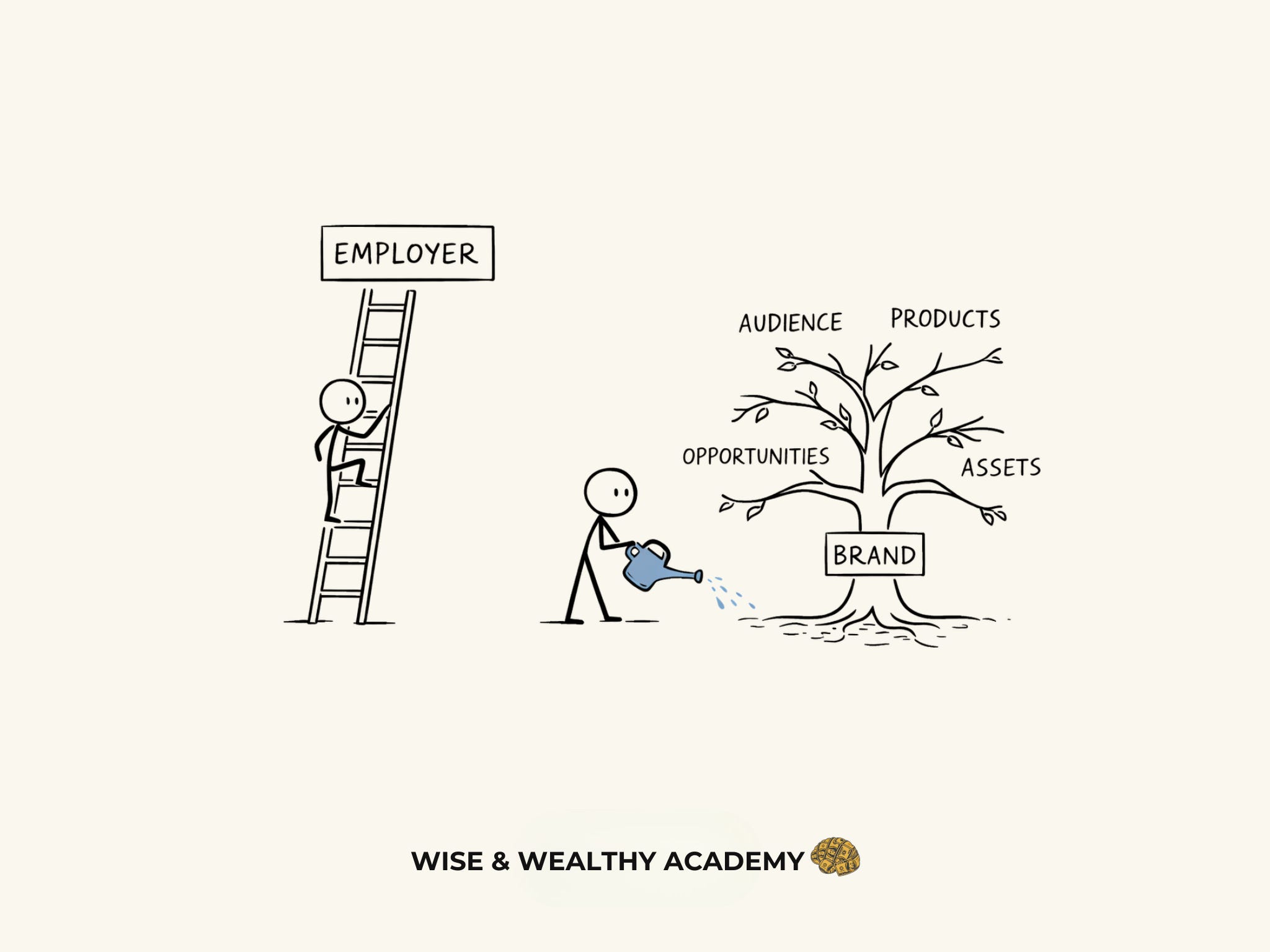
For decades, the formula was simple.
Get a good education. Land a stable job. Work hard. Get promoted. Save and invest.
For a long time, it worked well.
But something has shifted in recent years.
The top 1% of Americans now hold 31.7% of all U.S. wealth, the highest share since the Federal Reserve started tracking it in 1989.
Collectively, that group holds roughly as much wealth as the bottom 90% combined.
Meanwhile, wage growth for lower- and middle-income workers in 2025 ranged from 1.1% to 1.5%. For higher-income workers, it ran at 3%.
The wealth gap is widening.
But it’s important to remember that income is not the same as wealth.
A salary gives you money. Assets give you leverage.
And right now, the divide between people with leverage and people without it is accelerating faster than at any point in recent history.
The Income Trap
If your income depends entirely on your time, you are fragile. Even if the income is high.
Your time is finite.
Your income stops when you stop working.
And in a world where AI is restructuring entire industries, where layoffs jumped more than 50% in 2025, and where no job is as permanent as it once felt, a single income source is a single point of failure.
Most people respond to this by working harder, negotiating a higher salary, or switching jobs. All reasonable moves. But none of them changes the underlying structure.
Most of us are still trading time every single month.
And most still depend on one employer, who has the power to decide to keep you around.
The question worth asking is not “how do I earn more?”
It’s “how do I build something that works beyond my time?”
The Real Divide
The economy has always had rich and poor. Think about the Pareto Principle, or the 80/20 rule, which states that roughly 80% of outcomes (results) come from 20% of causes (inputs).
This concept was first described in 1896 by the Italian economist Vilfredo Pareto, who observed that 80% of Italy's land was owned by 20% of the population.
That was 130 years ago!
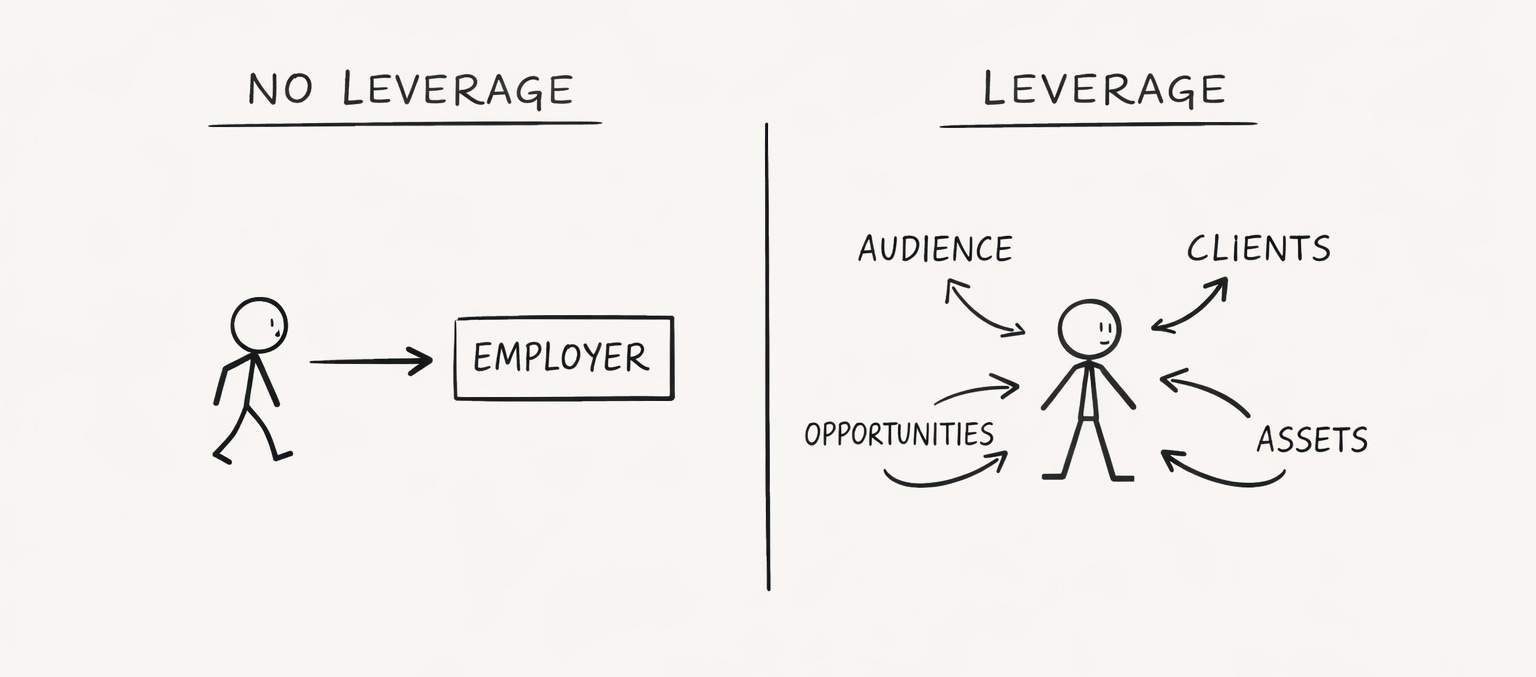
The divide today is no longer simply rich versus poor. It’s leverage versus no leverage.
People with leverage own assets, build systems, reach audiences, and scale beyond their own hours.
People without leverage trade time for money and depend on a paycheck. One side compounds. The other resets every month.
Technology has widened this gap dramatically. AI is widening it further. The people who benefit most from these shifts are not necessarily the most skilled or the hardest-working.
They’re the ones who built distribution, ownership, and credibility before the disruption arrived.
Why a Personal Brand Is Not What You Think
When most people hear “personal brand” they think about posting on LinkedIn, growing followers, and performing for an audience.
They find it uncomfortable (to be honest, I also don’t like the term personal brand, but I do think the underlying idea is very important).
A personal brand feels self-promotional, shallow, and pointless.
That framing is wrong.
A genuine personal brand is not about attention. It’s about distribution. And distribution is leverage.
Distribution means you can reach people directly, without asking permission from an employer, a publisher, or a platform’s algorithm.
When you have distribution, you can launch products, share ideas, attract opportunities, and build assets independently. Without distribution, you wait for someone else to give you a platform.
This is why personal brands matter more than ever.
Not because social media is popular, but because distribution used to be scarce and expensive. A TV channel, a publishing deal, a column in a newspaper. Now it’s (still) accessible to anyone with something real to say.
The data support that.
47% of employers won’t interview candidates they can’t find online.
85% of hiring managers say a strong personal brand influences their hiring decision.
Note: For sources, check the footnotes section of this post.
Professionals with recognized personal brands earn, on average, 25% more than their peers.
These numbers aren’t about vanity metrics. They’re about perceived credibility and trust at scale.
Ultimately, a personal brand is a reputation system.
What Actually Works
Most personal branding advice is wrong because it focuses on tactics: post more, grow faster, optimize for reach.
The people who build lasting personal brands do something different. They think about depth, not volume.
Here is what actually matters:
1. Develop original ideas. Most people simply share what they read. A personal brand with real authority is built on original thinking.
Not because you’re smarter than everyone else, but because you’ve done the work of developing your own perspective.
If you’re just curating other people’s ideas, you’re invisible in a sea of curators.
