


Here’s something I’ve noticed about my own behavior. And I don’t necessarily like it.
When I’m in a meeting or a conversation, I drift the moment things go on too long without something interesting. My mind wanders. My hand moves toward my phone. And I catch myself thinking: wait, what did they just say?
Have you felt this too?
I think it’s because of how we’ve been conditioned. Everything we consume has been optimized to hold our attention. TV shows, movies, social media, websites; all of it engineered for dopamine hits. Short, sharp, immediately rewarding.
No wonder we reach for our phones the second something gets slow or unclear.
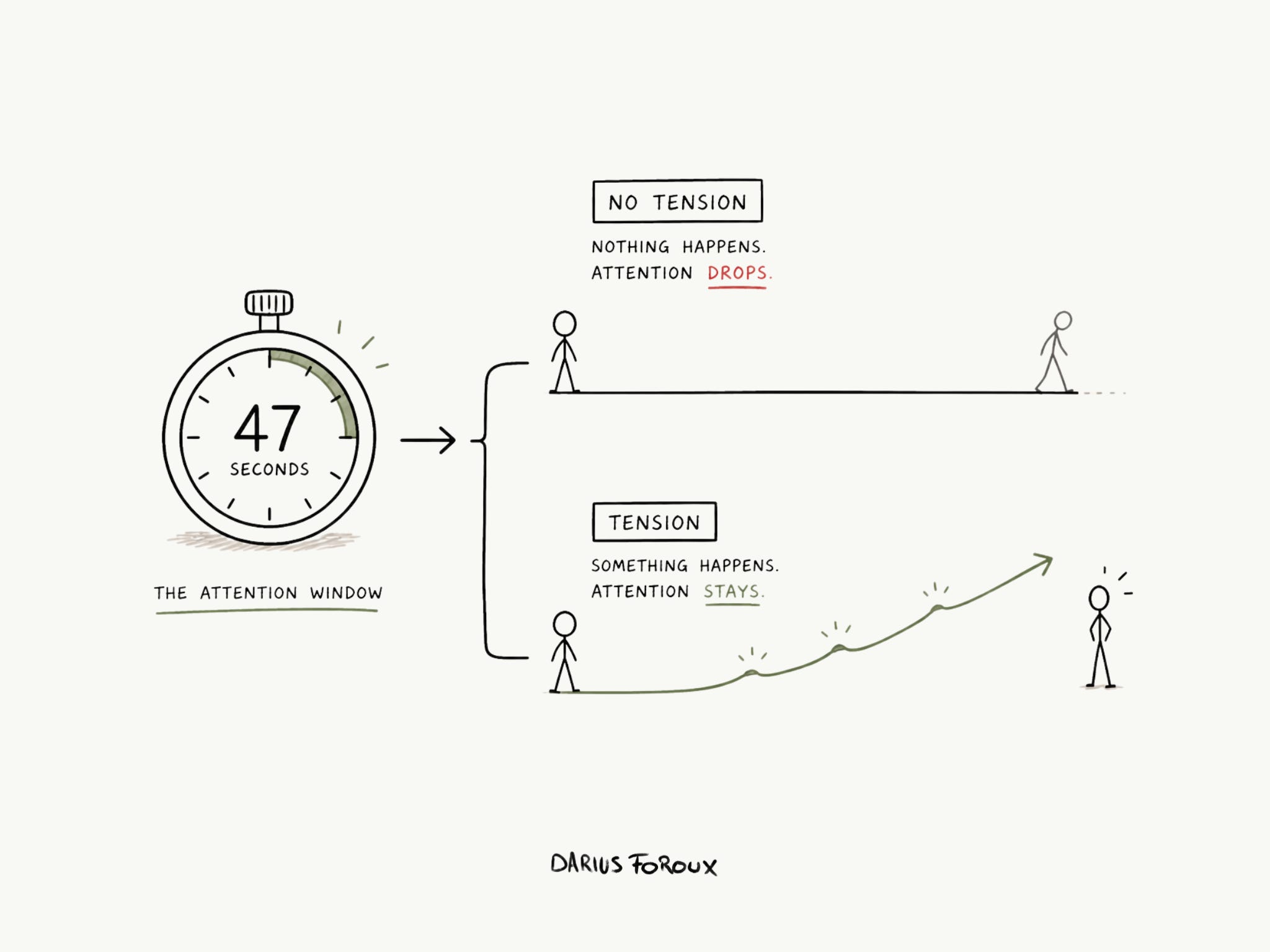
The research backs this up. Two decades ago, the average time someone stayed focused on a single task was around two and a half minutes. Today that number has dropped to 47 seconds.
47 seconds.
That’s what you’re working with.
I recently wrote an article about how to express yourself clearly, and a reader left a comment asking for more depth on one specific part; how to keep people engaged in the middle of a story.
That was a good observation because getting attention is one problem. Keeping it is a completely different one.
The myth that got it wrong
Before we go further, let’s kill a number you’ve probably heard.
The 8-second attention span. Shorter than a goldfish. You’ve seen it quoted everywhere.
It’s fabricated. A 2015 Microsoft report cited a data source that didn’t exist. No peer-reviewed research supports it.
The goldfish comparison was invented too. And yet it spread because it felt true and made a good headline.
The real number, 47 seconds, comes from Gloria Mark, a professor at UC Irvine who spent twenty years tracking attention using actual computer logging software.
But here’s the important nuance.
Those 47 seconds measure screen behavior.
How long do people stay on a digital task before switching? In a face-to-face conversation, you have more time than that. People can’t click away from you. They’re physically present.
The problem is their mind can still leave. And it does. Fast.
The real issue: New conditioning
This isn’t about intelligence or rudeness. It’s about rewired reflexes.
We’ve spent years training ourselves on content that never lets us get bored.
Netflix starts the next episode before you’ve decided if you want to watch it. Instagram refreshes the moment you reach the bottom.
TikTok serves a new video before you’ve finished the last one.
The result is a reflex.
The moment something feels slow, unclear, or pointless, the hand moves. It’s not a conscious decision. Your brain has been trained to expect stimulation at a certain pace, and when that pace drops, it goes looking elsewhere.
You’re not competing with the person in front of you. You’re competing with everything in their pocket.
That changes what it means to manage your attention.
What this means for you
If you want to be heard, you have to earn attention fast and then keep earning it.
In that article on expressing yourself, I introduced a simple framework: setup, buildup, payoff. Most people understand the setup and the payoff instinctively. The buildup is where they lose the room.
Here’s how the timing works in practice:
Setup: As short as possible. Set the scene. One or two sentences for a quick conversation, maybe a bit longer for a complex story. The rule is simple: give the minimum context needed to make the buildup land. Nothing more. The moment you add details that aren’t necessary, you’re spending attention you haven’t earned yet.
Buildup: Starts immediately. This is where tension needs to appear. Before 47 seconds are up, the listener must feel something unresolved. A question. A problem not yet solved. A decision is still hanging. If they don’t feel it by then, you’ve lost them.
Payoff: Earned, not rushed. Once the tension is built, deliver the point. Now it actually lands.
The setup is easy. The payoff is obvious. The buildup is the skill.
The buildup: What it is and how to do it
Tension.
That’s it. Not drama.
Just something unresolved that keeps the listener from leaving.
You’re controlling the pace at which they get the answer. The moment they feel like they already know where this is going, their attention is gone.
Here’s what it looks like in practice.
Example 1: Personal conversation
Without buildup: “I had a difficult conversation with my boss last week. It went fine in the end.”
Done. Nothing to hold onto. The listener nods and moves on.
With buildup: “I had a difficult conversation with my boss last week. I’d been putting it off for two months. Every time I thought about bringing it up, I convinced myself it could wait one more week. Then something happened that made waiting impossible.”
Same story. The listener is now leaning in. What happened? What did you say? How did it go?
You haven’t added new information. You’ve just left something unresolved. That’s the whole trick.
Example 2: Work setting
Without buildup: “We tried a new approach with the client, and it worked.”
With buildup: “We tried something with this client, I was genuinely not sure would work. We’d already failed twice with the standard approach. The team wasn’t convinced. We were out of options.”
Same ending. Completely different level of engagement. The buildup makes the payoff feel earned.
What kills the buildup:
Giving away the ending too early. “So this is actually a funny story,” or “it all worked out fine.” The moment you signal the outcome, tension is gone. Let them wonder.
Adding irrelevant details. If a detail doesn’t raise the stakes or deepen the uncertainty, cut it. Every unnecessary sentence burns attention you don’t have.
Going too slow. The tension needs to be felt before 47 seconds runs out. If you’re still warming up at 45 seconds, you’ve already lost them.
A simple way to practice:
Before you tell any story, ask yourself one question: what is the moment of maximum uncertainty?
Find it. Build toward it. That’s your buildup.
In a meeting, name the problem before you give the solution
In a conversation: hold the punchline one beat longer than feels comfortable
In a presentation, open with what’s at stake before explaining what you did
The listener doesn’t need more information. They need a reason to stay.
The good news
Most people are terrible at this. They ramble. They bury the point. They over-explain. They assume the listener will stay out of politeness.
That means the bar to stand out is low.
If you open strong, create tension early, and get to your point without unnecessary detours, you will be the person in the room people actually listen to.
Not because you’re a gifted speaker. But because you respected their attention enough to earn it.
In a world of 47-second attention spans, that’s a rare thing.
And rare things get noticed.
This is such an interesting take on attention span. It’s like reading a book, if you can already tell how it ends, it doesn’t make it as interesting to read or continue.
I kept mine at 5 seconds, I such stake undoubtedly highm