


Welcome to the Wise & Wealthy Academy series. Every week, I publish a new training that focuses on a single idea from one of four areas: clear thinking, personal execution, career antifragility, and investing psychology.
The last time many of us felt this level of uncertainty was March 2020.
The world had just locked down. Nobody knew what was coming. Markets were crashing. People were panic-buying toilet paper and other supplies.
Every decision, whether that was personal, professional, or financial, felt like it was made in the dark.
Six years later, we’re dealing with three major forces hitting at the same time:
Unemployment is rising globally as companies restructure around AI.
Geopolitical instability is at its highest in decades. We currently have the most active military conflicts worldwide since World War II.
AI is threatening our sense of purpose. If you’ve seen the videos of software engineers and developers questioning their entire career, wondering if what they spent years building still matters, you know what I mean. That’s coming for all of us.
When this much pressure hits at once, most people do the same thing.
They freeze.
Why Your Brain Shuts Down
We’ve all heard of the fight or flight response, the threat response your nervous system activates when you’re in danger.
In physical danger, it works perfectly. Your body floods with adrenaline, your focus narrows, and you act.
But modern threats don’t look like physical danger. They look like a notification, email, or text message.
An industry shifting overnight.
A career path that’s suddenly unclear.
News about a war breaking out.
The stock market dropping 3% in one day.
Your nervous system can’t tell the difference. It reads uncertainty as a threat and responds the same way.
Except in modern life, flight doesn’t mean running. It means avoiding the decision.
It shows up as waiting, scrolling the news, and getting into a passive mindset.
Gathering more information that doesn’t actually help. Talking it over with one more person. Postponing until there’s more clarity, which never comes.
Psychologists call it analysis paralysis. The more inputs you have, the more your brain struggles to process them.
And right now, the inputs are endless. Every platform is screaming something different about where the world is going. So you consume more, decide less, and the window keeps moving.
This is the real problem. Not the uncertainty itself but the paralysis it creates.
I share more about this in the video below:
The Research Nobody Talks About
Psychologist Tom Gilovich at Cornell studied what people actually regret over the course of their lives.
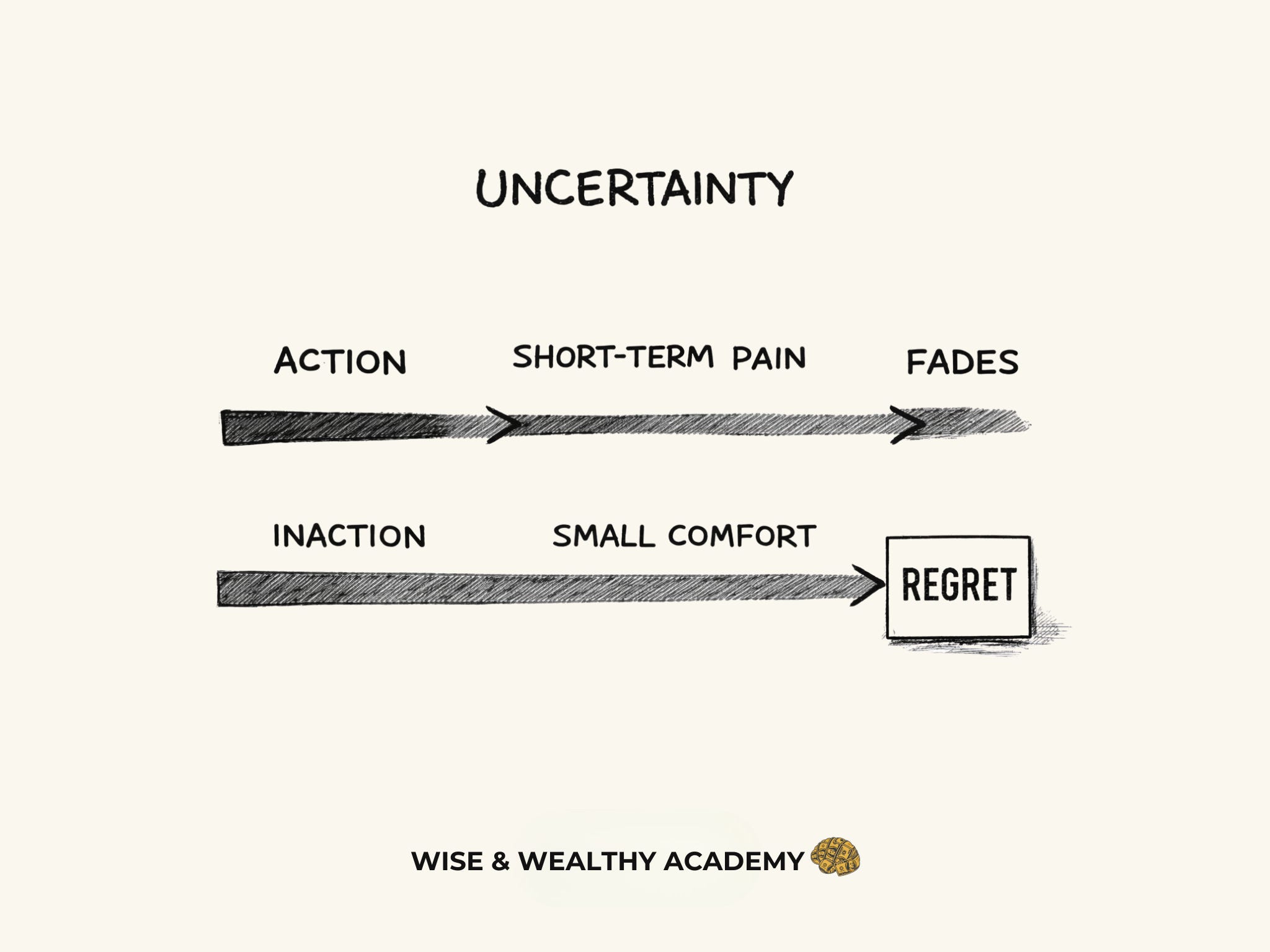
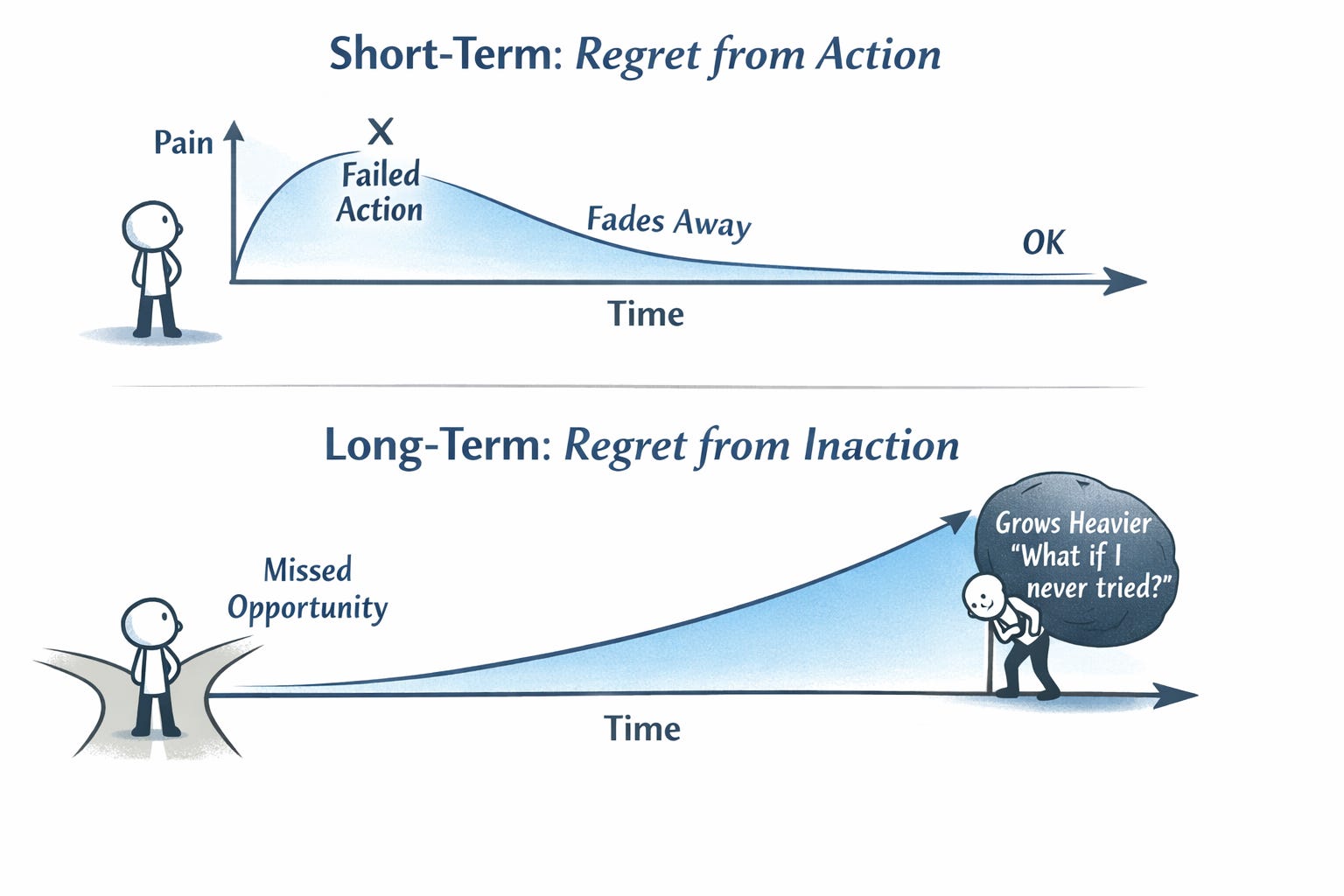
Short-term, you regret actions more than inactions. The thing you tried that didn’t work. The bet that went wrong. The move that looked bold and failed.
But in the long run, the pattern completely reverses. The regrets that stay with you, the ones you carry into old age, are almost always inactions.
The business you never started.
The career shift you kept deferring.
The version of yourself you kept putting off until things settled down.
Things never settled down. What are we waiting for?
Right now, with entire industries being restructured, the people who wait for stability before making a move are also making a choice.
They are deciding to wait.
They’re just not calling it that. They call it patience or just a blip. “Things well calm down.”
But how do we know?
The odds are higher that in five years from now, they’ll feel it in a way that’s harder to explain than a failed attempt.
That’s why I always remind myself of this:
Short-term, action stings.
Long-term, inaction haunts.
Most people are optimizing for the wrong kind of regret.
The Question That Cuts Through It
In 1994, Jeff Bezos had a secure job at a hedge fund in New York. He wanted to leave and build an online bookstore. His boss told him to think it over for 48 hours.
Bezos kept his decision-making process simple. He asked one question: “When I’m 80, which decision will I regret more?”
He realized he wouldn’t regret trying and failing. He might regret never trying at all.
That question works because it forces you to use the right time horizon. When you’re in the middle of uncertainty, your brain operates at close range.
Your reputation right now.
What your colleagues will think.
The things that you’re giving up to try something new.
The 80-year view strips all of that away and shows you what actually matters.
Apply it to what you’re sitting on right now. The career move you’re unsure about. The side project you keep meaning to start. The financial decision you’ve been delaying.
From age 80, most of these won’t be close calls.
The Protocol: What to Actually Do
Clarity in uncertain times doesn’t come from more information. It comes from a stronger foundation. Here’s what to focus on.