


A reader recently asked me this to write about balance:
“I’d like to read your takes on how to balance the tendency of slow living or the one-thing-at-a-time approach to life and staying current in the fast-paced world.
Moreover, how to balance honoring decisions to slow down and also not fall into irrelevance, especially when you’re pursuing professional goals or passion projects you’d like to flourish.”
I had a similar conversation with a friend who runs his own business. He told me, “Man, I’m so inconsistent.”
He kept feeling that he should do more.
His wife finally asked him to stop for a moment and look at his results so far this year. When he checked, he realized he was outperforming last year on all of his goals and targets.
So why did he still feel behind?
His perception had little connection to his actual progress. And I recognize this pattern in my own work too.
When you’re ambitious, your mind keeps moving the finish line.
Even when things are going well, you still hear the same thought: I should be doing more.
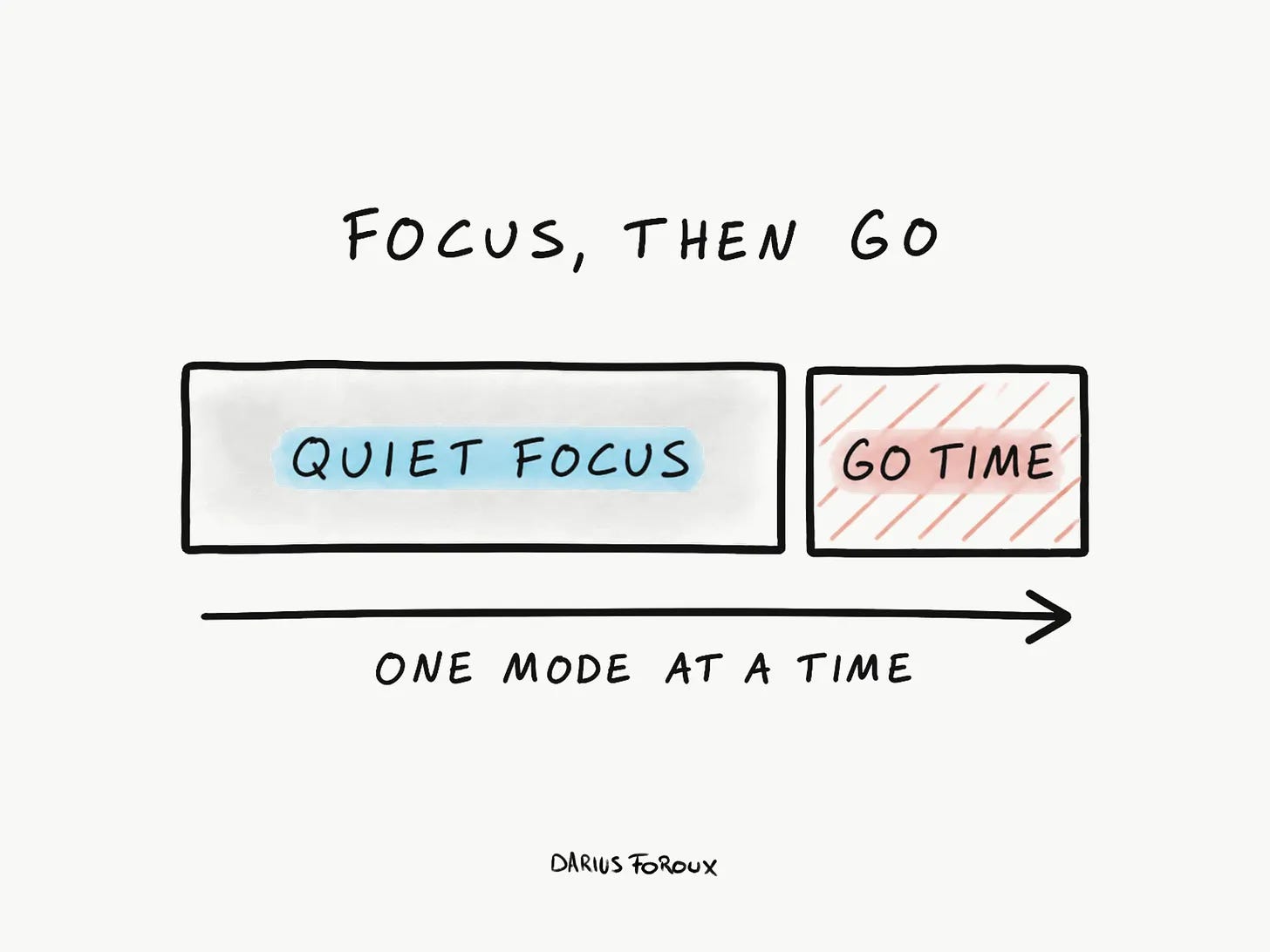
You can’t be in go time all the time
Most ambitious people have this false belief that they should always be in go time.
They want to be fit, social, have a good romantic relationship, spend time on their hobbies, see their friends, learn new skills, travel, and do well at work.
When I list all of this, it sounds ridiculous. How can one person push hard in every area of life, every single day?
You can’t.
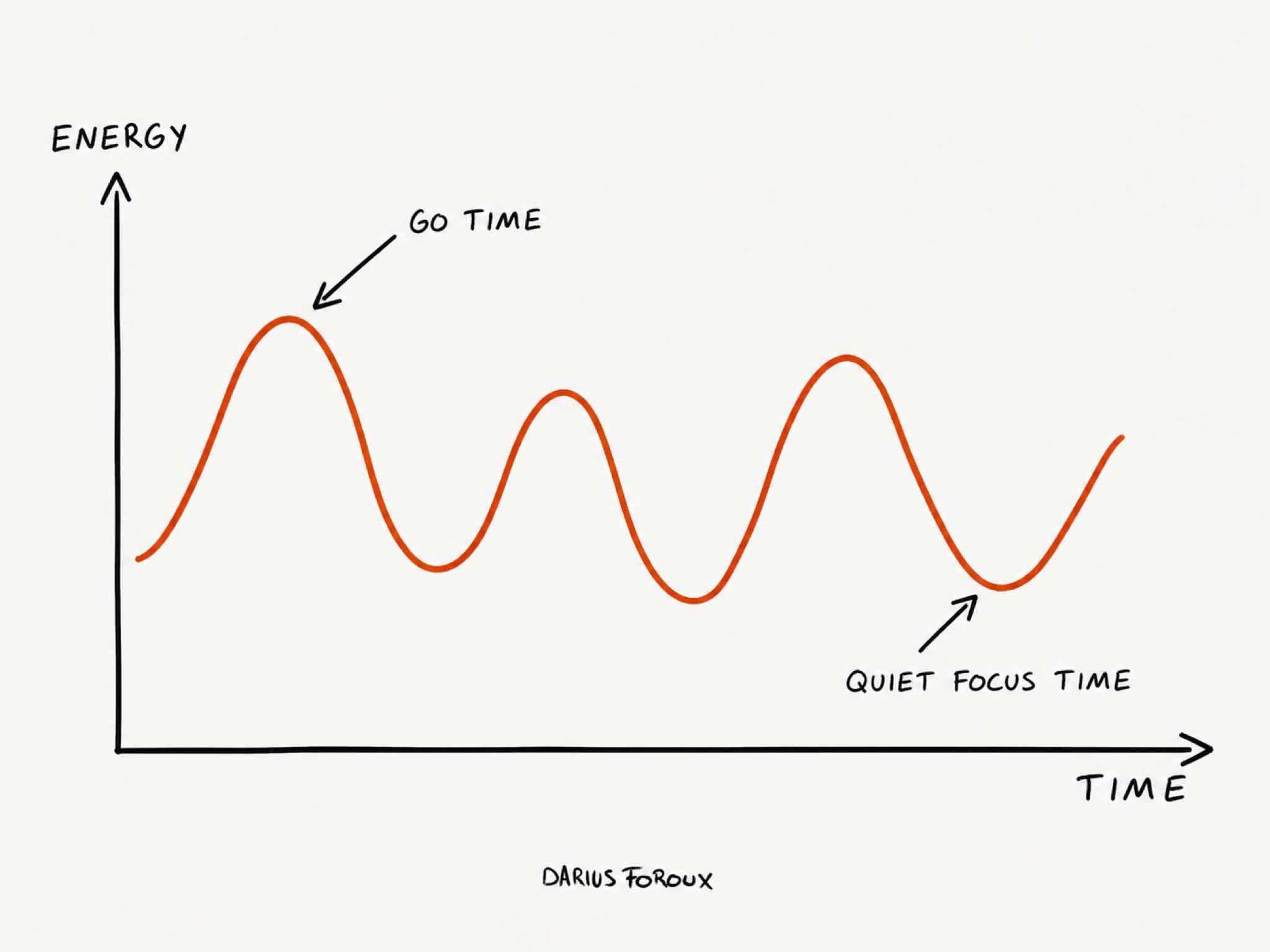
Your energy level is never the same all the time. Sometimes you have a great run and get a lot done. And sometimes you feel tired for a week or two, even when you’re sleeping enough.
I think that’s normal. Life has a natural rhythm, and I don’t expect my body and mind to perform at the same level every day.
But ambitious people often interpret a drop in energy as a problem. We immediately start looking for a way to fix ourselves because we want to get back to go time.
What’s the difference between quiet focus time and go time?
Go time is when you push. You execute ideas, meet people, travel, train hard, learn new skills, take on projects, and move things forward. Your energy goes outward.
Quiet focus time is when you slow down and narrow your attention. You read, think, write, plan, recover, or work on one important thing without trying to do ten other things at the same time.
You need both modes. And the balance between them keeps changing.
Some weeks call for more action.
You have a deadline, launch, trip, or important goal, so you go all in. Other weeks are naturally slower. You spend more time thinking, recovering, or quietly working on what matters.
A good year has both. A good life does too.
Seneca wrote about quiet focus in Letter 56. He was staying above a noisy bathhouse when he wrote:
“For I force my mind to concentrate, and keep it from straying to things outside itself.”
The outside world doesn’t determine whether your mind is quiet. You still have to protect your attention.
Stop trying to manufacture the same energy every day
When ambitious people feel their energy drop, they often try to manufacture more of it.
They rely on caffeine, supplements, stimulants, or a new routine because they want to be extremely productive every day.
I understand the urge. If you can force yourself to feel energetic, you can keep doing everything on your list.
But I don’t think that’s a good long-term strategy. You can override tiredness for a while, but eventually you pay for it. I don’t want to use up my body just so I can feel productive every day.
So I try to go with my natural flow.
If my energy is high, I use it.
If it’s lower, I keep moving but reduce the intensity.
I don’t turn every slower period into a personal crisis.
That last part is important. A quiet week doesn’t mean you’re becoming lazy or irrelevant. It may simply mean your body and mind need a different pace for a while.
Recovery is the name of the game
My friend asked me something else: “What about recovery? Mine isn’t very good on a daily basis.”
I think recovery has two parts: Physical and mental.
You need both, and they work best when you build them into everyday life.
For physical recovery, I keep it simple:
Walk. Walking gets the body moving without adding more strain. And it often clears my mind at the same time.
Stretch and use a massage gun. I have a small Hyperice Go massage gun that I take with me everywhere. I use it on my hips, calves, legs, and the bottoms of my feet, especially when I’ve walked a lot.
Use the sauna. I do this a few times a week. It helps me physically, but it also gives me time to sit quietly.
Protect your sleep. Sleep is the foundation. The other things can help, but they can’t compensate for a routine of poor sleep.
Mental recovery is less visible. You need some downtime every day, even if it’s only 10 or 15 minutes. Journal, read, think, or simply be alone without filling the silence.
Sometimes you can combine physical and mental recovery. The sauna does that for me. Walking can do the same because your body is moving while your mind gets a break.
And you need to plan these moments. If your work is demanding, your social life is busy, or you have kids, it’s easy to wake up and move from one thing to the next until late at night. By the time you get into bed, you’re so tired that you watch TV for ten minutes and fall asleep.
That’s a full day, but there was no real recovery in it.
So put recovery into the day. Take a short walk between work blocks, sit alone for 10 minutes before the evening starts, journal before you turn on the TV, or schedule the sauna a few times a week.
Daily recovery helps you return to go time with real energy instead of forcing yourself through another day.
How do you keep perspective when you feel inconsistent?
The first thing is to stop judging your progress by how productive you feel today.
Feelings change quickly. Results become clear over a longer period.
Here are a few practical ways to do that.
Check the evidence before you criticize yourself. Look at the last month, quarter, or year. Are you moving toward your goals? Are your skills, health, relationships, or business improving? My friend felt inconsistent, but his numbers told a different story. Your feelings don’t always give you an accurate picture of your progress.
Set a minimum for slower days. You don’t need to quit working because your energy is lower. Pick the one or two things that keep your life moving and do those. This could be one focused work block, some exercise, or taking care of an important responsibility. Then let that be enough for the day.
Plan your life in waves. When you know a busy period is coming, make room for it. And when that period ends, give yourself a quieter stretch. You can use time blocking for your week, but you can also think in terms of months and seasons.
The conversation with my friend was really about perspective. His results were improving, while his mind kept telling him he was behind.
And I think many ambitious people live with that same feeling.
They keep pushing because slowing down feels like losing ground. But when you zoom out, you often realize that you’re doing better than you think.
Isn’t that weird? Your mind just keeps you busy.
The truth is that you don’t need to feel productive every day to make progress.
Sometimes the quiet period is exactly what makes the next go period possible.
Just an FYI, that feeling of being wired all the time and not getting enough done is a symptom for high functioning adults with ADHD :) It's just your brain working on over time so whenever I hear that I always recommend talking to a therapist to get some support and hacks so you don't completely wear yourself down to the bone. I didn't know how bad it was until someone else pointed it out to me. There are awesome hacks out there that help with these situations like you mentioned going outside etc.
Thank you for this!