


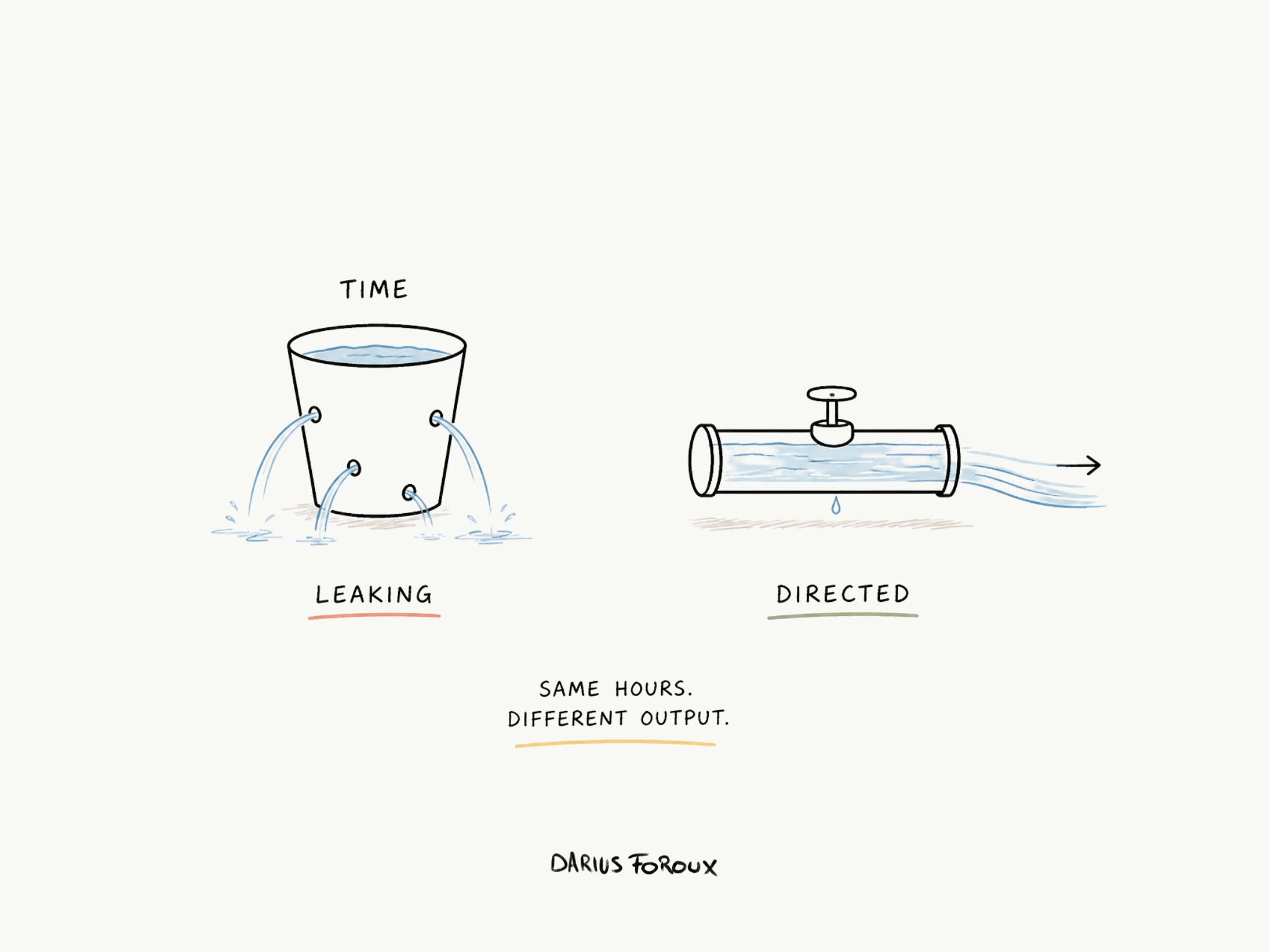
Before my son was born, so many people around me shared stuff like:
“Say goodbye to sleep.”
“Forget about your mornings.”
“You’ll never have time for yourself again.”
I nodded along. What else do you say? They’d been through it, I thought.
But here’s what nobody told me.
Having a child didn’t take time away from me.
It showed me how badly I was already wasting it.
The warnings were right about the wrong thing
Yes, my time got cut. I no longer control my own schedule the way I used to. My son sets the rhythm now. My wife and I adapt around him, support each other, and find pockets of time wherever they appear.
And that’s when something strange happened.
I started getting more done.
You might expect something like, “I started waking up at 5 AM got important work done!”
But that’s not me. I don’t believe in forcing yourself to do something out of character.
I’m not a morning person.
I simply let go of all my expectations and routines.
My goal is to adapt and seize whatever time window opens up. If I see an opportunity to do work for 30 minutes, I go for it HARD!
Before, I had more time and less pressure to use it wisely. I’d start work, drift, come back, sort of focus, sort of not. Hours would pass and I’d have maybe one real hour of output buried inside them.
Now? I sit down and I work. Because I don’t know how long the window is.
That’s it. That’s the whole system.
The poet and philosopher Goethe saw this clearly. Constraints don’t hold you back. They force you to rise to them. As he wrote:
“In limitations, mastery first shows itself.”
Responsibility is the most underrated productivity tool
We’ve been sold the idea that the key to getting more done is having more time, better tools, or the right morning routine.
Read enough productivity content and you’d think the secret is a specific type of notebook and waking up before the sun.
It’s not.
The real lever is stakes.
When something depends on you, you show up differently. You focus differently. You make decisions faster and stop fussing over things that don’t matter.
The Stoics understood this long before productivity culture made it a buzzword.
Seneca spent his life writing about time, and his conclusion was blunt: Most people don’t lose time because they have too little of it. They lose it because they don’t feel its weight:
“It is not that we have a short time to live, but that we waste a great deal of it.”
A child makes the weight real.
We’ve all heard of memento mori, the reminder that life is finite.
Most people know it intellectually. A new baby makes you feel it. When you’re holding something that small and fragile, you understand that we all started like that.
And especially once you start edging closer to 40, you start seeing the effects of aging.
“I’m getting older,” is something you start saying. But do you truly feel it? Do you use it to maximize what you get out of life?
If you do, the trivial things that used to eat your hours suddenly look exactly like what they are… trivial.
What actually changed
1. I found a new way to work.
In the first weeks after birth, I figured out a system that’s been working well. I put my son in a baby carrier on my chest, walk slowly around, and when he falls asleep, I move to my treadmill desk. Walking at the slowest pace, one eye on him, the other eye on writing.
That’s how I got most of my articles done in March and April.
Now he’s a bit older; he sleeps better, so I’m not doing the treadmill technique anymore.
When I’m at my desk without him, I know exactly what I’m doing before I sit down. Write new articles. Post the weekly Academy training for my paid Substack. Answer emails. Work on a new course.
I’ve simplified my work drastically. Just a short list of things that matter, and I do them.
2. Workouts got shorter and more consistent.
I used to do longer sessions, less frequently. Now I aim for every day, which realistically lands at four or five times a week.
Twenty to thirty minutes. Push, pull, or legs, three exercises, done. Short enough that there’s no excuse to skip. Frequent enough that the habit sticks.
I actually feel better than I did with longer sessions I kept postponing.
3. Some things shifted back.
I’m reading less than I want to. Right now most of my reading is about the stock market, the companies I invest in, and geopolitical developments. Books have taken a back seat. I want to fix that. I just haven’t found the right system yet with the new schedule.
My wife and I used to watch a show or movie every evening. Now it’s no longer every night.
We’ll get that back slowly. Same with time together as a couple. A strong relationship is good for us and good for him.
Nothing is gone. It’s just reorganized.
4. Social time looks different, not smaller.
Family visits us almost daily. I see my best friend every week. I talk to other friends on the phone. I take my son out in the stroller and we walk.
The low-value stuff, the obligatory hangouts where you don’t really connect and wonder why you went, that’s what disappeared. Not because I decided to cut it.
Just because there’s no room for it and I don’t miss it.
The real takeaway: Don’t be afraid to change your life
I’ve had stretches like this before.
When I started my writing career. When I moved to Spain. When I came back to the Netherlands.
Big events that disrupted everything and forced a reset. Each time, I came out more focused, more clear on what mattered, more productive than before.
The pattern is obvious in retrospect.
Big life changes make you better.
New responsibilities. A new environment. A different routine.
Things that force you to stop running on autopilot and actually decide how you want to live.
The things we’re most afraid of are usually the ones that push us furthest.
I’ll be honest. I was afraid of all of it. Especially having a child. The loss of freedom, the pressure, the unknown. Every single warning people gave me tapped into a real fear I had.
But every move like that brings you higher. It pushes you to become a more complete version of yourself.
If you’re sitting on something you’re afraid of, a commitment, a change, a responsibility you keep postponing, consider that the fear might be pointing at exactly the thing you need.
Seneca said it best:
“It is not because things are difficult that we do not dare. It is because we do not dare that things are difficult.”
You don't need more time. You need higher stakes.
I had my first son almost 14 years ago. My daughter -- 11. Having kids had taught me to cut out the BS and get to what really matters. I also learned to treasure small steps and focus on tiny progress rather than big jumps. I love your point about "I will get those back," when you talked about movies/series with your wife. This is a really helpful attitude to remind ourselves this is temporary. In general, running a business while raising 2 kids has been a time when I allowed myself to not strive for perfection, but focus on how I could serve even in small ways. My kids are now less dependent on me, and I have a business and clients I've helped and books I've written. Looking back, the only way I know I was able to do it is by taking tiny steps and allowing myself to show up the way I was able to at the moment. I also learned to ask for help and invest in tools that made my work more streamlined. Thanks for this!
Hello Darius,
Having had twins, I wouldn't recommend this "My son sets the rhythm now. My wife and I adapt around him, support each other, and find pockets of time wherever they appear.".
You can have your son your "sattelite", not the other way around. My wife and I set the schedule. Did it work every single day? No. But we made sure it was a priority for us.
Other than that, thanks for the insights :)