


You don’t know what you’re capable of until you actually start something.
As the famous Dutch football player Johan Cruyff once said:
“If you never take a shot, it means you will never score.”
But the problem is that most people never even start. They don’t take a shot.
They don’t bet on themselves.
That can be for many reasons…
Maybe you don’t believe you will succeed.
Your family or friends make fun of you.
It feels like the world is against you.
Or you might just not have the energy.
What’s a side project you've wanted to start for a long time? And let’s be honest. Everyone has some kind of idea they want to work on.
The other day, I met someone who said she wants to sell pet accessories online. That’s something she’s dreamt of for years. That’s her thing.
What’s yours?
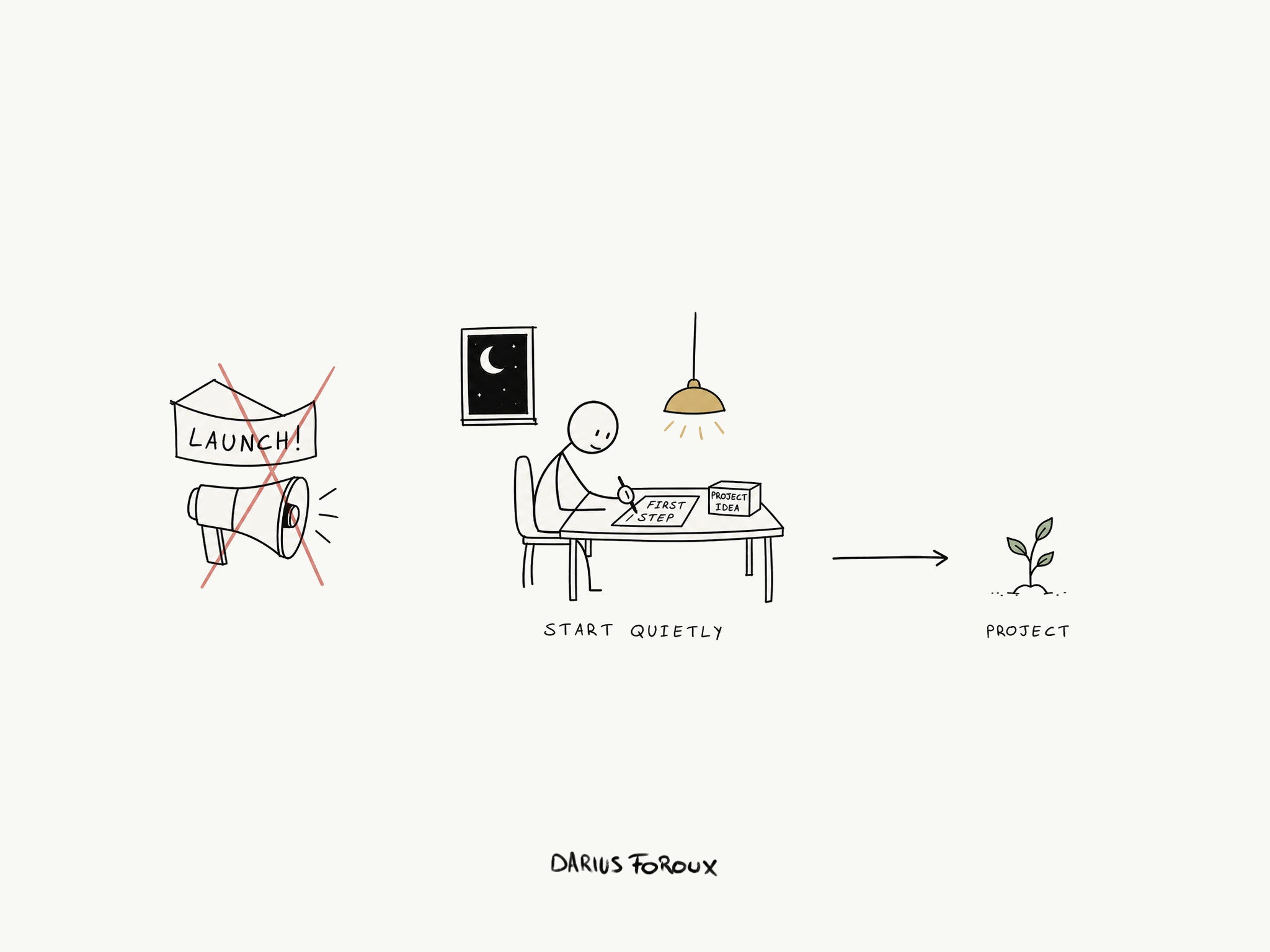
You can start small, in silence, on your own, on a Tuesday night.
But most people never do. They wait. They tell themselves they need to research more, learn more, line up support, and get the moment exactly right. They write a long list of things they need before they can begin.
And then they don’t begin.
I get emails about this all the time. A while back, I ran a survey on my newsletter, asking readers what their biggest challenge was. One of them wrote back with something a lot of people can relate to:
“Finding the courage, energy, and starting point when you can’t advertise what you’re doing (yet), you’re unsure where or how to connect with the right people, and you’re surrounded by people who aren’t particularly driven or encouraging. It feels like there’s often advice for people who are ready to go big, but not enough guidance for those of us trying to start quietly and purposefully.”
That’s a real problem. And nobody talks about it because almost all the advice online is for people already shouting from rooftops.
So let’s talk about the quiet way.
The first job is mindset, not strategy
Most people think starting a side project is a strategy problem. It’s not. It’s a mindset problem.
I see this constantly. Someone wants to start consulting on the side. They sit down to plan it out. Within an hour they’re staring at a list of tools, niches, websites, branding decisions, legal structures, and twelve open YouTube tabs.
They think, “Oh shit. That’s a lot of work.”
And they close the laptop.
This is the trap.
You talk yourself out of it before you ever start. The tools, the website, the technical setup, all of that is freely available and easy to figure out. What’s missing is something else.
You’re afraid. Not of the work. Of looking stupid. Of wasting your time. Of telling someone you tried and not having anything to show for it.
That fear is so loud you mistake it for “needing more information.”
But you don’t beat fear by reading more. You beat it by starting imperfectly on something small.
So before anything else, ask yourself two questions. Why am I doing this? And who am I doing it for?
Answer those two clearly, and the rest of the noise drops off. Everything else is just implementation.
Energy is not a sleep problem
The second thing readers tell me is they’re too tired.
They wake up tired, work tired, come home tired, and the idea of starting something new on top of all that feels impossible. So they keep waiting for a better week.
I know that feeling. Before I found writing in 2015, life had a gray quality to it. I’d only really light up for weekends, vacations, or specific events. The rest was just getting through the days.
When I found writing, that changed overnight.
I was going to bed at 2 a.m., waking up at 9, and counting down the minutes until I could sit at my desk with coffee. Nobody was paying me yet. I had no audience. I just wanted to do the work.
That’s what I mean when I say energy isn’t a sleep problem. It’s a meaning problem.
Think about a day when you were genuinely excited about something. A 4 a.m. wake-up to catch a flight for a holiday. Your wedding day. The first day of a trip you’d planned for a year. You ran on almost no sleep and felt fantastic.
That’s proof your body and mind have all the energy they need when something actually matters to you.
The Stoic philosopher Seneca, who spent his life writing about how easily we waste our time, put it bluntly:
“It is not because things are difficult that we do not dare; it is because we do not dare that things are difficult.”
You’re not tired because life is hard. You’re tired because you’re spending it on things that don’t move you.
Find one thing that does, and the energy shows up.
You don’t need to tell anyone
There’s a quiet assumption baked into the reader’s question. “I can’t advertise what I’m doing yet.”
But you never actually need to advertise.
Most people who start a side project feel they need to announce it. New website. New Instagram bio. Tell their friends. Tell their parents. Make it real.
You don’t. You can do real work for months, even a year, with nobody knowing. That’s not hiding. That’s focus.
I started writing on the side while running an industrial laundry business with my dad. I didn’t post about it on Facebook. I didn’t tell my friends. I just wrote, week after week, and put it on the internet. Most of my early articles got read by almost nobody. That was fine. The work was the point.
When you skip the announcement, you take a lot of pressure off yourself. You don’t have to perform. You don’t have to defend the project to a brother-in-law who thinks it’s a phase. You don’t have to explain anything to anyone.
The work stays private until it’s ready.
Your friends don’t have to be on board
The reader also wrote that they’re “surrounded by people who aren’t particularly driven or encouraging.”
Welcome to the club.
Other than my parents and my brother, almost nobody in my direct environment was driven the way I was. Most people don’t want to take risks. They want a stable job and a normal life. That’s not a flaw. That’s just the average.
The mistake is expecting your existing circle to be your support system for a project they don’t understand. They won’t be. And the more you wait for their approval, the longer you stall.
You need a different circle. Not a replacement, just an addition. People doing what you’re doing, or want to do.
Twenty years ago, that was hard to find. Today it’s almost free. Go where these people gather online. Read what they write. Reply to their posts. Share what you’re learning. You don’t have to be friends. You just need to be in the same room, even a digital one.
When I started publishing on Medium, I was suddenly surrounded by other writers. Some I admired. Some I disagreed with.
And when I started, everyone had a bigger audience than I did. But I never looked at that with jealousy. I saw it as a bunch of people just like me who are trying to build an audience.
You don’t need a mentor or a mastermind. You just need to stop being the only person in your day who cares about this.
How to actually start, today
Strip everything else away and start like this.
Answer the two questions on paper. Why am I doing this? Who am I doing it for? Three sentences each. Don’t overthink it. Write them on one page and keep it nearby.
Pick the smallest possible first action. Not a website. Not a business plan. The smallest thing that produces real output. One article. One sample project. One free session for someone who fits the customer you want.
Schedule one block this week. Two hours, somewhere on the calendar. Treat it like a doctor’s appointment.
Don’t tell anyone yet. Not your partner, not your friends, not your team. Let the work exist before you discuss it.
Join one community online. A subreddit, a Substack, a small Discord. Read more than you write. Just be in the room.
Repeat next week. And the week after.
That’s the whole method. No twelve-step strategy. No funnel. Just a quiet rhythm of work that nobody sees, for as long as it takes.
If you want a more structured way to get started, I built Launch in 48 for exactly that.
It’s a step-by-step framework distilled from more than a decade of building a personal brand online. The stuff that actually works, without the noise.
The quiet way is the real way
One of the students of Launch in 48, Kian Zarzari, works as a process operator at a dairy producer. He’s not a full-time creator or freelancer.
Someone with a full day of work before he ever sits down to write.
He started his Substack, From Fire to Intelligence, not to quit his job, but to do something with the ideas in his head.
To build something with potential without betting everything on it right now.
Nobody at work needed to know. Nobody needed to be on board. He just started, quietly, after hours, with no audience and no approval.
That’s the real way. It just doesn’t sell as well as “Build your million-dollar one-person business.”
The quiet approach doesn’t go viral. There’s nothing flashy to share. But it’s what actually works.
Almost every business or creative career you admire started as one person doing the work after hours, with no one watching, for longer than felt fair.
You don’t need permission. You don’t need applause. You don’t need a circle that gets it.
You just need to start. It’s as simple as that.
Just keep repeating the thing that Cruyff said: “If you never take a shot, it means you will never score.”
Here’s to taking more shots.
This was a much needed read 🌻✨ Thank you for this article. I’m saving this and re reading this weekly just to keep myself and my writing accountable, and just get started without outside validation or pressure to write or create content
This really resonated with me because it challenges the assumption that every meaningful pursuit has to begin with a public announcement.
I think we're living in a culture that celebrates declaring goals more than quietly pursuing them. But most durable careers, businesses, and bodies of work are built in obscurity first.
There's also a job search lesson here. You don't need to announce that you're "building your personal brand" or "networking strategically." You can quietly improve your skills, publish thoughtful work, reconnect with people, and become someone opportunities naturally find.
The loud part usually comes much later.
The quiet reps are what make it possible.