


My wife told me a story recently that I couldn’t get out of my head.
Her close friend works as a waitress at a restaurant. Hard worker, nice person. One evening she made a mistake at a table of seven people. She served six dishes and one had to wait a little longer.
One of those seven people went home and wrote a one-star review and named her specifically.
The boss saw it, and she was told she was no longer allowed to work as a waitress. Her salary was cut. She was moved to the kitchen.
A single negative review destroyed someone’s livelihood.
I know this isn’t rare. But it still makes me angry every time I hear it.
My own experience with it
My books have over 30,000 reviews on Amazon. If you scroll through the one-star reviews and read what some people write, you will find some harsh stuff.
If I read a book I don’t like, I put it down and move on. In fact, most folks are like that.
But some people have this urge to let others know that they didn’t like something. And they can be very nasty.
I’ve also dealt with it in my courses. People who bought a course and then opened a dispute with their credit card company without ever contacting me first, flagging the purchase as fraud.
This is a daily reality for anyone who offers a product, service, or puts their work into the world.
Whether you’re a small operator or interacting with thousands of customers daily, you have to deal with negative situations.
It’s simply a part of the game.
There are a lot of miserable people out there
If you’ve ever worked in a restaurant, a store, or any customer-facing role, you already know this.
My uncle has worked in the hospitality industry for nearly twenty years. The stories I heard from him are genuinely unbelievable.
Some people walk in looking for a reason to complain and cause drama.
Arthur Schopenhauer, the German philosopher who spent a lifetime studying human nature, warned us many years ago not to pay attention to these types of people. He wrote:
“We will gradually become indifferent to what goes on in the minds of other people when we acquire a knowledge of the superficial nature of their thoughts, the narrowness of their views and of the number of their errors. Whoever attaches a lot of value to the opinions of others pays them too much honor.”
Paying too much attention to what miserable people think of you is giving them an honor they haven’t earned.
Most negative criticism doesn’t come from people who want to help you improve.
It comes from people who are frustrated with their own lives and have found a safe outlet.
The anonymity of the internet makes it even easier. The review culture makes it acceptable.
If you have ever dealt with that type of negativity, don’t take it personally. It was never really about you.
What the Stoics said
Marcus Aurelius dealt with critics, enemies, and people who tried to undermine him his entire reign. His response was consistent: Focus on what you can control, and ignore the rest.
He wrote in his private journal:
“You have power over your mind, not outside events. Realize this, and you will find strength.”
The Stoic framework is practical here. Criticism is an outside event. You can’t control what others think or say about you.
You can’t control what your boss does with it. You can’t control whether a spiteful person decides to spend their evening trying to damage you.
What you can control is your response.
And more importantly, your identity.
Who you are is not determined by what a stranger on the internet says about you.
If you’re someone with proper values and have good intentions, you don’t have anything to fear. Just do what you’re doing and ignore the hate.
Don’t give them the power to define you
Schopenhauer made a distinction that I find very useful. He separated what a person is from what others think of them.
He argued that a person’s real existence is in themselves, not in other people’s opinions.
Schopenhauer put it this way:
“Every man’s chief and real existence is in his own skin, and not in other people’s opinions; and, consequently, that the actual conditions of our personal life are a hundred times more important for our happiness than what other people are pleased to think of us.”
Your health. Your relationships. Your work. Your character. These things are real. A one-star review is not.
The problem is that our minds don’t naturally make this distinction. A bad review or criticism at work feels like an attack on who we are, not just on what we did.
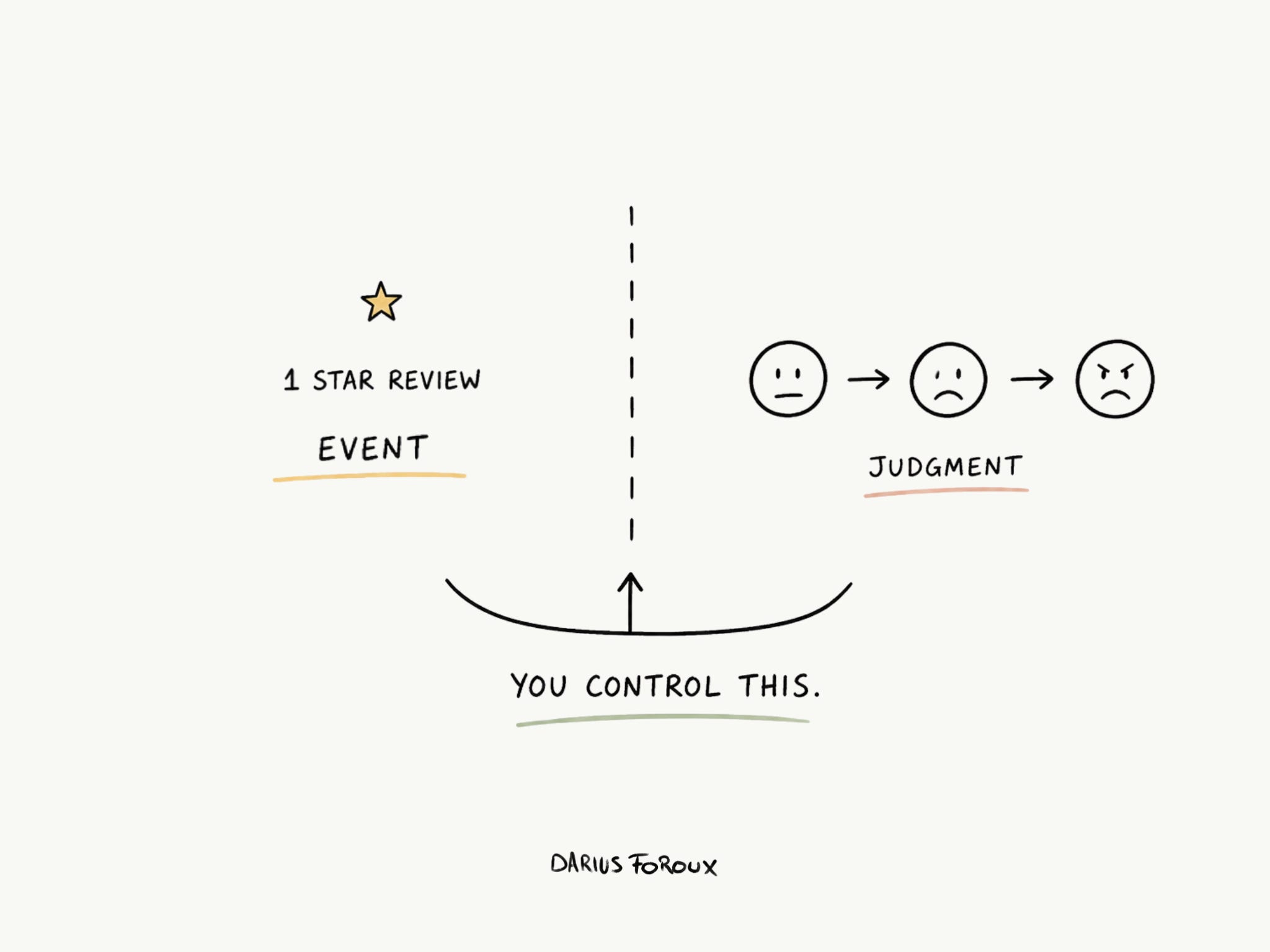
This is where the Stoic practice of separating events from judgments becomes essential.
The review or criticism is an event. Your interpretation of it is a judgment. And you control the judgment.
What to actually do
Accept that some people will always be negative. This is not cynicism. It’s just reality. You can’t please everyone and you shouldn’t try.
The person who tries to make everyone happy ends up pleasing nobody, including themselves.
Do your best work and let it stand. The waitress who made a mistake is still a good person doing a hard job.
The one-star review doesn’t change that. Her colleagues know it. Her regular customers know it. The review says more about the person who wrote it than about her.
No matter what happens, don’t respond in anger.
Responding to hate with your own hate just adds fuel. Most of the time, silence is the most powerful answer.
And finally, remember what Schopenhauer said about intellect and criticism:
“Intellect is invisible to the man who has none.”
The people who leave the most vicious criticism are almost always the ones least qualified to give it.
They lack the capacity to understand what they’re criticizing. That’s not an excuse to dismiss all feedback.
Genuine, constructive criticism from people who know what they’re talking about is very valuable.
That’s one of the most important ways to improve yourself… by listening to the feedback of people who want the best for you.
But hateful, anonymous attacks from strangers are not feedback. They’re noise.
Ignore them at all cost.
Update: Right before scheduling this article, I heard that the person I mentioned in it is back to waiting tables. That makes a huge difference financially, in tips alone. I was happy to hear that. A good example of staying the course and focusing on doing the right thing.
This is a very well-organized and excellent piece of writing. I have been reading your work for a long time; you may not realize just how many people you are quietly helping. I learn and discover so much through your writing. Today, I would like to publicly express my gratitude for everything. May your days ahead be filled with success and peace. Thank you so much dear Darius!
Truly appreciated this article. Thank you.