


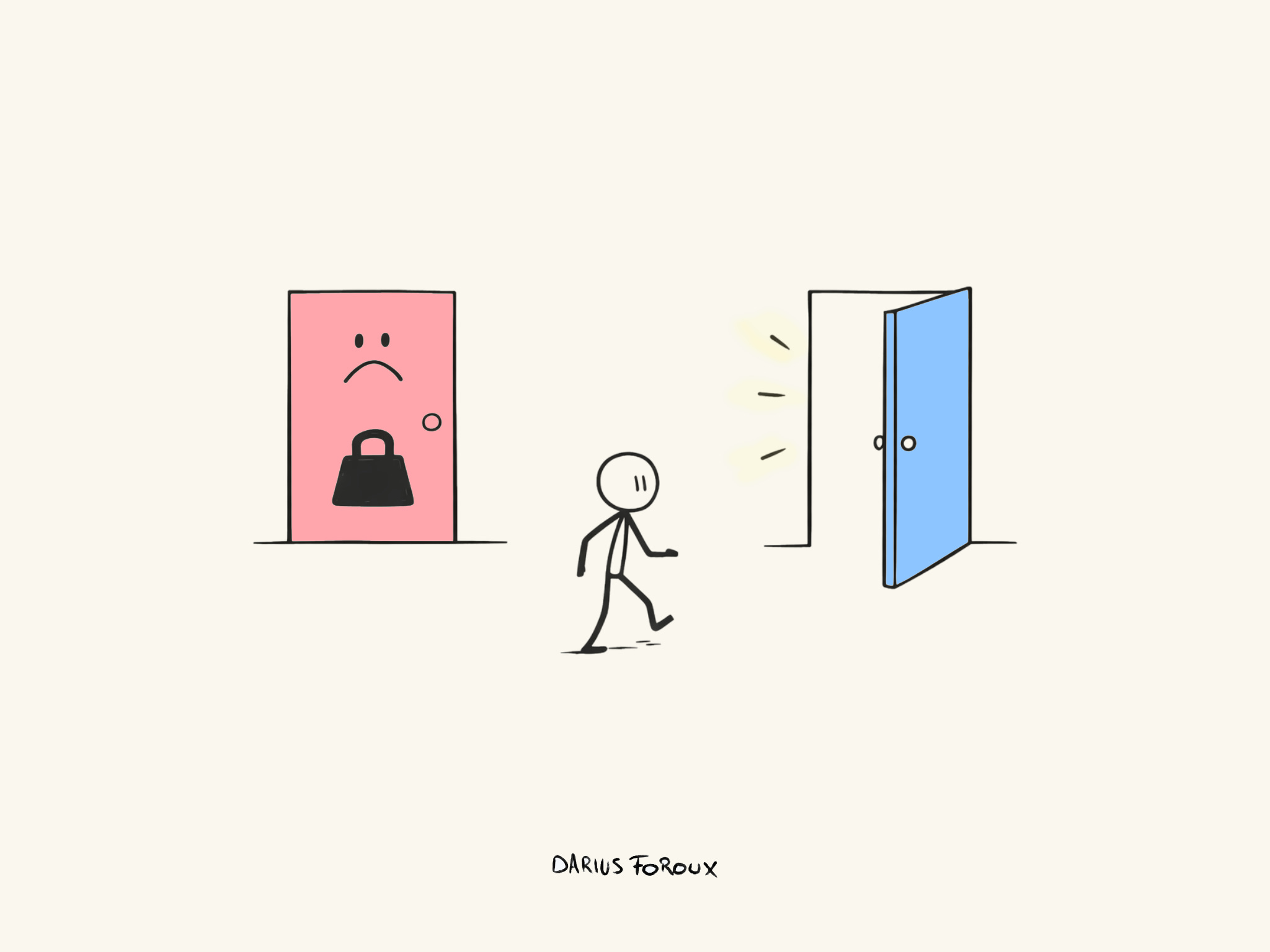
I want to share a theory I’ve been developing for years.
Most of our problems are not real. They’re linguistic.
They exist in the words you use to describe your situation, not in the situation itself.
In other words, if you change your words, you can make your problems go away.
Because what if the things you label as problems are not even problems in the first place?
I know that might sound too simple.
Stay with me.
Everything is a frame
First things first. I’m not talking about physical problems, injuries, or illnesses. Those things are very real.
But if you think about the problems we face day to day, the majority are not physical.
Think about the following.
You have a label for everything in your life.
You are disciplined or undisciplined.
Successful or unsuccessful.
Healthy or unhealthy.
Happy or not.
These are the mental labels we use in our minds. They sound like facts, but they’re not.
They’re interpretations. And interpretations can be changed.
If I look back at how I’ve dealt with my problems in the past, it’s been mostly by changing how I look at things.
I’ve done that subconsciously. But I always thought of turning this into something more real, so I can share it with others.
The moment I discovered The Reframing Theory
I was reading a book called The Inner Voice of Trading by Michael Martin. It’s a good book on trading psychology.
It was not the content about trading that made me think of Reframing, but a passage about discipline. Here’s how Martin framed discipline.
“Discipline is just acting in accordance with your goals or your agreements with other people, despite the strong impulse you may have to act otherwise.”
That’s the simplest and best description of discipline that I’ve ever heard.
Discipline is simply setting goals and sticking to them.
So if you’re not disciplined, there’s nothing wrong with you personally. It doesn’t mean you’re weak or lack willpower. It simply means you’ve set the wrong goals!
You see? This is a way of looking at life. It’s a mental model.
Anthony de Mello and the reframing of loneliness
So I started connecting the dots in my mind. After I read that line about discipline, I immediately thought of Anthony de Mello, the Jesuit priest and author.
He was one of the clearest thinkers I’ve ever read. He had a way of collapsing entire problems with a single reframe.
Here’s one of my favorites from his book, Awareness:
“Loneliness is when you’re missing people, aloneness is when you’re enjoying yourself.”
One word changed. The entire experience flipped.
If you’re alone and you call it loneliness, you suffer. If you call it aloneness, you rest. The situation is identical.
The label is everything.
That’s the Reframing Theory in its purest form.
Epictetus said the same thing two thousand years earlier:
“Men are disturbed not by things, but by their opinions about things.”
This isn’t positive thinking, though.
Positive thinking asks you to pretend bad things are good.
Reframing asks something different. It asks you to find the most accurate and useful interpretation of a situation.
Not the most flattering one. The most functional one.
There’s a difference between lying to yourself and choosing a better lens.
The reframes that changed how I think
You can apply this mental model to every area of your life.
These are the areas where I see people most often stuck, and the exact reframes I’d offer for each.
Most of the time, our inner dialogue focuses on what we lack.
So let me break it down here and offer a different frame.
“I’m not disciplined.”
Old frame: I lack willpower. Something is wrong with me.
New frame: My goals aren’t aligned with who I actually am, what I actually want, or what my life actually allows right now.
Discipline follows naturally when your goals are honest. If you keep breaking agreements with yourself, don’t fix your willpower.
Fix the agreement. Set goals that are realistic, genuinely yours, and compatible with your actual life. Then watch how “undisciplined” disappears.
“I’m not successful.”
Old frame: I haven’t reached the outcomes I wanted. I’ve fallen short.
New frame: I’ve been chasing someone else’s definition of success.
When you define success on your own terms, based on your own values and your own standard of a good life, you stop failing at someone else’s game.
You start playing your own. That’s where real progress begins.
“I’m not healthy.”
Old frame: I don’t have enough discipline to eat well and exercise.
New frame: My habits don’t match the life I actually want to live.
Health isn’t about restriction. It’s also not about living to 100.
Health is about optimizing your life to achieve real, lasting energy. When you connect healthy habits to how you feel daily, they stop feeling like a sacrifice.
Too much exercise or being obsessed with every calorie you consume will only drain your energy. It’s about finding a balance that works for you.
“I’m not happy.”
Old frame: Not enough good things have happened to me.
New frame: I’ve been waiting for happiness instead of practicing it.
Marcus Aurelius ruled an empire during wars and plagues. He wrote in his private journal: “Very little is needed to make a happy life; it is all within yourself, in your way of thinking.”
Happiness isn’t something that arrives. It’s something you cultivate daily through what you choose to notice and focus on.
“I’m not popular.”
Old frame: Not enough people like me.
New frame: I’ve been optimizing for quantity instead of depth.
As social beings, we care about what others think. I don’t think there’s anything wrong with that.
The problem is that we want to be liked by many people. That’s impossible.
Stop chasing approval from others. Focus on the people who you like and who like you, and be good to them.
“I’m not rich.”
Old frame: I don’t have enough money.
New frame: I’ve been measuring wealth against a target that keeps moving.
Seneca said it best: “It is not the man who has too little, but the man who craves more, who is poor.”
Wealth is sufficiency. That bar is lower than you think. The problem isn’t your income. It’s the definition you’re using.
“I’m not famous.”
Old frame: Not enough people know who I am.
New frame: I’ve been confusing fame with impact.
One person who truly understands your work is worth more than a thousand passive followers.
The obsession with fame is really an obsession with validation. Build a reputation in a small circle. Let it grow from there.
How to actually use this
When you find yourself stuck, frustrated, or telling yourself a story about why something is impossible, stop and ask one question.
Is this a fact, or is this a frame?
Most of the time it’s a frame. And once you see it as a frame, you can ask the better question: what’s a more useful way to look at this?
You don’t need a different life. You need a different lens.
The problems don’t disappear. But they stop running you.
Remember: your words create your experience. Choose them deliberately.
This was a perfect Monday Morning article! Thank you for showing us how to reframe our recurrent thoughts.
This article is helpful in so many ways!
Thank you for your insight on this, I needed this today.