


As long as I can remember, money has been one of the most important subjects in my life.
I remember being seven or eight years old and already understanding that money was a problem in our household. It caused fights, pain, and struggle.
I didn’t understand anything about personal finance, of course. But I felt what a lack of money could do to people.
From that moment, I wanted to get to a place where I didn’t have to worry about money.
Little did I know that, even as a child, I could already feel different levels of wealth. But I had no clue what kind of challenge was ahead of me.
As the years went by, I started to understand money better.
I lived through a lack of it, worked my way up the ladder, acquired skills, built businesses, earned more, saved, and invested. I also read hundreds of books and articles about money and philosophy.
The tactical side matters. You need to know how to increase your income, build useful skills, invest, and protect what you have.
But money is also emotional:
How much is enough?
Why can you have more than you ever expected and still worry?
And what does wealth actually do to your state of mind?
This article is my current answer to those questions.
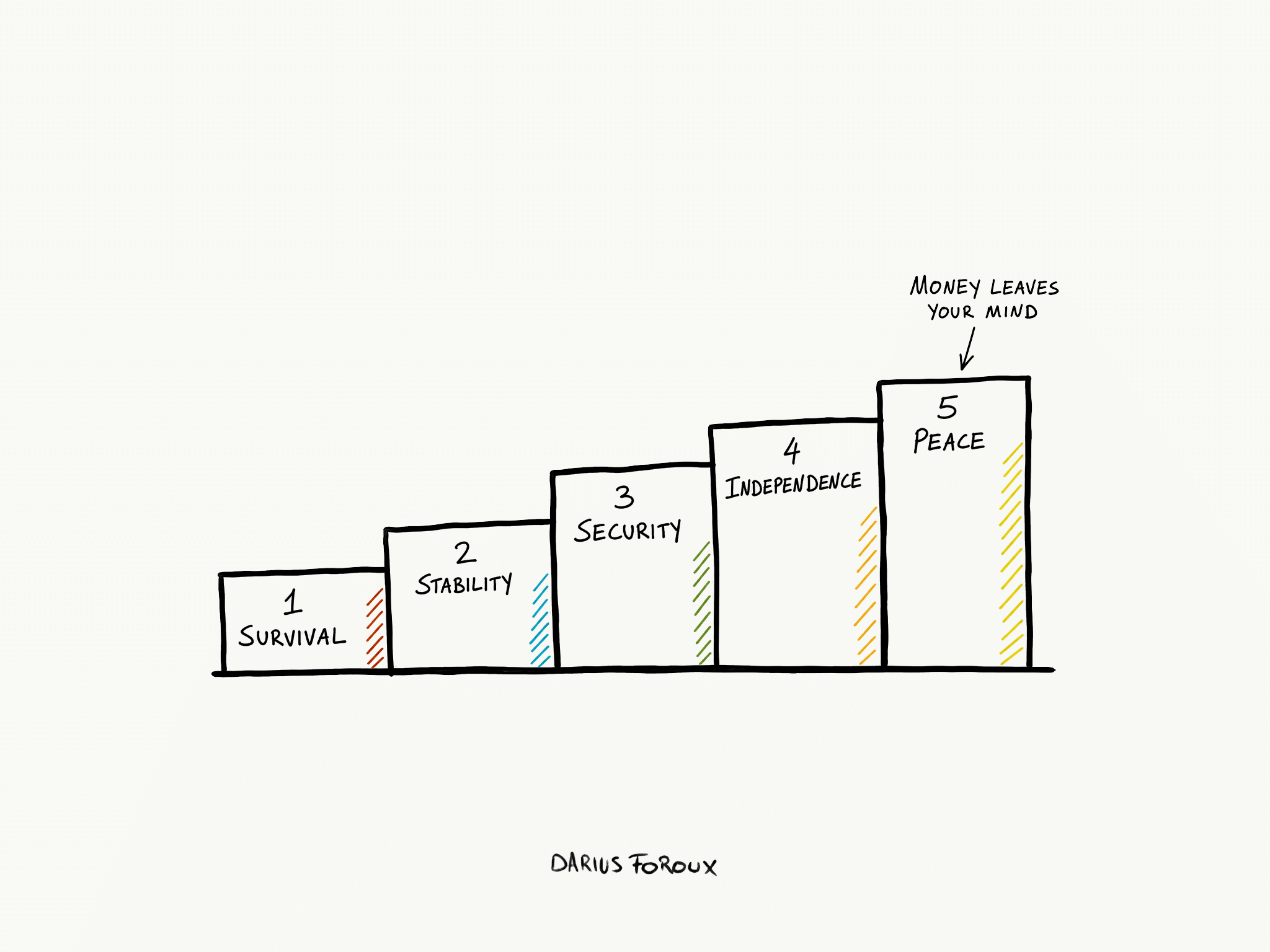
These are the five levels of wealth I’ve seen in different countries, cultures, and walks of life. The currency and numbers change, but the progression is mostly the same.
First, I’ll explain the levels. Then I’ll share what I think it takes to move from one to the next.
What are the five levels of wealth?
Level 1: Survival
At this level, nearly all your income goes toward current expenses. An unexpected bill can throw off the whole month, so money influences almost every decision.
There’s no shame in being here. But your first goal is not passive income, investing, or early retirement. It’s breathing room, starting with a buffer of one month of essential expenses.
Level 2: Stability
You have several months of expenses in cash. A repair, a medical bill, or a slow month is inconvenient, but it doesn’t create panic.
Stability doesn’t look impressive, but you sleep better and make fewer desperate decisions. You can start thinking beyond the next paycheck by improving your skills, negotiating better, or looking for work that fits you.
Level 3: Security
Your buffer is solid, your income is reliable, and you’re building assets. You could handle a longer period without income without dismantling your life.
This is where your options expand. You can say no, take a calculated career risk, and invest for the long term. Security doesn’t mean nothing can go wrong. It means one setback is less likely to decide your future.
Level 4: Independence
Your assets can cover your lifestyle, which means work becomes optional. You no longer have to accept work purely for the money.
You may still want to build, teach, invest, or contribute. But now you control your time, which raises an important question: If nobody paid you, what work would you still do?
Level 5: Peace
Most people describe this level as having enough. I call it peace because enough sounds like a number, while peace is the outcome. You know what your money is for, you’ve stopped moving the goalpost, and you no longer compare your life with people who have more.
Money is available, organized, and useful. You can acquire it without craving it, spend or give it away without fear, and lose money without feeling that you’ve lost yourself.
So where am I on this ladder?
If I had to place myself, I would say I’m somewhere around level four. But I rotate. Sometimes my mindset goes back to level three because that’s the conditioning of my life.
And as an entrepreneur, I still sometimes feel like I’m one bad decision or one recession away from struggling again. Financially, I know that’s not an accurate picture. Emotionally, the old feeling can still return.
Do we ever fully arrive at level 5?
I don’t think so. We oscillate. Ideally, you move between levels four and five. More realistically, you might move between three and five as your life, finances, and mindset change.
I see wealth as a lifetime process. You improve your financial position while also improving your relationship with money.
Focus on moving up one level at a time
The mistake is looking at level five while you’re still at level one. That creates impatience. And impatience makes bad shortcuts look attractive.
Focus on the next level. That’s it.
I wrote before that you can achieve almost anything if you focus on one thing at a time. The idea sounds simple. But it’s one of the hardest things to practice.
We want to do everything at the same time. I fall for this too, and I always have to correct myself.
I see my wife doing the same thing. She’s ambitious. She wants to go back to school and get her master’s degree. She wants another kid, to start a business, and to learn a new language. And naturally, she would like to do all of that around the same time.
Who wouldn’t?
The problem is that we’re not very good at calculating how long things take. We think we can fit everything into one year.
There’s a common line that gets attributed to several people: We overestimate what we can do in one year and underestimate what we can do in ten years.
I don’t know who said it first. But the point is right.
You can build a career, start a business, get another degree, raise a family, learn a language, become fit, and build wealth. You just can’t do all of those things at full intensity at the same time.
Wealth works the same way. Don’t try to jump from survival to peace. Get to stability. Then security. Then independence.
One level at a time.
The most important thing: Make level 3 your floor
No matter where you start, your job is to get to level three and do everything you can to avoid falling below it.
If you move from level five back to four, fine. If you move from four to three during a recession, career change, or difficult period, that can happen too. But below level three, money starts controlling too many parts of your life again.
So how do you build security?
1. Become excellent at something valuable
Your earning power is your first asset. Before my investments made a meaningful difference, I spent years building skills, experience, a network, and an audience.
Focus on becoming the best you can be at what you do. Treat life like a competition with yourself. Are you better than you were last year? Can you create more value? Can you solve harder problems?
You don’t need to compete with everyone on the internet. You need to keep improving your own position.
2. Keep enough of what you earn
Skills help you earn more. But if every increase in income creates a more expensive lifestyle, you never build security.
Keep your fixed costs under control. Build liquid savings. Invest consistently. And avoid the kind of large, reckless decision that can erase years of work.
You don’t need a spectacular financial move. You need to stay in the game long enough for your skills and assets to compound.
3. Stop treating time like a renewable resource
You get one life. You get one year at a time and one day at a time. There’s no rerun.
Of course, you should rest, spend time with your family, and enjoy yourself. But don’t spend your best years only consuming entertainment and then wonder why your position never improves.
An ordinary life is a valid choice. But if you choose the path of excellence, your actions have to reflect that choice. You can’t keep saying you want an extraordinary level of freedom while giving ordinary attention to your work, skills, health, and finances.
Use your time well. It’s the only resource you can never recover.
4. Keep correcting yourself
You will get distracted. You will take on too much. You will have periods when you work less, spend more, or lose your edge. I do too.
The important thing is to notice it early and correct yourself. Don’t turn one lazy month into three lazy years.
Momentum works both ways. Improvement makes the next improvement easier. Drifting makes the next bad decision easier too.
How do you keep acquiring wealth without becoming owned by it?
The biggest challenge at level four is complacency. Your income is good, your investments are growing, and you have options. So you take a step back, stop learning, and slowly start living on what you built in the past.
There’s nothing wrong with taking a break. But complacency is a downward cycle you often notice too late. Keep improving and building wealth, not simply because you want more, but because the process keeps you sharp.
Seneca understood this tension. He was one of the richest men in Rome, but he didn’t argue that a wise person should reject wealth. In On the Happy Life, he wrote:
“For the wise man regards wealth as a slave, the fool as a master.”
You can keep acquiring wealth without becoming owned by it.
Hold on to money because it gives you security and options. But remain willing to spend it, give it away, and share it. You have to find the balance that makes sense for you.
At some point, work becomes optional. You keep doing it because you love the work, enjoy the challenge, and want to contribute. If it also rewards you financially, great.
But whether you win or lose, you know you’ll be fine. That’s peace. And to me, that’s the highest level of wealth.
The balance sheet can move through these levels much faster than the person holding it. You can reach independence financially and still be managing the position like survival is one bad month away.
Beautiful read, thank you so much for this