


When I started writing over a decade ago, I was eager to connect with other authors.
I read books about how important it is to build a network. I also read online advice about how to connect with your peers so you can grow together.
In my experience, this is bad advice.
From all the people that I’ve connected with and became “online friends” with, there’s only one person I still talk to.
The rest were all insincere.
And I don’t blame anyone because this is the culture that we’ve created.
The internet does not reward honesty
Social media used to be a place where you connected with people that you actually knew. Then, Facebook changed the game.
The Facebook feed stopped being about your friends and started showing you all kinds of content. This changed everything. The platforms realized that if they showed you content that triggered you, you would stay on the app longer.
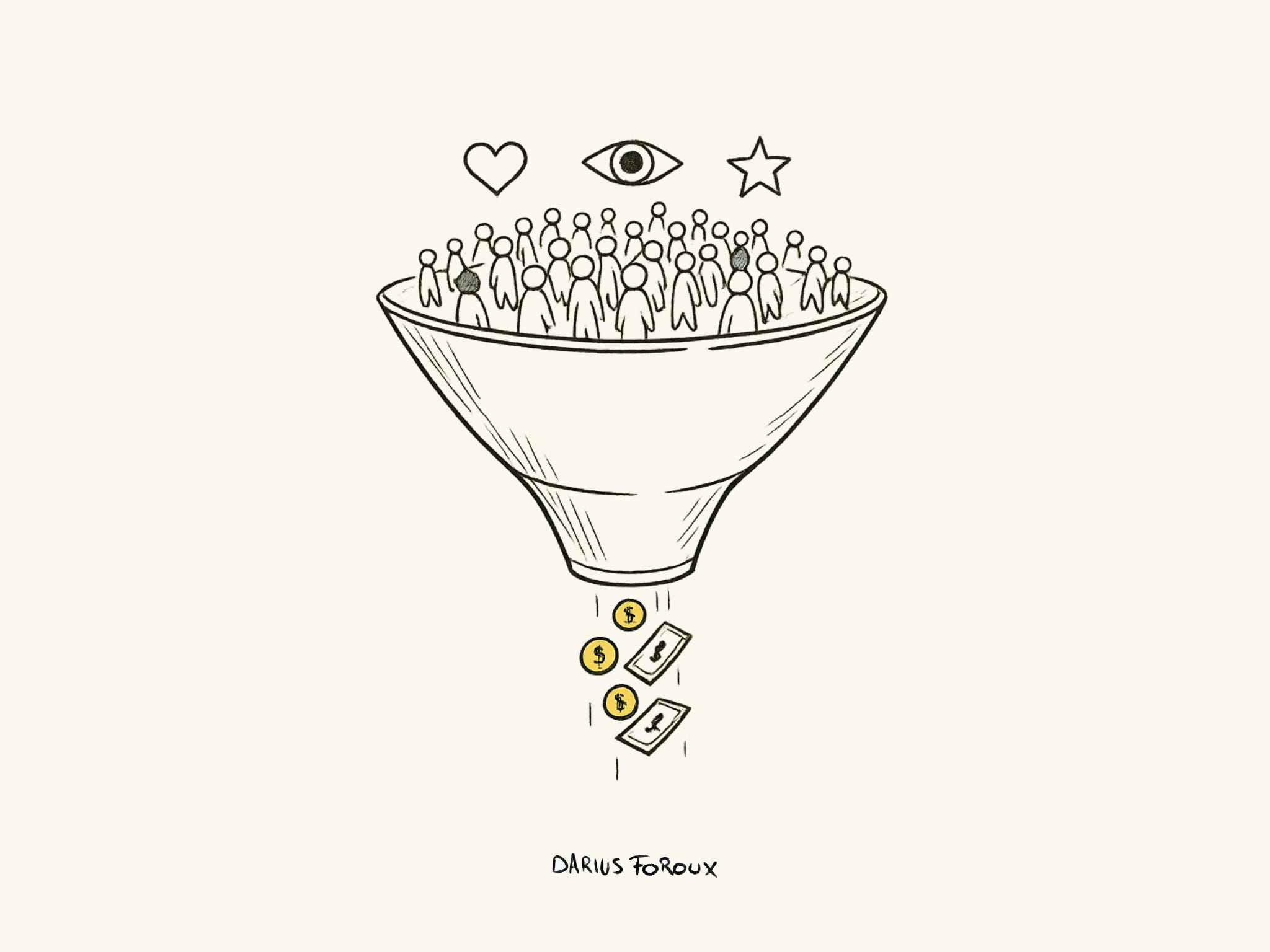
The goal moved from connection to attention. And we all know the formula: Attention equals money.
This progressed quickly. YouTube creators started optimizing for views. Instagram became a race to show the most perfect, filtered life. TikTok turned everything into a 15-second hit of dopamine.
I often hear people say that long-form podcasts are the exception. They think that because someone talks for three hours, they are being “real.”
That’s not true. Long-form is just another way to capture attention.
The business model is the same. The podcast exists to sell advertising. A long list of multi-million dollar companies was built entirely on the back of podcast ads.
The hosts are rewarded for how many eyeballs they get, not for how honest they are. When money is the primary metric, sincerity is the first thing to go.
The creators reflect the values of the culture
We shouldn’t be surprised that creators are insincere. They are simply responding to the environment. If the culture values attention above all else, creators will do whatever it takes to get it.
They are incentivized to only talk to people who can help them grow. This isn’t a moral judgment. It is just the reality of how the creator economy works.
Early on, I tried to “network” like everyone else. I quickly realized that most interactions were purely transactional.
People didn’t want to exchange ideas or talk about the craft of writing. They wanted to know:
How many subscribers do you have?
Can you share my link?
How can I get to where you are?
Can we work together?
If you aren’t playing that game, you have no value to them.
I learned this first around 2016. I started a podcast back then, before it was a normal thing to do. I had the chance to interview some high-profile authors I really admired.
It was disappointing. The people I met were nothing like the personas they projected online.
If you look up my podcast, you will see that I stopped doing interviews at some point because it was just about having superficial conversations.
There is an old saying: Don’t meet your heroes.
That’s 100% true. Most of the time, the person you see on the screen is a carefully constructed brand.
Underneath that brand is usually someone who is just as stressed, insecure, and transactional as everyone else.
I prefer to hang out with my “boring” friends. The normal folks. Because that’s how I see myself as well.
Sincerity will always be a contrarian strategy
This sounds cynical, but I’m actually optimistic about this whole online personal brand space.
In my opinion, 99.9% of what you see online is fake.
But the internet is a big place.
There are, of course, enough sincere people out there. They just aren’t the ones screaming for your attention.
And if 99.9% of what you see online is fake, that means being real is one of the rarest things you can do.
And rare things stand out.
Most people assume you have to choose between being honest and being successful. That’s not true.
You can sell without being fake.
You can build an audience without playing a character.
You can earn a good living without becoming someone you don’t recognize.
The difference is what you’re selling. If you’re selling a persona, you have to maintain that persona forever. That’s exhausting. And people eventually see through it.
If you focus on being honest and providing value, you will be rewarded for it ultimately.
I’m not saying go sit in a corner and be a starving artist. That’s not the point. The point is that you don’t have to do it like everyone else.
There’s a market for honesty. It’s just undersupplied.
When you stop looking for validation from a culture that doesn’t value honesty, something shifts.
You stop comparing.
You stop acting.
You focus on making a contribution.
In a world where everyone is performing, being yourself is the rarest strategy of all.
It probably won’t make you famous overnight. But it’s the only approach that lets you sleep at night. And over time, it’s the one that wins.
What a refreshing dose of honesty. The “don’t meet your heroes” observation is one I’ve felt personally, and it’s worth unpacking.
I was initially demoralized when I discovered the truth about Napoleon Hill. By all accounts, he was a fraud. He never met Andrew Carnegie, and the interviews with successful individuals that formed the foundation of Think and Grow Rich were largely fabricated. And yet, it remains one of the best-selling books in history, with estimated sales between 70 and 100 million copies. He died in the 1970s with roughly 30 million in print, meaning another 40 to 70 million copies sold in the half century since his death. He is widely credited with launching the entire self-help industry.
That realization forced me to confront something I had struggled with my entire life, the inability to separate the messenger from the message. The message, it turns out, still has value. The messenger was deeply flawed.
Your post is a reminder that most of what we consume online is performance, not truth. For those of us committed to integrity, that’s not discouraging, it’s an opening. And at the very least, we can look ourselves in the mirror and know we chose the harder, more honest path.
Days by days.. the cost of being real and something that look real is no longer matter.. it is just how ppl view that that matters.. as long as it seems real enough.. nobody would question.. and even some would question lesser one would be able to confirm... Until everything that looks real are just fake. That is when what is authentic matter.. because it will stand out...
But when?