


I’m currently reading The Nicomachean Ethics by Aristotle, and it’s funny how that goes.
I’ve read philosophy for years. Stoics, pragmatists, modern thinkers. I’ve quoted Aristotle multiple times in my work. Yet somehow, I’m only now reading The Nicomachean Ethics cover to cover.
Written during the 4th century BCE, it’s considered one of the most important books in philosophy.
And what struck me most is how this book resembles what we now call “self-help.”
Aristotle isn’t motivating you. Nor is he promising anything.
He’s asking a simple question:
What does it actually mean to live a good life?
You see? It’s not a pleasant, successful, or even meaningful life.
He was interested in living a good life.
The good life according to Aristotle
Aristotle shares a warning that already dismantles most modern ideas about happiness:
“One swallow does not make a summer, neither does one fine day; similarly one day or brief time of happiness does not make a person entirely happy.”
In other words, happiness is not a moment. It’s not a mood. And it’s definitely not your Instagram feed.
Happiness is a way of living. A skill you practice over time.
Here’s what Aristotle believed a good life actually consists of.
The goal is human flourishing, not feeling good. The highest aim is eudaimonia, the state of human flourishing. It’s not about pleasure. The goal is to build a life that holds up when you step back and look at it honestly.
A good life is built through action. You don’t possess a good life. You practice it. What you do repeatedly matters more than how you occasionally feel.
Virtue is trained through habit. Character isn’t discovered through introspection. It’s formed through repetition. You become disciplined by acting with discipline. There is no shortcut.
Virtue lives between extremes. Courage sits between cowardice and recklessness. Generosity between stinginess and waste. The right action depends on context and judgment, not rigid rules.
Reason should govern desire. A good life is one where reason guides emotion and impulse. The goal is not to suppress your feelings but to understand them and direct them.
Judgment matters more than rules. There is no ethical checklist. Practical wisdom means reading situations, weighing trade-offs, and deciding under uncertainty. There’s no clear-cut blueprint for a good life.
Friendship is essential. You cannot flourish alone. A good life requires relationships that make you better and that you show up for in return.
External conditions still matter. Virtue is central, but health, money, and stability affect how fully you can live well. Pretending otherwise is naive.
As you can see this is a way of living. It’s not like you can just do a few things and then you’ll be happy. A good life is something you have to work on daily.
What happiness is NOT about
All of this sounds obvious. You can find all of the above advice online. And yes, it’s hard to practice.
But Aristotle’s real value is not in listing what to aim for. It’s in being ruthless about what to avoid.
He puts it bluntly:
“Happiness does not lie in amusement; it would be strange if one were to take trouble and suffer hardship all one’s life in order to amuse oneself.”
By amusement, he doesn’t mean joy. He means distraction, escapism, and entertainment as an end.
For example, rest and entertainment have their place. But according to Aristotle, only as recovery, and not as the aim.
If the structure of your life is as follows:
Suffering through work,
then escaping through entertainment,
something is off.
I’ve done that too for years. I was simply enduring most of the things in life to distract myself afterward.
How can you recognize if you’re in that pattern? Watch for the following signs:
Your weekends are all thoroughly planned for the next few months
By late Sunday afternoon, you start feeling uneasy and anxious
You’re often telling yourself, “Only X more weeks of work, and then I’m off to Y.” And Y is always a sunny destination like Florida or Spain.
That’s not happiness. That’s avoidance with breaks in between.
Starting with what to avoid is often more useful than starting with ideals. Cut the obvious traps first.
Build a life that you actually enjoy on a day-to-day basis. Avoid living for moments that lie in the future. Live for today.
Find pleasure in your career and in your habits.
Happiness is still the end goal
Aristotle ends where he began:
“Happiness then, is found to be something perfect and self-sufficient, being the end to which our actions are directed.”
This is the part that we all know, but tend to forget as soon as we start mindlessly working on our goals.
We want to make more money, gain recognition, be loved, and enjoy all the luxuries life offers.
And on top of that, we also want to be happy!
Happiness is not a side project.
It’s not something you get after everything else is done. It’s the standard your actions should answer to.
Ask yourself:
Does the way I spend my days actually point toward a life I respect?
We already know the wrong answers.
The things that consistently support a good life are actually quite boring.
Having meals with the people you care about.
Going for a long walk.
Sitting on the couch, reading a book.
Journaling about all the things you’re working on.
Making yourself useful around the house.
Acting with integrity when no one is watching.
Most of those things are free. You don’t need to be rich and famous for that. You can do all those things even if you’re not getting likes.
The problem is not that we don’t know what makes us happy.
The problem is that we keep trading it away for short-term substitutes that give us a dopamine hit.
Aristotle doesn’t offer comfort. He offers a standard.
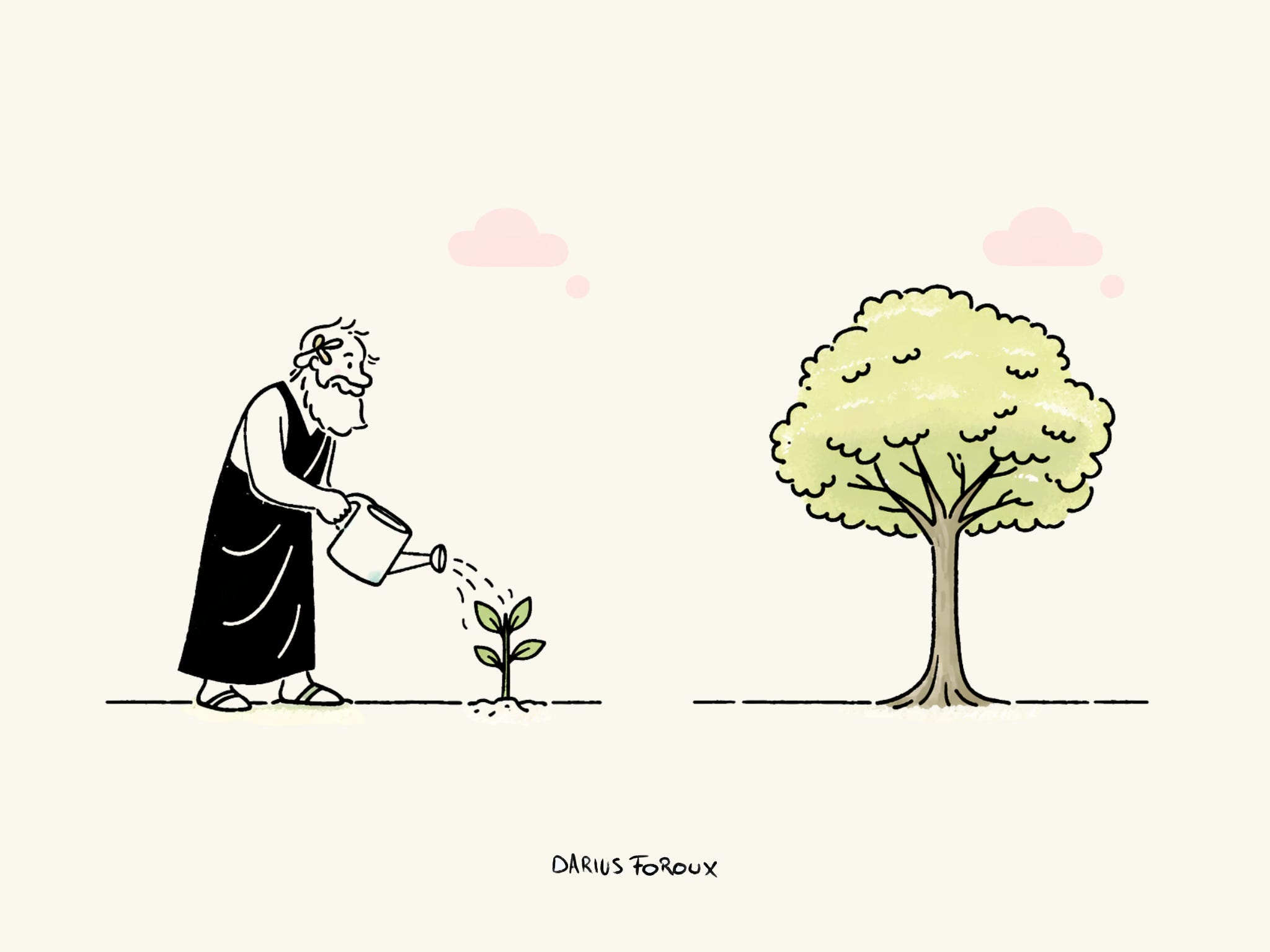
Happiness is something you slowly earn through your actions. Just like planting a tree, watering it, and waiting for it to grow.
Loved this post! Printed it and hung it over my desk to contemplate as I start my new year.
My definition used to be money, cars, etc. Now, it’s being able to dictate my life and schedule